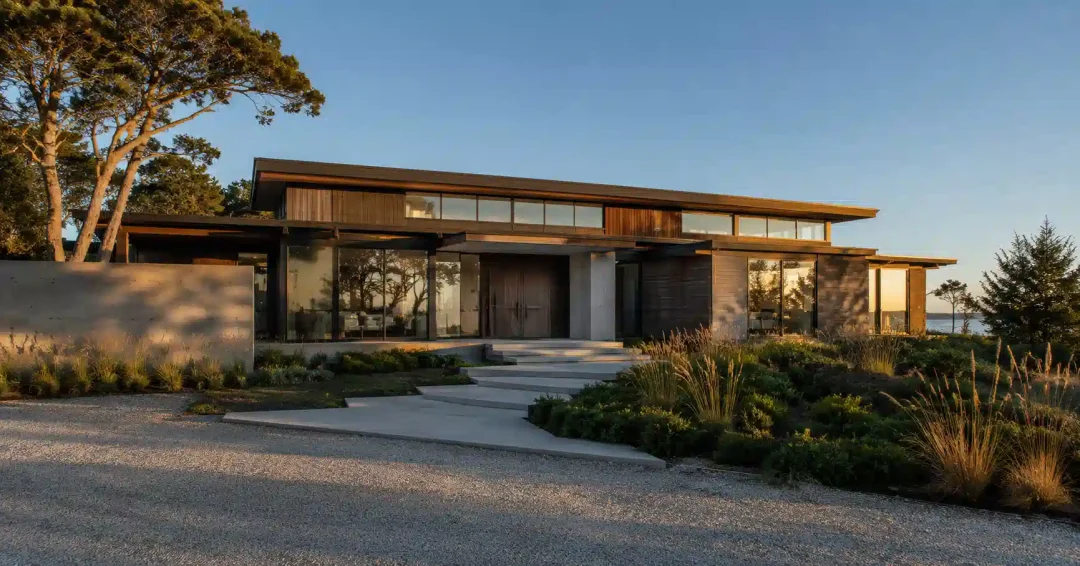
Late February, nine in the morning. A family has found land in Water Mill – two acres, south-facing, a view corridor to the water they had not expected at this price. They want to know if they can break ground by fall. I ask about the FEMA designation. They do not know what that is. Forty minutes later they understand that what they hired a Hamptons architect to do is not draw their house. That was never really the job. The job is to give them the truth about a market that is more than willing to take a year and several hundred thousand dollars from people who did not know what they were getting into. This guide is that conversation.
What makes the Hamptons genuinely different. Where the real timelines live, not the ones in a sales brochure. How to tell whether a firm has actually done this before or is planning to figure it out on your project. And what changes, in dollar terms and month terms, when the architect you hire has delivered work in this specific geography and knows whose calls get returned on a Friday afternoon.
Why the Hamptons Is Unlike Any Other Luxury Market
I have worked with buyers who came out of projects in Aspen, Nashville, coastal Connecticut. Good projects. They show up in the Hamptons with the same playbook and it stops working somewhere around the first permit submission, which is a terrible place to discover that.
The Hamptons is not a place so much as a collection of eleven separate municipalities – Southampton Village, East Hampton Village, Bridgehampton, Water Mill, Sagaponack, Wainscott, Sag Harbor, Amagansett, Springs, Montauk, and several others that each run their own zoning code, their own architectural review board, their own collective memory about what they will and will not approve. That variance request you thought was straightforward? It passed in Southampton without a public hearing. In East Hampton Town, the same request took three meetings and a conditional approval with seventeen line items attached. The examiner matters. The board member who remembers the last project on that road matters. The attorney who has been showing up at these hearings for twenty years knows things about what gets approved that are not in any published code. None of this is transferable from one municipality to the next, which means none of it is transferable from a firm that has not worked here.
Then there is the contractor side of it. The builders who can execute a $10M+ custom home at the finish level UHNW clients expect book 18 to 24 months in advance and they choose their projects based on who is calling. An architect they have built with before – someone whose drawings hold up in the field and whose specifications are tight enough to actually bid against – gets a call back. An unknown firm from another market sends emails. Understanding how regional codes interact with design is a starting point, but the Hamptons layers municipal code, coastal regulation, and contractor market access in ways that only come clear through years of working here.
The Hidden Timeline Every Buyer Gets Wrong
Four years. That is the number I give people now. Land acquisition through certificate of occupancy on a reasonably well-situated site with a competent team. Some projects go faster. More go longer. The land acquisition process in a coastal market like this already has more friction than buyers expect, and what follows it is where the calendar really diverges from what most people were told going in.
| Phase | Typical Duration | What Happens |
|---|---|---|
| Site Analysis & Feasibility | 2 – 4 months | FEMA flood zone determination, survey, soil testing, setback mapping, zoning overlay review, preliminary program development |
| Schematic Design | 3 – 5 months | Program to form, massing studies, site response, preliminary material palette, client review cycles |
| Design Development | 3 – 4 months | All systems coordinated, structural engineering, MEP coordination, FF&E direction established, specification development begins |
| Permitting | 6 – 18 months | Building department review, zoning board hearings if variances required, architectural review board, coastal erosion and environmental agency approvals. This range is wide because the number of boards your project touches depends entirely on site conditions and design scope. |
| Bidding & Builder Selection | 2 – 3 months | Invitation-to-bid, scope clarification, leveling of bids, contractor interviews, contract negotiation |
| Construction | 18 – 30 months | Full build, architect on-site administration, FF&E procurement and installation, punch list, certificate of occupancy |
Timelines reflect typical custom luxury residential projects in the Hamptons market. Complex sites, variances, or environmental reviews extend the permitting phase significantly.
Permitting is where the expectations crack. Six months is possible – clean site, responsive village, no variances, complete application on first submission. I have seen it. Eighteen months is also possible, and it is not the outlier people assume. An oceanfront V-zone lot with a Coastal Erosion Hazard Area line running through it, a program that needs a ZBA variance, an architectural review board that meets six times a year – that is eighteen months at minimum, and that is before construction starts. Money does not speed up a board. What does: a Hamptons architect who has appeared before those specific boards before, who submits packages that do not come back for revisions, who knows which questions to answer before they are asked. That is the only real lever. If a firm you are considering cannot tell you how many times they have stood before the East Hampton or Southampton ZBA, that tells you something.
What a Hamptons Architect Actually Does for You
The services agreement covers design. What it does not say anything about is the call to a builder in March who will not take a meeting with a firm he has never worked with – or the budget conversation in month two that prevents the gap at bidding in month fourteen. A Hamptons architect who has delivered work here carries that advisory layer as part of the job. One who has not is figuring it out in real time. The table below maps what that actually looks like.
| What the Project Needs | Hamptons-Experienced Architect | Generalist Luxury Architect |
|---|---|---|
| Builder Access | Direct relationships with qualified Hamptons contractors; invitation-to-bid list drawn from trusted partners | Cold outreach to unfamiliar contractors; real risk of thin bid field or no response from qualified builders |
| Zoning Knowledge | Knows which overlay districts apply before design begins; has appeared before local boards; anticipates variance requirements | Learns the code from scratch; may design to a program that cannot be approved; discovers variances after construction documents are complete |
| Budget Stewardship | Current knowledge of Hamptons labor and material costs; realistic preliminary budgets; no design development surprises | Cost estimates benchmarked to other markets; gaps emerge at bidding when redesign is expensive |
| FF&E Coordination | Integrated specification and procurement planning from design development forward; lead times managed against construction schedule | FF&E treated as a separate engagement; coordination gaps between architect and interior designer surface as field conflicts |
| Construction Administration | Regular site visits; quick decision resolution; RFI turnaround that keeps the schedule; change order scrutiny | Remote review only; slow RFI responses that stall trades; change orders accepted without scope analysis |
| Privacy Protocol | Discretion standards established from first meeting; project referenced by code name; contractor confidentiality standard | No established privacy framework; client details may appear in award submissions or portfolio materials without explicit consent |
I want to be clear about something: this is not a talent argument. Beautiful work has come out of firms that had never built in the Hamptons before. The architecture was good. What fell apart was the budget at bidding – up 30% because the cost benchmarks came from another market. The permitting revision that added eight months because the application was not what this particular board expected. The builder who delivered two finish tiers below what the drawings specified because the firm had no relationship and no leverage. Those are the outcomes that luxury residential architecture at this investment level cannot absorb. And they are preventable – though not by talent. By having done this here before. The real cost of high-end architecture in a market like this includes the cost avoidance that most buyers never see because, when it works, nothing goes wrong.
The Zoning Reality That Changes Your Square Footage
I have had this conversation probably forty times. A family walks in with a program already formed in their heads: main house at a certain square footage, pool house, four-car garage, a guesthouse for the in-laws. We map the regulatory envelope and the program does not fit. Not because the site is undersized. Because the buildable area – what the municipality actually permits you to cover – is smaller than the acreage implies.
Sagaponack is a good example. A two-acre lot there can carry four independent overlay constraints at once: the base zoning FAR, a coastal erosion hazard area overlay, an agricultural protection zone restriction, and a groundwater protection overlay. Each one places limits that do not cancel each other out – they stack. The buildable envelope after all four are applied may be a fraction of what you would calculate from the property dimensions alone. An almost identical two-acre lot in Water Mill carries a completely different regulatory stack and may yield substantially more program. You cannot read any of this from a survey. You have to know it before you buy, which means you need a Hamptons architect involved before the purchase closes – not after.
The FAR calculation is where most buyers from other markets get surprised. In the Hamptons, the pool house counts. So does the garage. The guesthouse, the detached studio, the covered outdoor structure with a permanent roof – all of it runs against the same Floor Area Ratio as the main house. A program that felt conservatively sized eats through the FAR fast once the accessory structures are added in. Mapping that calculation is one of the first things we do. The zoning requirements here need to be understood before the program is written, not reconciled against it afterward. Discovering the conflict at design development – when the drawings are done, when fees have been spent – is an expensive outcome. Avoidable, but only if someone checked first.
Coastal Erosion Hazard Areas add a layer on top of all this. Near the ocean or bay, the CEHA line established by the New York State Department of Environmental Conservation restricts where permanent structures can be placed – and the line is not fixed. It moves as erosion mapping gets updated. An architect actively working in this market knows where the line sits now, not where it was three years ago, and knows how the DEC is currently reviewing applications near it. Someone coming in fresh from another market may be working from outdated information. The engineering consequences of building in a CEHA zone are detailed in our guide to building with a Hamptons modern home architect – worth reading before any coastal site purchase.
How to Evaluate a Hamptons Architect Before You Hire
The portfolio meeting is not the evaluation. Every firm that wants Hamptons work shows you beautiful coastal homes. The images are similar. What produced those images is not. A Hamptons architect who has delivered ten projects in East Hampton Village and one who has delivered zero can show you portfolios that look nearly indistinguishable. The difference shows up months eight through twenty-four: in the permit that did not need a second submission, the contractor who answered the phone, the bid that came in where it was supposed to. Our general guide to choosing a luxury architect lays out the full framework. For this specific market, five questions cut through.
5 Questions to Ask Any Hamptons Architect
Which villages have you permitted projects in within the last five years?
Not “the Hamptons.” Specific villages. The boards are different people with different histories and different thresholds. Broad coastal experience somewhere else is not Hamptons municipal experience, and the two are not interchangeable.
Walk me through a project where you worked through a CEHA review or a ZBA variance.
You want a specific village, the nature of the variance, what happened at the hearing, how it resolved. If the answer is a general statement about handling complex regulatory situations, they have not done it here.
Who are the general contractors you recommend, and when did you last complete a project with them?
Names. Projects. Completion dates. A firm with real Hamptons history answers immediately. “We have a vetted network of regional contractors” is a non-answer and you should treat it as one.
Who owns FF&E coordination and how does it interface with the construction schedule?
A Hamptons build runs 24 to 30 months. Custom and European FF&E lead times run 16 to 20 weeks, sometimes longer. If the architect and interior designer are not actively coordinating procurement against the build schedule from design development forward, the finish phase stalls in ways that cost more than the delay itself. Find out who owns this before you sign anything.
What is the default on award submissions and portfolio publication – and how do you handle exceptions?
Some firms submit every project to award programs as standard practice. Others post construction progress publicly. For clients who require privacy, the default matters more than the exception policy. Know it before the project starts.
The answers that matter are specific and come without a pause. They come from someone who has been in those rooms – the ZBA hearing that ran four hours, the bid leveling session where two of the three contractors came in 40% over, the construction meeting where a subcontractor’s mistake needed a decision before the concrete truck left the site. That is the experience you are actually paying for. Our consultation process starts with these questions because the right answer on both sides of the table is a project that is buildable at the budget and quality level the client came here to achieve.
What the Right Hamptons Architect Changes About Your Project
The Cost of Hiring the Wrong Firm
In the Hamptons, an architect without local market knowledge does not just produce slower results. They produce quantifiable costs that compound over the project timeline.
- Redesign costs when the permitted program does not match the designed program – typically $80,000 to $250,000 in additional fees and delayed construction start
- Budget gaps at bidding when contractor estimates come in 20-35% above the architect’s preliminary figures because cost benchmarks from other markets were applied
- Builder quality shortfall when the firm cannot access qualified Hamptons contractors and the project is bid to whoever responds
- Schedule overruns driven by slow RFI responses, construction administration gaps, and FF&E delivery failures – each month of delay carrying real holding costs on a multi-million dollar project
- Privacy exposure when a firm’s standard award submission and marketing practices conflict with what a high-profile client actually requires
A project that goes well is hard to describe because there is nothing to point to. The permit sailed through – yes, but so what, permits are supposed to sail through. The bid came in on budget – fine, bids are supposed to come in on budget. The FF&E arrived on schedule and the finish phase did not stall – obviously. What is easy to miss is that none of these things are guaranteed in this market, and each one failing carries a real number attached to it. The value of the right Hamptons architect shows up in what does not happen. That is not a satisfying answer, but it is an accurate one.
Our studio has delivered projects across the New York region – Hudson Valley, the Hamptons, nationally from the Caribbean to the mountain west. Same ownership model everywhere: architecture, interiors, estate-scale master planning, FF&E, one studio from site selection through certificate of occupancy. The full design process is structured to hold when a project runs three-plus years across multiple regulatory environments – which is what Hamptons work actually requires, more often than not. Forbes recognized the studio in 2024 and 2025 for that body of work. Not for any single project, but for what holds up consistently across the ones that are genuinely hard.
Clients who have been through a Hamptons project learn what to look for the second time. They ask different questions. They already know what consistency costs when it is absent.
Ready to Discuss Your Hamptons Project?
Our studio takes on a limited number of new projects each year. If you are at the land acquisition stage or evaluating sites in the Hamptons or New York region, the right conversation to have is with a Hamptons architect – before the purchase closes.
Start the ConversationFrequently Asked Questions
How long does the permitting process take for a new build in the Hamptons?
Six to eighteen months – and both ends of that range actually happen. Six months: clean site, cooperative village, no variances, complete package on first submission. Eighteen months or longer: oceanfront V-zone, CEHA review required, ZBA variance needed, architectural review board that meets quarterly. You cannot write a check to move the boards faster. A Hamptons architect who has appeared before these specific boards multiple times submits packages that do not come back for revisions – that is the only compression available. If a firm you are considering cannot name the ZBA members they have appeared before in Southampton or East Hampton, factor that into your decision.
What is the difference between a Hamptons architect and a luxury home builder?
The architect designs, manages permitting, selects and oversees the builder, and administers construction start to finish. The builder builds, under the architect’s direction. Design-build collapses that distinction, which creates a structural conflict: when a design change costs the builder money, the builder has an incentive to resist it. On a high-complexity Hamptons project that runs three or more years, you want those roles separated. An independent architect’s financial interest is entirely in the client’s outcome – not in protecting the construction margin.
Why do I need a local Hamptons architect rather than a New York City firm?
A Manhattan firm can be excellent. What it almost certainly lacks is standing familiarity with Hamptons municipal codes, existing relationships with ZBA members and building department staff who know their work, and direct access to the builders who deliver at the finish level this market demands. Those things are not acquired in a few months. They come from years of permitting projects in specific villages, showing up at specific boards, completing work with specific contractors. That accumulated history is what a Hamptons architect brings to your project. Without it, the learning curve runs on your timeline and your budget.
What is a Coastal Erosion Hazard Area and how does it affect Hamptons home design?
The CEHA is a zone defined by the New York State DEC that restricts where permanent structures can go on properties near the ocean, bay, or tidal wetlands. Inside it, construction is either prohibited outright or requires DEC approval before local permits can issue. The line is not permanent – coastal erosion mapping gets updated, and the line can shift. An architect working actively in this market knows where the line is now. Someone reading the code fresh from another geography may be relying on information that is a few years old, which in a coastal erosion context is the same as being wrong. For any site near the water, CEHA designation is the first thing to check – before the program, before the design, before the offer is made.
How much does it cost to build a custom luxury home in the Hamptons per square foot?
Hard construction runs $500 to $900 per square foot for the structure, depending on program complexity, material specification, and what the coastal engineering situation requires. FEMA-compliant foundations, elevated mechanical systems, and coastal-grade exterior assemblies cost more than their inland equivalents – that is not negotiable on a site in a flood zone. Soft costs on top of that – architecture, engineering, permitting fees, and the carrying costs that accumulate over a permitting period that may run a year or more – typically add another 20 to 30 percent to the hard construction figure. Our guide to the full cost of high-end architecture covers the fee structure and how to think about budget contingency for a market like this.
What does Floor Area Ratio mean for a Hamptons project, and does it include the pool house?
FAR is total allowable floor area relative to lot size – and in most Hamptons municipalities, yes, it applies to every structure on the property. Main house, pool house, garage, guesthouse, detached studio. All of it. Buyers from markets where accessory structures are counted separately hit this and have to redesign programs they assumed were already settled. The right time to map FAR against the full site program is before schematic design begins, not after the drawings come back from the structural engineer. A Hamptons architect should do this on first engagement. If the firm you are talking to is not asking about accessory structures in the initial programming conversation, ask them why not.
At what stage should I involve a Hamptons architect if I am still evaluating land?
Before the offer goes in, ideally. After the offer, at minimum before closing. A parcel’s flood zone, CEHA line, setbacks, overlay districts, and FAR envelope collectively determine what can actually be built there – and none of that is visible in a listing. Sites that look right on acreage and location sometimes have buildable envelopes that cannot support the program a buyer has in mind. A feasibility analysis takes a few weeks. Any Hamptons architect worth working with will do it as part of the initial engagement – because the alternative is discovering the problem after the purchase is complete. Our guidance on site selection covers what that analysis involves and why it belongs in the conversation with your attorney before anything is signed.