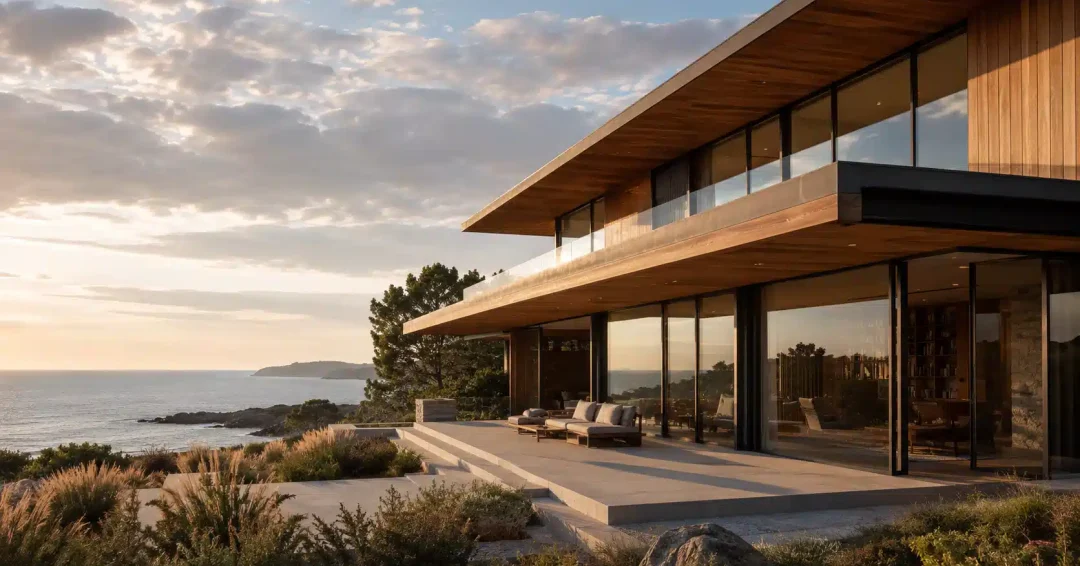
The first time I walked a coastal site in the Bahamas, the client had already fallen in love with it. The views were extraordinary – the water reached three different shades of blue before meeting the horizon, and the prevailing wind came off the water at a perfect angle for natural ventilation. I understood the pull completely. What I also understood, standing there with a site plan, was how many decisions would be made in the next eighteen months that a less experienced eye would get wrong.
Modern coastal architecture is not a style. It is a discipline. The gap between a home that looks coastal and one that actually performs as a coastal building – surviving salt air, humidity cycling, hurricane-load wind, and flood zone requirements without sacrificing the clean contemporary lines that make these properties worth building – is entirely a function of technical knowledge. The aesthetic is the easy part. Most clients do not know that until they are three years into ownership and the wrong specification is showing itself in ways that cost real money to fix. What the best modern coastal architecture delivers is not just the view. It is a building that holds its integrity, its finish quality, and its structural performance for decades in one of the most demanding environments residential construction encounters.
We have completed projects across the Bahamas, Florida, Virginia waterfront, Maryland, and The Hamptons. Each one has reinforced the same principle: every successful coastal home begins with a site analysis that most architects skip and a material specification conversation that most clients never know to have. This article is that conversation.
What Coastal Architecture Actually Demands
When a client tells me they want a modern beach house design, what they mean is clean lines, generous glazing, indoor-outdoor flow, a connection to the water. All of that is achievable. The question is whether the firm they hire understands that achieving it at the coast requires a completely different specification logic than the same program executed inland.
Coastal contemporary architecture operates under four simultaneous pressures that do not exist together anywhere else:
- Salt air corrosion – Airborne chlorides attack ferrous metals, degrade standard sealants, and work their way into finishes. Within two years, a specification written for an inland home begins to show it. Within five, it fails visibly.
- Humidity saturation – Coastal environments run at relative humidity levels that require HVAC systems sized and configured differently from standard residential practice. The building envelope itself – its insulation type, vapor barrier placement, window seal specification – determines whether the mechanical system succeeds or fights constantly against moisture intrusion.
- Wind-load and hurricane codes – In South Florida, the Bahamas, and coastal Texas, applicable wind codes require structural engineering that directly constrains design. The floor-to-ceiling glazing that defines modern coastal architecture must be specified as impact-rated assemblies. Every cantilever, every roof overhang, every exterior connection point carries a load calculation that shapes the final form.
- Flood zone requirements – FEMA flood zone classifications determine base flood elevation, which determines finished floor height, which affects the entire vertical organization of the home. Getting this wrong in design development means expensive corrections during permitting – or worse, after construction is underway.
None of these are insurmountable. All of them require that the architect understand the site before drawing a single line.
The Site Analysis That Most Firms Skip
Site orientation is the most under-applied tool in modern coastal architecture. In a humid coastal environment, the difference between a home positioned to capture prevailing breezes and one that sits perpendicular to them is not a matter of comfort – it is a matter of moisture load on the mechanical system. Cross-ventilation through primary living spaces during moderate weather reduces the HVAC system’s dehumidification burden over the life of the building, and that reduction shows up in operating cost, equipment longevity, and interior finish performance over time.
Our site analysis protocol on every coastal project covers three things before any program work begins. Prevailing wind direction by season is first – because the program itself gets organized around it. Solar path and its relationship to glazing exposure on each facade comes next, since uncontrolled solar gain on a heavily glazed coastal home is both a mechanical problem and a finish durability problem. The third is the specific FEMA flood zone classification and corresponding base flood elevation, because that number sets the finished floor height from which everything else is measured. The program – square footage, where the primary suite lands, how outdoor living connects to the interior – gets developed in response to those findings. Not before.
When the site drives the architecture, the result is a home that works with its environment rather than against it. The views get captured because they were planned for. The light arrives controlled because its angle was understood. The breezes are useful rather than destructive because the apertures were positioned deliberately. This is what coastal home design looks like when it starts from the land, not from a floor plan.
Material Selection in Salt Air Environments
The material conversation is the one most clients do not know to have – and the one that determines whether the home they imagine is still performing a decade after completion.
Standard residential specifications assume a benign environment. Coastal modern architecture requires a different set of assumptions at every layer. The framing system, the roofing assembly, the cladding, the window hardware, the fasteners, the sealants – each carries a coastal-specific specification that looks nearly identical to its standard equivalent from the outside and costs significantly more to execute correctly.
| Element | Standard Spec | Coastal Spec | Why It Matters |
|---|---|---|---|
| Roofing Metal | Galvanized steel or standard aluminum | Galvalume, copper, or zinc alloy | Galvanized steel corrodes within 5 – 7 years at high salt-exposure elevations |
| Window Hardware | Standard stainless or powder-coated aluminum | 316 marine-grade stainless or solid bronze | 316 stainless resists chloride pitting; standard 304 stainless does not |
| Exterior Cladding | Fiber cement, wood siding, EIFS | Natural stone, porcelain panel, Kebony or Ipe, fiber cement rated C4H+ | Moisture absorption and salt infiltration destroy standard cladding at the substrate level |
| Glazing | Standard insulated glass unit | Impact-rated IGU per Miami-Dade NOA or equivalent jurisdiction | Required by code in high-velocity hurricane zones; also eliminates storm shutter systems that disrupt clean modern facades |
| Fasteners | Hot-dipped galvanized or standard zinc | 316 stainless or silicon bronze throughout | Fastener corrosion is invisible until structural connections are compromised |
| Sealants | Standard silicone or polyurethane | High-movement silicone rated for UV and salt exposure (DOW 795 class or equivalent) | Standard sealants chalk and crack under UV and salt cycling; water infiltration follows |
The cost premium for coastal specification runs 12 – 18% above a standard residential specification for comparable finishes. That number surprises clients who have not heard it before. It should not surprise them – but it does, because most architects either do not know it or do not say it early enough. A coastal home built to the wrong specification does not fail dramatically. It fails slowly, in ways that accelerate after the first few salt seasons, and by the time the deterioration is obvious the remediation costs dwarf what the correct specification would have cost at the outset.
The Code and Design Tension – How Modern Minimalism Survives 150 mph Wind Loads
The defining aesthetic of modern coastal home design is transparency. Large glass openings, minimal frames, open corners, sliding wall systems that erase the line between interior and exterior. That aesthetic is achievable. What it requires is that the glazing system be engineered to the same standard as the structural frame behind it – from the first day of design, not at permit review.
In South Florida and the Bahamas, the applicable standard is the Miami-Dade Notice of Acceptance system – one of the most stringent product approval frameworks in residential construction. A window or glazing system must carry a current NOA to be permitted in a high-velocity hurricane zone. The good news for modern coastal architecture is that impact-rated glazing systems have advanced significantly; multi-point locking, thermally broken frames, and large-format single-lite panels are all achievable. The challenge is that these systems require structural backing – the opening sizes, the mullion placements, the wall construction behind them – that must be designed in coordination with the glazing specification from the start of design development.
When we work on a coastal project with significant glazing, the structural engineer and the glazing consultant are in the room during schematic design. The open corner, the full-height sliding system, the clerestory band – these are not decisions made at design intent and handed to engineers to validate afterward. They are structural decisions that happen to have an aesthetic dimension, and the wind-load calculation informs them before the drawing set advances. That is why the design intent survives the engineering process intact in our work. It does because we have never treated those two things as sequential.
Clients building in The Hamptons, coastal Connecticut, or Maryland waterfront sites face a different regulatory framework than South Florida – but the underlying principle is the same. Waterfront home design in any jurisdiction requires wind and flood zone requirements to inform the structural and envelope design from day one, not arrive as a constraint at permit review. FEMA’s Flood Map Service Center is the starting point for understanding any coastal site’s flood zone classification – a step every modern coastal architecture project should complete before design development begins.
The Luxury Cost Paradox – Why Coastal Homes Cost More and Should
There is no version of a properly built coastal home where the cost equals an equivalent inland home. The premium is real, it is significant, and the question is not whether the client will pay it – they will, either upfront by choice or later by necessity – but whether they understand what it is purchasing before the project begins.
The premium is not in the finish selections visible to guests. It lives in the substrate decisions invisible to everyone: the wall assembly managing vapor diffusion, the structural connection detail at the roof-to-wall junction that keeps the roof on in a storm, the window frame specification that will not pit and seize after three salt seasons, the fastener specification that will not fail before the finish above it does. None of this shows on a finish schedule. All of it determines whether the home is worth what was paid for it a decade out.
We have the coastal specification conversation at the beginning of every project. What the building envelope actually costs, done correctly, versus what coastal-adjacent projects that cut these specifications cost. A properly specified coastal envelope – framing, cladding, glazing, roofing, and waterproofing treated as a coordinated system rather than independent line items – typically runs 15 – 20% above a standard luxury residential envelope of equivalent aesthetic quality. A client who does not know that going in will discover it mid-project, when value engineering is far more disruptive than it would have been if the number had been part of the original budget conversation.
This is precisely what our master planning process is designed to surface. Before a site is purchased, before a design direction is set, the project budget – including the full coastal specification premium – needs to be understood. It changes the land budget. It changes the program size. It changes what is actually possible at a given total investment. The requirements for a luxury second home covers the full pre-design checklist, including the financial framework questions worth resolving before any design work begins.
Project Reference – Caribbean Pine
What a Bahamas Build Teaches About Coastal Specification
The Caribbean Pine project required coordinating with a structural engineer experienced in Bahamian building codes, a glazing consultant whose systems carried local jurisdiction approvals, and a contractor with direct experience managing marine-grade material logistics on an island where every component arrives by freight. That team does not assemble itself. It took several projects in that environment to build it.
The site sat at low elevation with direct ocean exposure on three sides. Roof pitch and overhang depth were set to manage wind uplift. Exterior fin walls were positioned to shield the primary glazing from prevailing storm quadrants. The ground-level subfloor system used sealed concrete over wood framing because the flood elevation and marine exposure made wood framing at grade a liability. None of those decisions shows in the finished photographs. The home reads as a calm, horizontally-composed modern retreat. What makes that calm possible is the technical framework beneath it.
Design intent and engineering requirement were never in conflict because they were never treated as separate conversations. That is the only way to do this work correctly.
Coastal Architecture in The Hamptons, Miami, and the Caribbean – What Changes by Market
Modern coastal architecture is not one problem with a single solution. It is a family of related problems shaped by local climate, local code, and the specific construction market where the project is being built. The technical challenge is real in all of them. The version of it differs.
In The Hamptons and coastal Connecticut, wind exposure and storm surge flood zone requirements are the primary structural concerns – but local architectural review boards add a layer that surprises clients who are accustomed to less regulated markets. Many Hamptons municipalities limit roof pitch, cladding materials, and exterior color to a regional vernacular palette. Modern coastal architecture is achievable within those constraints. It requires knowing which municipalities will approve what, and having relationships with local review processes that come from having done it before. Our Hamptons modern home work reflects that familiarity. The projects that read as clean and contemporary got there by going through those processes with design intent intact, not around them.
South Florida is a different environment in almost every respect except one: the technical standard is clear. The Miami-Dade product approval system governs the glazing specification, and the construction ecosystem there – contractors, glazing installers, specialty material suppliers – is well-developed for coastal work. The challenge is not access to the right trades. It is coordination and sequencing among them, which on a large custom home at the luxury level requires a project management structure most design-only firms do not maintain.
The Bahamas and broader Caribbean present a different category of challenge entirely. Material delivery timelines, customs and duty schedules, and the limited local availability of specialty coastal-grade products mean the specification must be finalized earlier in design development than on a domestic project – and the contractor must be selected with logistics capability weighted as heavily as construction quality. Private island architecture in the Caribbean requires a project management layer that most continental firms simply do not have. We built that infrastructure over the course of projects like Caribbean Pine, and it is the reason clients in those markets work with us rather than starting from scratch with a local firm that has never managed a project of this specification level.
What to Ask a Coastal Architect Before You Hire
The right modern coastal architecture firm has done this in the actual environment. Not coastal-adjacent projects. Not a single beach house completed ten years ago in a different climate zone. Projects finished in the specific coastal environment where you are building – with the specific code framework, the specific material supply chain, the specific contractor ecosystem that environment requires.
Before committing to a firm for a coastal project, these questions surface the difference between genuine expertise and familiarity with the aesthetic:
- What glazing systems have you specified in a high-velocity hurricane zone, and do those systems carry current jurisdiction approvals?
- Walk me through your coastal material specification for a project in this environment – specifically the roofing assembly, the cladding substrate, and the window hardware specification.
- How do you coordinate structural engineering and glazing consultation during schematic design rather than at permit review?
- What is the realistic construction cost premium for a properly specified coastal envelope versus a standard luxury residential specification, and how does that affect our program?
- What is your experience in this specific jurisdiction’s permitting and review process for modern residential design?
A firm with genuine coastal experience answers those questions with specifics. They know what Galvalume is and why it matters at elevation. They know the difference between 304 and 316 stainless in a marine environment without looking it up. They have been through NOA approval sequencing enough times that it is not a special case – it is just part of the project. When the answers are general – about process, about collaboration, about bringing in the right specialists – that is the answer of a firm that will learn on your project. In a coastal environment with this level of investment at stake, your project is not the place for that.
For clients working through the full picture of what a coastal architecture engagement involves, our approach to luxury residential architecture covers the full process from site selection through completion. The guide to choosing a luxury architect works through the evaluation framework in detail. And if you are considering a coastal site and want to understand what the project actually involves before a land purchase is made, reach out directly – that pre-purchase conversation is one of the most consequential things we do.
Forbes-Recognized Luxury Residential Architecture
Building at the Coast? Start With the Right Conversation.
We work with UHNW clients from site selection through completion – including the coastal specification conversation most firms never have. If you are considering a coastal build in The Hamptons, South Florida, or the Caribbean, we would be glad to talk through what the project actually involves.
Begin the ConversationFrequently Asked Questions – Modern Coastal Architecture
What is the difference between modern coastal and contemporary coastal architecture?
“Modern” and “contemporary” get used interchangeably in most conversations about coastal residential design, but they do mean slightly different things. Modern coastal architecture draws from mid-century modernism – horizontal emphasis, flat or very low roof pitch, deep overhangs, large glass openings that establish a deliberate relationship between the interior and the site. It is a defined movement with specific formal principles. Contemporary coastal architecture is a broader category: it describes what is being built now, which often incorporates modern principles but may also fold in vernacular coastal forms – gabled roofs, board-and-batten cladding, covered porches on multiple elevations – with a current interior organization and material palette. At the high end of the market, the distinction is less about style category and more about how well the design responds to its specific site and environment. That response is what we are most focused on, regardless of what the formal vocabulary is called.
What are the best exterior materials for salt air environments?
The materials that perform best in salt air are either inherently non-reactive or designed to patina in a controlled, stable way. Natural stone and large-format porcelain panels are among the most durable cladding options – neither absorbs moisture nor reacts to salt. For roofing, copper and zinc alloy systems outlast galvanized steel at high salt-exposure elevations by decades; the upfront cost differential is significant, and so is the performance gap. For wood, Ipe and Kebony modified wood hold up to marine exposure in ways that domestic hardwoods and pressure-treated lumber do not. Hardware is where specifications most commonly get cut and where the consequences show first: every hinge, handle, screen frame, and fastener should be 316 marine-grade stainless steel or solid bronze. The grade distinction between 304 and 316 stainless is invisible to the eye and critical to performance in a chloride-heavy environment.
How do hurricane codes impact modern cantilevered designs?
Cantilevers create uplift forces in high-wind events, and those forces have to be resolved back into the primary structure through connection details. That is where the tension with clean modernist aesthetics typically shows up – the connection hardware required to transfer uplift loads is not always easy to conceal within the formal vocabulary of a minimalist design. The way we handle it is by engaging the structural engineer during schematic design, before any cantilevered element is committed to in the drawings. The structural solution and the design intent develop in parallel, which means the connection detail gets designed as part of the architecture rather than retrofitted into it at permit review. The result is that cantilevers appear in our coastal work the way the client imagined them – because the engineering was part of the original design conversation, not a constraint imposed on a finished concept.
How do you balance view capture with hurricane-rated glass requirements?
This is one of the most common design challenges in South Florida and Bahamas work, and the answer has gotten considerably better over the past decade as impact glazing technology has advanced. The visual quality of current high-velocity hurricane zone-compliant assemblies is close to standard glazing in most applications. The constraints that remain are real but manageable: maximum single-lite panel sizes for impact glass are smaller than what can be achieved with standard glass, and frame profiles tend to be deeper. Both of those constraints shape the design rather than blocking it. We resolve large glazed facades by working with a grid of impact-rated panels within a minimal frame system, where the structural wall layout is coordinated with the panel grid from the start so that the visual result reads as a continuous surface. The structural glass corner – always a client request in modern coastal work – is achievable in most jurisdictions with current impact-rated technology. It requires a glazing engineer of record alongside the structural engineer, and it requires that the corner be designed structurally from schematic phase, not treated as an aesthetic detail to be solved later.
What is Lowcountry architecture versus modern coastal architecture?
Lowcountry architecture is a regional building tradition from coastal South Carolina and Georgia – elevated construction on piers or tabby foundations, deep covered porches on multiple exposures, steeply pitched metal roofs that shed rain quickly, and cross-ventilation logic developed over generations before mechanical cooling existed. It is highly refined and performs extraordinarily well in its specific environment. Modern coastal architecture is not a regional tradition. It is the application of contemporary architectural principles to coastal sites broadly, and it draws on the same performance imperatives – wind resistance, humidity management, flood elevation response, passive ventilation – while expressing them through a contemporary formal language rather than a vernacular one. Some of the best contemporary coastal work borrows from Lowcountry thinking without borrowing its forms: the logic of the elevated ground plane, the deep porch as shading device, the roof pitch calibrated to water management. Translated into modern material and formal vocabulary, those principles are not nostalgic. They are just good coastal architecture.
How does Ralston Architects approach coastal site selection?
We treat site selection as an architecture decision. The flood zone classification, the prevailing wind direction and how the parcel’s orientation relates to it, the setback conditions, the specific regulatory constraints of that jurisdiction – these are not details to work out after a site is under contract. They are the information that determines whether the program the client has in mind is buildable on the specific parcel at the budget they have established. We have had pre-purchase conversations that changed the site selection decision entirely – not because the site was bad, but because the combination of flood zone elevation requirements and setbacks made the program the client wanted impossible at any reasonable cost. That conversation before a purchase is made is worth considerably more than the same conversation after. Coastal sites under consideration for net-zero or high-performance design carry additional pre-purchase variables – orientation relative to solar gain, available roof area for mechanical systems, shading from adjacent structures – that we also work through at this stage.