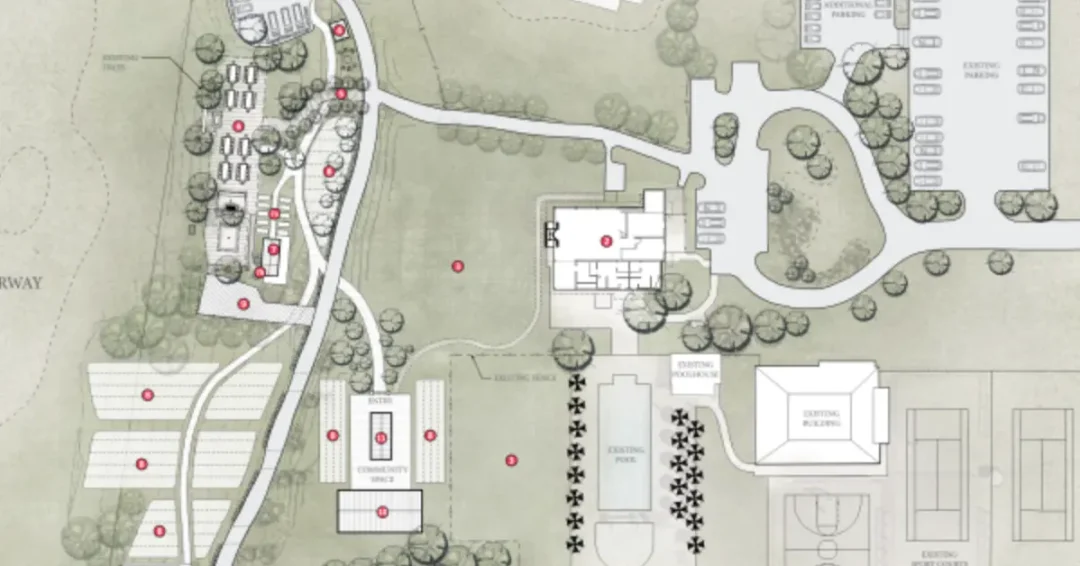
Before a single foundation is poured, before a floor plan is drawn, and before a contractor is selected, there is a decision that separates well-conceived luxury estates from those that get rebuilt, regretted, or never fully realized. That decision is whether to begin with a residential master plan.
Residential master planning is the strategic framework that organizes an entire property — its structures, site, landscape, circulation, and future growth — before architectural design begins in earnest. It answers the questions that most clients don't know to ask until they're already six figures into a project and facing constraints they could have avoided.
At Ralston Architects, we apply master planning thinking to every large parcel and multi-structure estate we take on. Not because it's procedurally required, but because it's the single most consequential thing we can do for a client who is building something they intend to live in, pass down, or simply get right.
What Residential Master Planning Actually Means
There's a common misunderstanding worth addressing directly. Residential master planning is not a site plan. It is not a zoning map. It is not a government document or a municipal approval process.
A residential master plan is an architect-led, whole-property framework for how an entire property will develop over time — often over many years or in multiple phases. It coordinates the placement of every significant element on a parcel: the primary residence, guest structures, outbuildings, landscape zones, recreational areas, service access, arrival sequences, and future additions.
Think of it this way. A floor plan tells you how to arrange rooms inside a home. A master plan tells you how that home — and every other structure on the property — should relate to the land, to each other, and to the life being built there.
For a luxury estate on 10, 40, or 400 acres, the difference between having a master plan and not having one is the difference between a property that feels purposefully composed and one that looks like it was figured out as it went along. The latter condition is more common than most clients realize, and far more expensive to correct.
Key Elements Defined During Master Planning
- Primary residence siting and orientation — where the home sits relative to views, sun, privacy, and topography
- Guest house and accessory structure placement — how secondary buildings relate to the main home without compromising it
- Approach sequence and arrival experience — the choreography of how you arrive and what you perceive as you do
- Landscape and outdoor living zones — how gardens, pools, recreation, and natural areas are distributed across the site
- Service and utility infrastructure — how mechanical systems, maintenance access, and staff functions are positioned discreetly
- Phasing and future structures — what gets built now, what gets reserved for later, and how those decisions protect future optionality
Why Luxury Estates Need Master Planning Before Design Begins
Most architectural projects start with a program — a list of rooms, a square footage target, a budget. For a modest home on a standard lot, that's often enough. For a luxury estate on a large or challenging parcel, starting with a program without a master plan is one of the more costly mistakes a client can make.
Large parcels offer tremendous freedom, but that freedom creates complexity. Where you site the primary residence affects every other decision on the property — not just aesthetically, but practically. The wrong placement can sacrifice irreplaceable views, create privacy conflicts between the main house and a guest structure, or lock out future additions that would have made the estate far more useful a decade from now.
Master planning addresses this before it becomes a problem. Specifically, it protects four things that are difficult or impossible to recover once design is underway:
Views and Privacy
Non-RecoverableIdentifying which sight lines to protect and which structures could threaten them is a master planning exercise, not a design one. Achieving extreme privacy on a luxury estate depends almost entirely on decisions made at this stage. Once a building is sited, these choices are largely fixed.
The Arrival and Approach Experience
ChoreographyOn a luxury estate, how you arrive matters as much as where you arrive. The road, the gate sequence, the first impression of the house — these are choreographed at the master plan level, not resolved after the floor plan is done.
Coordination Between Structures
Deliberate PlacementGuest houses, pool pavilions, caretaker quarters, and sport courts all need to be positioned in deliberate relationship to the primary residence and to each other. Doing this after the main house design is advanced almost always produces compromises.
Long-Term Cohesion
LegacyProperties that are added to over time without a guiding plan tend to feel like collections of unrelated decisions. A master plan means that a structure added fifteen years from now still belongs to the same vision as the one built today.
There is also a financial argument. Cost overruns in luxury residential construction often trace back not to a single expensive decision, but to a series of adjustments made because the original design wasn't informed by a clear picture of the whole property. Master planning reduces that exposure significantly.
What Gets Decided During the Master Planning Process
Residential master planning is a discovery and decision-making process, not a design process. The output is a framework — a set of resolved choices that positions everything on the property with intention before detailed architectural work begins.
The process typically begins with a thorough site analysis. This is not just a survey. It is an interpretive exercise: understanding topography, drainage, prevailing winds, sun angles throughout the year, vegetation worth preserving, views worth protecting, and views worth screening. On a coastal or mountain property, this analysis is often the most valuable work done in the entire project.
Site Analysis and Land Constraints
Topography, drainage, setbacks, easements, and any regulatory considerations that shape buildable areas are mapped and interpreted — not just surveyed.
Primary Residence Siting
Orientation for light, views, privacy, and relationship to the broader landscape — the foundational positioning decision that everything else follows from.
Guest Accommodations and Secondary Structures
Placement and scale of guest houses and private guest accommodations, pool houses, sport facilities, and outbuildings in relation to the main residence.
Landscape and Outdoor Living
How terraces, gardens, pools, and natural areas are distributed and connected across the site — treating the outdoors as a designed sequence, not leftover space.
Roads, Arrival, Parking, and Service Access
The functional circulation of the estate, including discreet separation of guest arrival from service and maintenance access — invisible when done right, glaring when ignored.
Zoning and Regulatory Constraints
Lot coverage limits, height restrictions, setback requirements, and environmental and zoning overlays that affect what can be built where.
Phasing and Future Additions
What is built in phase one, what is reserved for future phases, and how infrastructure is sized and positioned to support what comes later — without costly reopening or rerouting.
The result is a document — part plan, part narrative — that the entire design and construction team can reference as a north star throughout the project. It doesn't constrain design creativity. It directs it.
How Master Planning Supports Landscape Integration and Estate Usability
One of the most underappreciated contributions of a residential master plan is the way it integrates architecture with landscape. On a luxury estate, the line between the built and the natural is not a boundary — it is a composition. A well-executed master plan treats the land itself as part of the design.
This has practical implications. A home positioned without regard for its relationship to the terrain around it will always feel placed rather than planted. The outdoor spaces will feel like leftovers. The approach will feel arbitrary. The views from inside will compete with the views toward the building rather than extending them.
Master planning resolves this by establishing what might be called the site hierarchy — the sequence of outdoor rooms, natural features, constructed landscapes, and structures that together create the experience of the property. This framework then informs everything from how landscape design is scoped and priced to the way individual rooms in the home are oriented and glazed.
Sloped and Challenging Terrain
Designing on sloped and challenging terrain demands that the master plan resolve how structures step with the terrain, how outdoor terracing is sequenced, and how the experience of moving through the property changes with elevation. These are decisions that affect construction cost, drainage, accessibility, and the fundamental quality of the finished estate.
Sport Courts and Recreation Zones
A tennis court should sit where it won't be visible from the primary guest arrival, where the noise won't travel to the main bedroom wing, and where it can be accessed from the recreation zone without crossing the formal garden. These are site planning decisions — not architectural ones made after the floor plan is done.
Outdoor Living as Architecture
Every element of luxury outdoor living — from terraces and pools to sport courts and garden rooms — needs to be positioned in deliberate relationship to the whole. Master planning is where that positioning gets resolved, before any single structure takes precedence over the others.
Master Planning for Phased Luxury Estate Development
Many of Ralston's most complex projects are not built all at once. Clients may begin with the primary residence and a guest cottage, with a clear intention to add a sport pavilion, additional guest housing, or a caretaker facility over the following years. Others acquire large parcels — sometimes in stages — and need a framework that allows them to build intelligently without foreclosing future options.
Without a master plan, phased development produces a predictable set of problems:
Infrastructure Undersized for Phase Two
Utility runs, electrical capacity, and service access sized for the first building have to be extended, rerouted, or replaced for the second — at substantial cost that master planning would have avoided entirely.
Prime Positions Consumed Too Early
A guest house added five years after the main residence ends up in a location that feels like an afterthought because the best site positions were consumed by decisions made without the full picture in mind.
Grading Work Reopened for Each Phase
Earthwork done for phase one has to be reopened for phase two at significant cost — preventable when phasing is resolved at the master plan level before any ground is broken.
A Property That Feels Assembled, Not Designed
Without a guiding framework, later additions — however well-designed individually — never fully belong to the whole. The estate reads as a collection of separate decisions rather than a single composed vision.
A master plan prevents this by preserving optionality. It reserves the best locations for the most important future uses, sizes utility runs and service infrastructure to support the full build-out, and identifies which views and approach sequences to protect from the beginning.
For clients thinking about the long-term legacy of a property — passing it to the next generation, eventually subdividing a larger parcel, or creating a compound that accommodates extended family — the master plan is the instrument that makes those futures possible. Designing a luxury estate to last 100 years requires exactly this kind of framework: one that builds in adaptability, protects structural and site integrity, and leaves deliberate room for what the next generation will want.
What Master Planning Looks Like at the Resort and Estate Scale
The principles of residential master planning become especially clear when applied to properties of genuine scale and complexity. Projects like Silo Ridge Field Club in New York, Gozzer Ranch Golf and Lake Club in Idaho, and The Abaco Club on Scotland Cay in the Bahamas represent the kind of multi-structure, landscape-intensive development where master planning is not optional — it is the foundation on which everything else is built.
Properties
Parcel Planned
Estate Experience
Contexts
Silo Ridge Field Club, New York
A dramatic, topographically varied site where the positioning of residential clusters, amenities, and circulation must work with the landscape rather than against it. The master planning framework defines arrival sequences, view corridors, building envelopes, and the relationship between private residences and shared amenities — decisions that cannot be made structure by structure without producing incoherence.
Gozzer Ranch Golf and Lake Club, Idaho
On a large Idaho lake property centered on golf and outdoor recreation, where homes sit relative to fairways, lake access, and each other — and how that positioning protects both privacy and views — is a master planning problem resolved before individual architectural design begins.
The Abaco Club, Scotland Cay, Bahamas
Site access, environmental sensitivity, hurricane resilience, and the relationship between private residences and the club's shared amenities all have to be reconciled in a master plan before any individual structure can be designed responsibly — within the particular constraints and opportunities of a Caribbean island setting.
These examples are relevant not because every Ralston client is building a resort community, but because the master planning logic is the same at any scale. A private estate on 50 acres has the same fundamental questions: How do structures relate to the land? How does the property develop over time? How does the whole stay coherent as pieces are added?
When a Property Owner Should Invest in Residential Master Planning
Not every residential project requires a formal master planning process. A renovation of a single-family home on a quarter-acre lot does not. But there are clear signals that a project has crossed into territory where master planning is not just valuable — it is necessary.
Consider investing in a residential master plan if any of the following apply:
- You are acquiring or have acquired a large parcel — whether 5 acres or 500, the complexity of developing it well requires a framework that precedes individual design decisions
- You intend to build multiple structures — a guest house, caretaker quarters, a pool pavilion, a sport facility, or any combination of accessory structures alongside the primary residence
- You are planning in phases — building the main house now with the intention to add other elements over time, which requires protecting the best sites and sizing infrastructure correctly from the start
- The site is topographically complex — hillside, sloped, coastal, or otherwise challenging terrain where the relationship between building and land has significant design and cost implications
- You are building a second or third home — especially a destination property where the quality of the overall site experience is as important as the quality of the architecture itself
- The property represents a long-term family asset — a legacy property intended for future generations, eventual subdivision, or use as a multigenerational family compound
- Privacy, approach, and views are primary concerns — protecting these assets requires master planning decisions, not just architectural ones
If you are in the early stages of thinking about a project like this — still working through land selection, program requirements, and the question of how you want this property to actually function over the coming decades — that is precisely the right moment to bring a master planning framework into the conversation. Understanding second home planning requirements early helps align budget, permitting expectations, and design scope before commitments are made.
How to Know If Your Property Needs a Master Plan Before Architectural Design
The simplest question to ask is this: are there decisions about this property that will be difficult to change once architecture begins?
If the answer is yes — and for any large parcel or multi-structure estate, the answer is almost always yes — then a master plan should precede design work, not follow it.
The most expensive version of residential development is the one where these decisions are made as the project proceeds, each one constraining the next, until the finished estate reflects the sequence of choices made rather than the vision the client actually had. Master planning reverses that sequence. It establishes the vision at the property scale first, then allows architecture, landscape, and construction to execute against it with clarity.
At Ralston, we approach every large-parcel engagement with master planning thinking from the first conversation. It is part of how we protect our clients' investments and confirm that what gets built is what they actually intended — not a capable approximation arrived at through a series of workable compromises.
The Right Framework Changes Everything
If you are considering a significant residential project and want to understand how master planning would apply to your specific property and program, a consultation is the right starting point. We can discuss your site, your timeline, and the decisions that should be resolved before design moves forward.
Explore our approach to luxury architecture, or start a direct conversation about your property.
Schedule a ConsultationFrequently Asked Questions About Residential Master Planning
Residential master planning is the strategic framework that coordinates all structures, landscape zones, circulation, and future development on a property before individual architectural design begins. A site plan is a technical drawing showing the location of structures on a lot, typically produced after design decisions have already been made. A master plan precedes those decisions — it is the framework that informs them. On a large parcel or multi-structure estate, the master plan is the foundational document; the site plan is one of many outputs that follows from it.
There is no fixed acreage threshold, but most properties that include two or more structures — or where the owner intends to add structures over time — benefit from a master planning process. Properties with significant topographic variation, coastal or waterfront conditions, or complex regulatory constraints also benefit at smaller acreages. The relevant question is not size but complexity: how many significant decisions about placement, phasing, and site relationships need to be made, and how much does each one constrain the others?
It can, but it is substantially less effective. The value of master planning is that it establishes the framework before design decisions lock in site placement, infrastructure routing, and the positioning of outdoor spaces. Once a primary residence design is advanced, the master plan becomes less a strategic framework and more a documentation of constraints. Clients who engage in master planning after design has begun often find that the most valuable insights — about view protection, phasing, or guest structure placement — require revisions to work already done. Starting earlier is almost always less expensive.
Master planning scope and fees vary based on the complexity of the site, the number of structures being planned, the degree of regulatory analysis required, and the depth of landscape integration involved. On most significant estates, master planning is structured as a distinct phase of the overall architectural engagement — separate from schematic design — with a scope defined by what the specific property requires. The investment typically represents a small fraction of overall project cost but has outsized influence on the quality and coherence of the finished estate. A preliminary consultation with Ralston is the best starting point for understanding what a master planning engagement would involve for a specific project.
Phased development is one of the primary reasons clients undertake residential master planning. The process establishes a full build-out vision for the property — even if only a portion of it will be built immediately — so that infrastructure is sized correctly, the best site positions are reserved for their highest-value uses, and structures added in later phases relate intentionally to those built earlier. Without this framework, phased estates tend to accumulate compromises: utility runs that have to be extended or replaced, secondary structures placed in suboptimal locations because the prime positions were already consumed, and a property that feels assembled rather than designed.
At Ralston, master planning begins with a thorough analysis of the site — its topography, orientation, views, regulatory context, and any constraints that shape where and how structures can be placed. From that analysis, we develop a framework that positions all significant elements of the property: primary residence, guest structures, landscape zones, arrival sequences, service access, and any future phases. This framework is refined in collaboration with the client before architectural design begins, so that the design phase proceeds with a clear, agreed-upon picture of the whole property. The master planning process typically takes four to eight weeks depending on site complexity and the scope of the program. If you'd like to understand what our architecture consultation process involves from first conversation through completed framework, that is a good place to start.