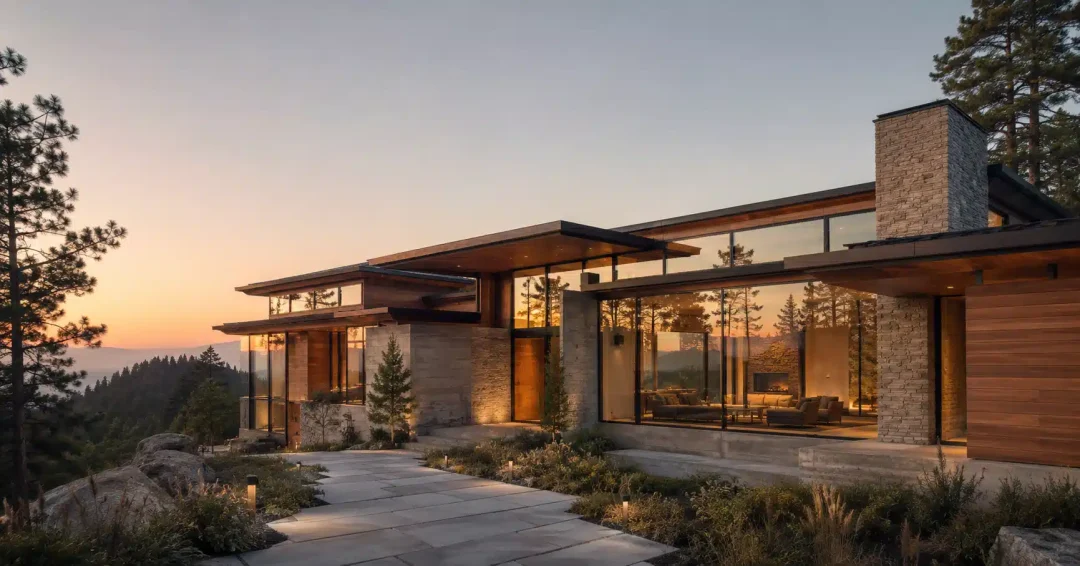
I stood on a limestone ridge west of Fort Worth last spring while a client asked me the question every serious Texas buyer eventually asks: does a luxury home architect in Texas actually need to think differently here, or is good design simply good design everywhere? The honest answer is both. Proportion, light, and materiality hold true in every market our studio serves, from the Hamptons to the Caribbean. How you apply them changes completely once you cross into Texas. Houston’s humidity, the Hill Country’s slopes outside Austin, and a gated ranch community west of Fort Worth each ask a different question of a home’s design, and after two decades practicing across a dozen states, Texas has taught our studio more about site-specific design than almost any other market we build in. That experience is exactly what a luxury home architect Texas buyers can trust needs to bring to the table before a single line gets drawn.
Why a Coastal or Mountain Playbook Doesn’t Work in Texas
Firms that build well in one region sometimes assume those lessons carry over everywhere. They mostly do not. When we work in Nashville, the conversation centers on rolling terrain and a different set of local review boards. Along the coast, it is floor-area-ratio math and storm-review timelines. Texas asks its own questions, and none of them are small ones. How does a home stay comfortable in August without living inside its mechanical systems around the clock? How does a 400-acre ranch parcel get an actual site plan instead of a floor plan dropped onto it? What happens when a homeowners’ architectural review committee has more say over your exterior stone percentage than your own taste does?
None of this makes Texas harder to build in than other markets. It means the firm you hire should have already answered these questions on a comparable project, not discovered them for the first time after a permit application gets sent back.
The Three Texas Markets: Houston, Austin, and Dallas-Fort Worth
Texas is not one luxury market. It behaves like three separate ones, and they do not share a client profile, a material vocabulary, or a pace of decision-making.
Houston’s wealth mixes long-standing energy money with newer energy and medical-sector wealth, and the resulting brief usually wants a home that reads as substantial rather than showy. Clients researching the luxury residential architects Houston trusts most tend to ask about storm performance before they ask about square footage, and rightly so. Humidity and storm exposure push the specification toward durable materials and covered outdoor rooms, the same logic our studio applies on coastal projects along the Gulf and in South Florida.
Austin’s wealth skews younger and technology-driven, and the design conversation runs quieter: cleaner lines, genuine sustainability credentials, and Hill Country sites that reward restraint over sheer square footage. A custom home architect Austin buyers hire needs to read a limestone slope as fluently as a floor plan, since the two decisions are rarely separate out here.
Dallas-Fort Worth carries generational wealth alongside a real wave of relocations, and increasingly that wealth is choosing gated golf-and-ranch communities like the ones rising west of Fort Worth, where a home answers to the client’s vision and to a private architectural review committee in equal measure.
| Texas Market | Wealth Profile | Design Priority | Site Consideration |
|---|---|---|---|
| Houston | Energy sector, established wealth | Durability, covered outdoor rooms, storm-rated materials | Humidity, hurricane exposure |
| Austin | Technology and founder wealth | Quiet modern lines, sustainability credentials | Hill Country slope, limestone, water access |
| Dallas-Fort Worth | Legacy wealth, relocation growth | Timeless materials, ranch-vernacular forms | Gated-community architectural review, larger acreage |
A Team With Texas Roots
One of our team members, Joy Godvin, is based in Dallas and has called Texas home for more than a decade, which shapes how our studio reads a Texas site and a Texas client from the first conversation. Our studio is also completing an active project at Maverick Golf & Ranch Club in Fort Worth in 2026, one of several gated golf-and-ranch communities reshaping the Dallas-Fort Worth luxury market, which gives us a direct, current view of how these communities’ review processes actually work in practice.
Designing for Texas Heat: Passive Cooling as a Luxury Feature
Most of Texas sits inside what the U.S. Department of Energy classifies as a hot-humid climate zone, and Houston in particular carries some of the heaviest cooling loads of any major American city. The instinct is to answer that with bigger mechanical systems. We answer it with the building itself first.
Deep roof overhangs cut direct summer sun before it reaches the glass. Covered porches and breezeways create outdoor rooms that stay usable through the hottest months, which matters enormously to a client who is paying for indoor-outdoor living and does not want it available for only eight months of the year. Thermal mass in stone and concrete keeps interior temperatures steadier through the day instead of swinging with the outdoor air. Courtyard planning pulls cross-ventilation through the plan rather than fighting it. Even night-flush ventilation, opening the house to cooler night air and closing it again before the heat returns, plays a real role once the mechanical engineering and the architecture are designed together instead of layered on after the fact.
None of this reads as an energy-code checklist to the people living in these homes. It reads as a house that stays comfortable on a July afternoon without a generator-sized mechanical room fighting against it, and in this climate, that is what genuine luxury looks like.
Site Selection: Hill Country, City Lots, and Gated Ranch Communities
Site selection carries more weight in Texas than in most markets we serve, because the three site types common here, an in-city lot, a Hill Country parcel, and acreage inside a gated ranch community, each call for a different read before a single line gets drawn.
A city lot in Houston or Dallas comes with its own zoning, setback, and drainage questions, most of them familiar to any experienced residential team. A Hill Country parcel outside Austin brings limestone bedrock, steep grade, and water availability into the very first conversation, often before a client has settled on a floor plan at all. Acreage inside a ranch community, the kind increasingly common around Fort Worth, brings a homeowners’ architectural review committee into nearly every material and massing decision from day one. For a property of any real size, that acreage usually calls for master planning rather than a single-building floor plan, so the guest house, the barn, and later phases each sit in the right place from the start instead of competing for space later.
Before You Buy Land in a Gated Ranch Community
- Review committee timeline – how long the architectural review process typically runs, and how many submission rounds most designs need before approval.
- Material and massing rules – required stone or masonry percentages, roof pitch limits, and exterior color restrictions written into the deed.
- Water and septic feasibility – well capacity, water rights, and septic approval, confirmed before the purchase closes rather than after.
- Utility and access easements – how power, gas, and driveway access reach the site, and what that adds to the true build cost.
- Phasing of the surrounding development – what is already built nearby, what is planned next, and how that shapes the property’s long-term setting.
Choosing a Luxury Home Architect in Texas: What Buyers Should Look For
The families who get this right are not always the ones who found the most talented designer on paper. They are the ones who asked pointed questions up front and chose a modern home architect Texas developments have already tested, rather than a firm learning this market on their dollar. Our guide to how to choose a luxury architect works through that evaluation in detail, and our breakdown of the real cost of high-end architecture covers fee structure and budget contingency for a project at this level.
What we consistently see matter most for a Texas project specifically is one firm owning the process from land search through architecture, interiors, and completion, so a ranch community’s review committee, the builder, and the interior team are never working from three different sets of assumptions. A track record recognized outside the region matters too. Ralston has been named to Forbes’ Top 200 Residential Architects for two consecutive years, one of a small number of regional studios on that list nationally, and that recognition travels with our studio into every new market we enter, Texas included.
Common Questions About Building a Luxury Home in Texas
These are the questions we hear most often from families evaluating a luxury home architect Texas-wide, before they have settled on a specific city or site.
How much does it cost to hire a luxury home architect in Texas?
Architectural fees vary from project to project, based on scope, site complexity, and the level of service involved, so there is no single number that applies across the board. Our detailed cost guide walks through how that fee structure works and how to think about budget contingency for a project at this level.
What does the architectural review process look like in a Texas ranch community?
Most gated golf-and-ranch communities run design submissions through a private architectural review committee, separate from city or county permitting, that reviews massing, materials, and often exterior color before construction drawings can move forward. Timelines and the number of submission rounds vary by community, which is why direct experience with a specific development shortens the process considerably.
How does Texas heat affect luxury home design?
Much of Texas sits inside a hot-humid climate zone, and the strongest response is architectural rather than mechanical: deep overhangs, covered outdoor rooms, thermal mass, and courtyard-driven cross-ventilation, working alongside a properly sized mechanical system rather than in place of good design.
Do I need a licensed architect to build a custom home in Texas?
Texas law technically exempts private single-family and duplex residences from requiring a licensed architect’s stamp. In practice, nearly every UHNW buyer chooses a licensed architect anyway, because licensure brings a legal standard of care and smoother passage through both municipal permitting and a private community’s review committee. The Texas Board of Architectural Examiners outlines the exemption and its limits in detail.
What architectural styles are most popular for luxury homes in Austin versus Houston?
Austin trends toward quieter contemporary forms with visible sustainability features, reflecting its technology-driven buyer. The contemporary architecture Houston clients favor leans toward substantial, durable materials and more traditional massing, softened with genuinely modern detailing, reflecting an established wealth base that wants presence without excess.
How long does it take to design and build a custom luxury home in Texas?
Design typically runs 9 to 14 months depending on complexity, with construction adding another 18 to 30 months. Ranch-community projects usually sit at the longer end of that range, since they carry an added architectural review cycle before permitting even begins.
Standing on that ridge west of Fort Worth, the real question was never whether Texas is harder or easier to build in than anywhere else we practice. It was whether the next eighteen months would be spent solving problems our studio had already solved somewhere else, or discovering them for the first time on someone else’s site. If you are planning a project in Houston, Austin, Dallas-Fort Worth, or a ranch community in between, we would welcome the chance to talk through what your site actually requires. You can see where else we practice on our locations page, review our founder’s background on his studio bio, or start a conversation about your Texas project directly.