
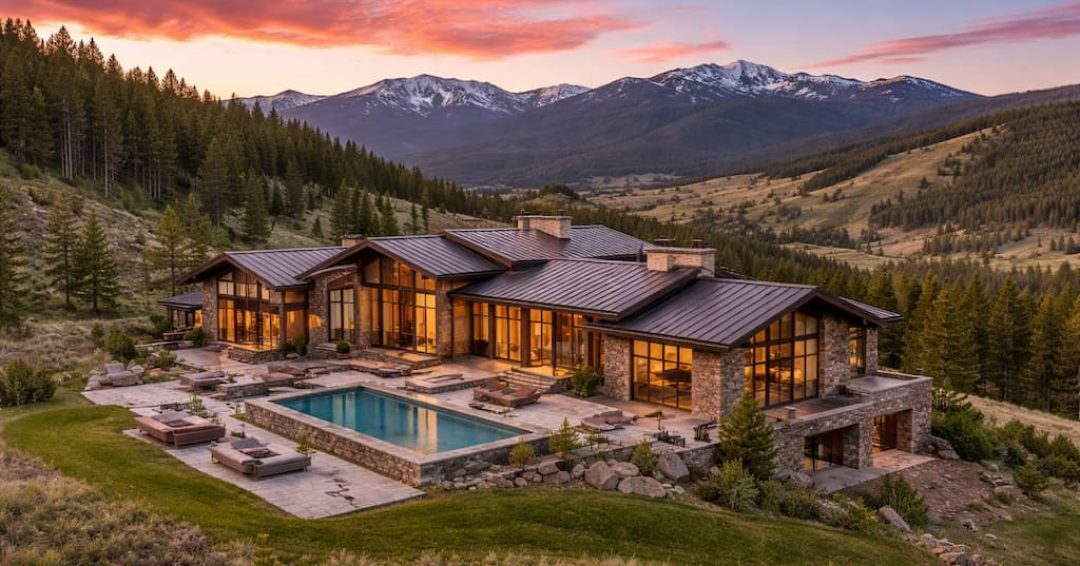
High-end residential architecture can achieve complete utility independence while maintaining luxury standards. Clients building in remote locations need off the grid luxury home design that delivers the same performance as grid-connected estates – reliable power, unlimited water, and invisible waste management. The question isn’t whether off-grid is possible at luxury standards. It’s how to design systems that work reliably without constant intervention.
The answer requires three integrated utility systems: power generation and storage sized for actual loads with redundancy, water sourcing and treatment that delivers potable supply year-round, and waste processing that handles all flows without environmental impact or maintenance nightmares. Most architects treat off the grid luxury home design as an engineering problem solved by consultants. The proper approach is designing it as architecture where every major building decision affects utility performance and every utility choice shapes the architecture.
Why Standard Off-Grid Approaches Fail Luxury Standards
Here’s what happens with typical off the grid projects. The architect designs the house, then asks engineers to “make it work” off-grid. Solar panels get crammed onto roofs never designed for them. Battery rooms occupy prime basement space. Water tanks dominate mechanical areas. The result is compromised architecture serving oversized systems that still underperform.
The pattern is predictable. Undersized solar arrays because roof orientation was never considered during design. Inadequate battery storage because the loads were calculated after finishes were specified. Water systems that run dry in summer because watershed analysis happened after site planning. Septic systems that fail because soil conditions were never properly evaluated. These homes don’t achieve independence – they achieve expensive disappointment.
Effective off the grid luxury home design requires understanding utility systems as primary design drivers that shape siting, orientation, program organization, and architectural form from the earliest schematic decisions. The difference between functional independence and grid-dependent luxury comes down to whether utilities drive design or accommodate it.
The Foundation of Independent Luxury
When I talk about off the grid luxury home design, I’m describing residences where utility independence enables location freedom rather than limiting it. You’re not accepting reduced performance to live remotely. You’re designing systems sophisticated enough to deliver grid-equivalent reliability from on-site resources.
Think about the fundamental shift this requires. Grid-connected homes assume unlimited power, water, and waste capacity. Off-grid homes must generate everything they consume and process everything they produce. This changes how you approach every aspect of design – from window sizing that affects heating loads to appliance selection that determines power requirements to fixture choices that influence water consumption.
This approach requires treating utility independence as the primary design parameter rather than a secondary constraint. You’re not designing a luxury home that happens to be off-grid. You’re designing an off-grid estate that achieves luxury performance through intelligent system integration.
Power System Design: Generation, Storage, and Management
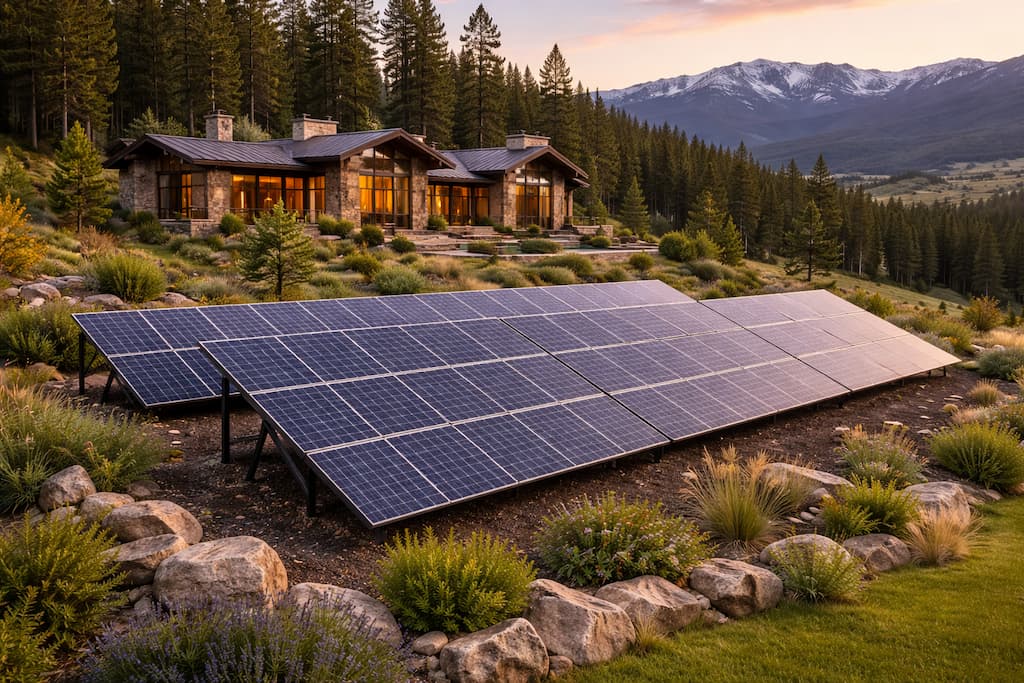
Reliable off the grid power requires three components working together: generation capacity that exceeds average loads with margin for weather variability, storage capacity that bridges multi-day weather events, and load management that prioritizes critical systems during scarcity.
Solar Array Sizing and Architecture Integration
I size solar arrays for winter production rather than summer capacity. December and January deliver 40% to 60% of summer solar gain depending on latitude. Your system must generate sufficient power during the worst production months while carrying loads that peak during those same months for heating.
For luxury estates, this typically requires 20 to 40 kilowatts of solar capacity – 60 to 120 panels depending on efficiency. This is substantial roof area: 1,200 to 2,400 square feet. Most residential roofs can’t accommodate this without compromising architecture. I design roof forms, orientation, and pitch during schematic design to optimize solar production.
South-facing roof planes with 30 to 40 degree pitch deliver optimal production in northern latitudes. I organize building massing to create these surfaces through architectural form rather than fighting against designs created for other priorities. Shed roofs, gable orientations, and building wings position to maximize south exposure while creating architectural compositions that work aesthetically.
Ground-mount arrays solve capacity when roof area is insufficient, but they consume site area and require landscape integration. I locate them during site planning – typically 200 to 300 feet from the house to balance wire losses against visual impact. Strategic landscape screening makes arrays invisible from primary views while maintaining solar access.
Battery Storage Infrastructure
Battery storage determines how many sunless days you can operate normally. I size storage for 3 to 5 days of autonomy. For luxury estates, this typically requires 80 to 150 kilowatt-hours of usable capacity.
Modern lithium battery systems need dedicated rooms with environmental control. A 100 kWh system requires approximately 60 to 80 cubic feet – a 6 by 8 foot room with ventilation and temperature management between 50 and 80 degrees Fahrenheit. I locate battery rooms near electrical service entrance to minimize wire losses and design dedicated HVAC maintaining optimal temperature, extending battery life from 10 to 15 years.
Backup Generator Integration
Solar and batteries handle 90% to 95% of annual power needs. Extended weather events require backup generation. I specify diesel or propane generators sized for full house loads – typically 30 to 60 kilowatts. Generator buildings locate 80 to 120 feet from the main house with landscape berms for sound attenuation, detailed as architectural elements matching the main house aesthetic.
Fuel storage requires substantial capacity for true independence. A 500-gallon propane tank provides roughly 100 hours of runtime at 50% load. I integrate fuel storage into site planning during feasibility studies.
Load Management and System Prioritization
I design electrical systems with load prioritization: critical circuits that never shut down (refrigeration, minimal lighting, heating controls, water systems), standard circuits for normal operations, and deferrable loads (pool heating, hot tubs, certain HVAC zones) that pause during power scarcity. Smart home systems automate load management, shifting heavy loads to high-production periods and smoothly shedding deferrable loads when storage reaches minimum thresholds.
Water System Design: Sourcing, Treatment, and Storage
Water independence requires three components: reliable source development, treatment to potable standards, and storage to buffer seasonal variability. Most off-grid projects undersize every component and wonder why water becomes the limiting factor.
Water Source Development and Capacity
Wells provide the most reliable water sourcing. I bring water consultants into projects during feasibility studies to assess aquifer depth, recharge rates, and sustainable yield before site purchase. Luxury estates need 15 to 25 gallons per minute sustained yield. Well depth varies dramatically – 100 to 600 feet depending on location. I budget $15,000 to $40,000 for well development. Spring development provides alternatives where geological conditions support it, requiring collection boxes, transmission lines, and more extensive storage since flow rates vary seasonally.
Water Treatment for Potable Quality
Well water rarely meets potable standards without treatment. I design comprehensive treatment systems addressing specific water quality rather than generic filtration. Treatment typically includes sediment filtration, carbon filtration for taste and chemicals, water softening in hard water regions, and UV sterilization. The complete system occupies 40 to 60 square feet with floor drains and service access.
I design treatment systems with bypass capability and dual filtration trains ensuring continuous operation during maintenance, eliminating single-point failure.
Water Storage Strategy
I size storage tanks for 3 to 7 days of household consumption plus fire reserve – typically 1,500 to 3,000 gallons domestic plus 2,500 gallons fire protection, totaling 4,000 to 5,500 gallons. Storage tanks locate to provide gravity-fed pressure when possible, reducing pumping energy. When gravity feed isn’t feasible, pressure tanks and booster pumps provide pressure.
I design water storage as architectural elements – stone pump houses, timber enclosures, or underground cisterns integrated into site design. Above-ground tanks in cold climates need heating and insulation detailed as building architecture.
Water Conservation and Graywater
I design plumbing systems separating graywater from blackwater for irrigation reuse. A family of four generates 80 to 120 gallons of graywater daily. Graywater systems require dedicated plumbing during design – separate drain lines, storage, filtration, and distribution. This adds 8% to 12% to plumbing costs but can reduce well demand by 30% to 40%.
Low-flow fixtures reduce daily consumption from typical 80-100 gallons per person to 45-60 gallons: 1.5 GPM showerheads, 1.28 GPF toilets, 0.5 GPM bathroom faucets.
Waste Management: Septic Systems and Alternative Treatment
Waste processing represents the most regulated and site-dependent aspect of off the grid luxury home design. Systems must handle all flows without environmental impact while operating reliably in conditions that often challenge conventional septic systems.
Septic System Design
Conventional septic systems work when soil conditions, topography, and groundwater levels cooperate. I start with soil testing during site evaluation. Luxury estates generate 300 to 500 gallons daily. I size septic tanks at 1,500 to 2,000 gallons minimum – larger than standard to reduce maintenance frequency. Drain fields require 600 to 1,200 square feet depending on soil type. I reserve this area during site planning with adequate setbacks from wells and property lines.
Alternative Treatment Systems
Sites with challenging conditions need advanced treatment. Aerobic treatment units use mechanical aeration providing better treatment than conventional septic. They require electrical power and more maintenance but work in poor soil conditions and occupy less space. Constructed wetlands provide biological treatment requiring 1,500 to 3,000 square feet but operate with minimal energy. I integrate wetlands into landscape design as water features.
Composting Toilet Considerations
Some remote sites make conventional waste treatment impossible. Modern composting systems are sophisticated engineered systems processing waste into safe compost. I specify these for properties where conventional treatment isn’t viable. They require dedicated mechanical space with ventilation, and I design composting chambers in dedicated buildings or basement spaces with exterior access so users never interact with the composting process.
Building Envelope and Energy Performance
Off the grid success depends on reducing loads as much as generating power. I specify insulation values 30% to 50% higher than code: R-30 to R-40 walls versus typical R-20, R-60 to R-70 roofs versus R-38. This reduces heating loads by 40% to 60%.
Air sealing targets 1.5 air changes per hour at 50 pascals. Triple-pane windows with U-values of 0.20 or better cost 40% to 60% more but reduce heat loss by 60% to 70%. Passive solar design with south-facing glazing, thermal mass, and properly sized overhangs reduces winter loads while avoiding summer overheating.
System Integration and Monitoring
Smart systems monitor battery state, solar production, and load demands, automatically adjusting operations to maximize self-sufficiency. They defer heavy loads to sunny days and gracefully shed non-critical systems during scarcity. Whole-house energy monitoring showing real-time flows reduces consumption 15% to 25%. Water monitoring tracks well levels, storage capacity, and consumption, alerting before crisis rather than discovering dry tanks.
The Real Cost of Off-Grid Independence
Let’s address the investment. Off-grid systems add $150,000 to $400,000 to luxury residential projects depending on utility complexity and site conditions. Here’s how that breaks down.
Solar power systems with battery storage for comprehensive estates run $80,000 to $200,000. This includes panels, inverters, batteries, generator backup, and all electrical infrastructure. Ground-mount systems add $20,000 to $40,000 for racking and installation beyond roof-mount costs.
Water systems including well development, treatment, and storage cost $40,000 to $80,000. Complex sites with deep wells, spring collection, or extensive treatment needs reach $100,000 to $150,000. This represents 2 to 4 times the cost of connecting to municipal water but delivers permanent independence.
Waste treatment systems range from $25,000 for conventional septic to $80,000 for advanced treatment or constructed wetlands. Challenging sites requiring engineered solutions reach $150,000. Compare this to $5,000 to $15,000 for municipal sewer connection where available.
Enhanced building envelope performance adds 4% to 8% to construction costs – approximately $40,000 to $80,000 on a $1 million construction budget. This investment returns value through reduced system sizing and operational costs.
The total premium for comprehensive off the grid capability typically runs $200,000 to $500,000 within luxury residential projects. This represents 4% to 8% of total construction cost on estates in the $5 million to $8 million range. Compare this to utility connection costs in remote locations that often exceed $100,000 for electric alone, plus ongoing monthly utility costs that off-grid systems eliminate.
Maintenance and Operations
Off the grid systems need monitoring and seasonal maintenance. Solar arrays need occasional cleaning and annual electrical inspection. Battery systems require monitoring but minimal physical maintenance. Generators need quarterly service. Water systems need filter changes quarterly to annually. Storage tanks benefit from annual inspection. Septic systems need pumping every 2 to 5 years – I size tanks on longer intervals. I provide detailed operational manuals documenting all systems and maintenance schedules.
Site Selection for Off-Grid Success
I evaluate potential sites for solar access, water availability, soil conditions, and access before clients commit to purchase. Solar access requires unobstructed south-facing exposure. I bring hydrogeologists into site evaluation to assess aquifer potential before purchase. Soil testing and percolation analysis happen during due diligence – impermeable soils or high water tables need alternative treatment adding significant cost. Access must support both construction and long-term operations including fuel delivery.
Climate-Specific Strategies
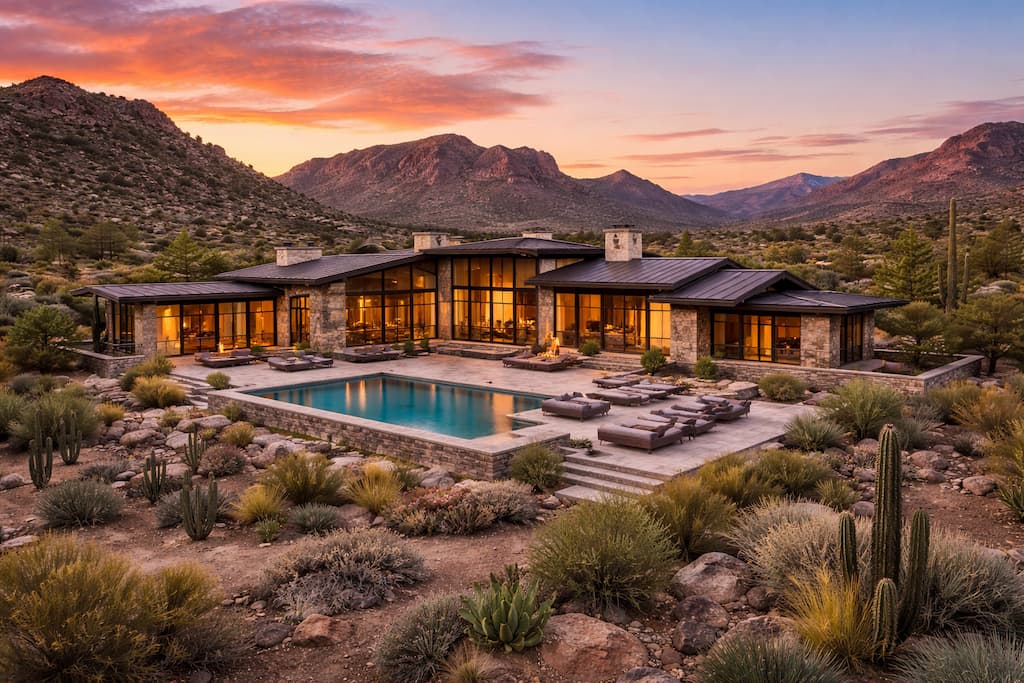
Cold climates need substantial battery storage since winter loads peak when solar production drops. I size for worst-case winter conditions with heated water storage, propane backup heat, and robust insulation. Hot climates prioritize cooling loads and water conservation with shading, thermal mass, and cisterns supplementing well capacity. Humid regions need dehumidification consuming substantial power factored into electrical loads. Coastal locations require corrosion-resistant equipment.
Moving Forward with Off-Grid Luxury Home Design
Building an off the grid luxury estate requires accepting that utility systems drive design decisions from project inception. Site selection, building orientation, envelope performance, and program organization all respond to the requirements of independent operation. This isn’t constraint – it’s opportunity to create residences that perform better than grid-connected homes while enabling location freedom.
That requires early commitment to off the grid luxury home design goals. Site analysis addressing solar access, water availability, and soil conditions happens during property search, not after purchase. System sizing and integration drive schematic design rather than getting addressed during construction documents. Building envelope performance gets specified based on utility loads rather than minimum code compliance.
Successful off the grid luxury estates are built by clients who understand that independence costs more initially but delivers ongoing freedom from utility companies and rate increases. They value resilience – homes that operate through grid failures, natural disasters, and infrastructure disruptions affecting conventional residences. They’re building in remote mountain locations, island properties, and areas where remoteness provides privacy and connection to landscape.
If you’re considering a luxury estate in a remote location, start by honestly assessing site conditions and your commitment to independent operation. Then work with an architect who understands off-grid systems as architecture rather than engineering add-ons. Because the most successful off the grid estates are designed from the beginning for independence – not adapted from grid-dependent plans after systems prove inadequate.
Frequently Asked Questions: Off-Grid Luxury Home Design
What is off-grid luxury home design?
Off-grid luxury home design refers to creating high-end residences that operate independently of public utilities by integrating systems for power, water, and waste while maintaining luxury finishes, functionality, and architectural sophistication.
What sustainable systems are essential for off-grid luxury homes?
Key systems often include solar photovoltaic arrays with energy storage, rainwater harvesting and filtration, septic or advanced waste systems, and passive design strategies for heating and cooling.
How does off-grid design differ from net-zero homes?
While both emphasize sustainability and energy efficiency, off-grid design aims for complete independence from public utilities, whereas net-zero homes balance utility use with onsite renewable production to achieve a net zero energy footprint.
What site characteristics best support off-grid luxury home design?
Optimal sites are typically remote with adequate solar exposure, topography favorable for water systems, and access for construction—plus regulatory clearance for standalone utilities and waste systems.
What are some architectural strategies used in off-grid homes?
Architects use passive solar orientation, high-performance insulation, strategic window placement, and integrated renewable energy systems to reduce mechanical loads and enhance comfort without grid reliance.
Are off-grid luxury homes more expensive to build?
Initial costs can be higher due to custom systems and infrastructure, but these investments often reduce long-term operating costs and elevate resilience, sustainability, and property value.
