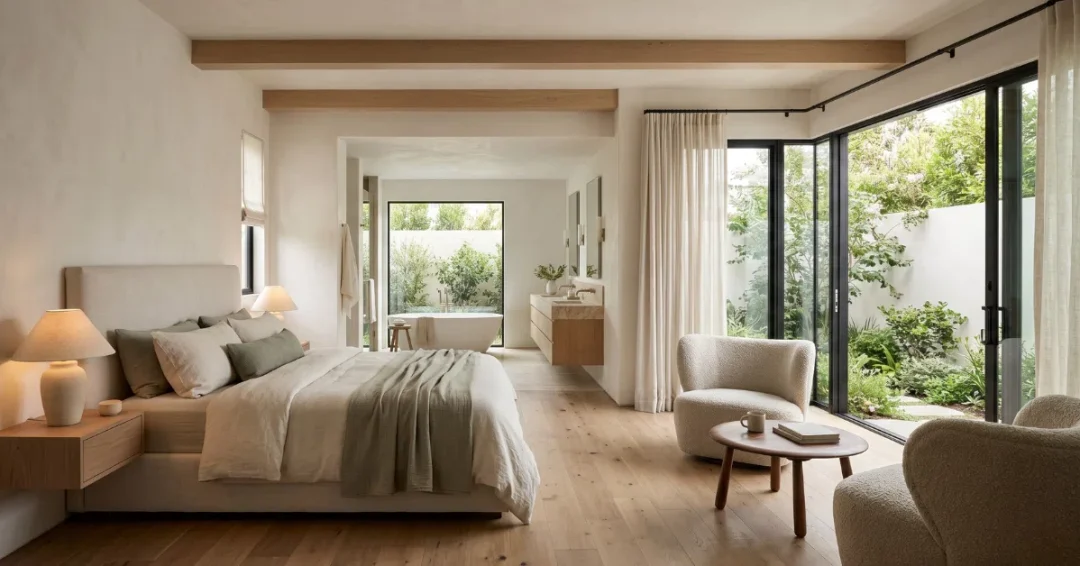
When clients begin planning primary suite floor plans, most start with square footage. That's the wrong starting point. The suites that genuinely deliver privacy and retreat share a set of architectural decisions made before any finish is chosen - decisions about placement, sequence, light, and acoustic separation. The ones that disappoint, regardless of budget, trace their failure back to those same decisions, made carelessly or skipped entirely.
I've been designing primary suite floor plans for nearly two decades, across homes in the Hamptons, Montana, the Caribbean, and Los Angeles. The approach we take to private home design runs through every square foot of the suite program. This guide covers everything that matters: where the suite sits in the plan, how you arrive at it, what controls the atmosphere inside, how the bath fits as one element within it, and how the suite connects to the private outdoor spaces that make it feel complete.
Many of our clients are navigating second home planning for the first time. The primary suite is almost always the room where the architectural thinking matters most.
Why Primary Suite Layout Is the First Decision, Not the Last
When I review primary suite floor plans with clients, I ask them to set aside the square footage number and look at how the suite relates to everything else in the home. Where does it sit relative to the kitchen? The family room? The guest wing?
Those relationships matter more than almost anything else. The primary suite layout decision gets compromised constantly - because it competes with other priorities. The client wants the suite to face the view, but the view faces the pool terrace. Guest parking sits next to the suite wing. The children's rooms share a floor with the primary bedroom. Each compromise seemed reasonable. Together, they produce a room that functions but never feels like a retreat.
The primary bedroom layout considerations we address before anything else:
- Separation from shared daytime spaces. The suite should not be adjacent to the kitchen, family room, mudroom, or laundry. Physical proximity creates a psychological connection that undermines the sense of removal - even with good acoustic insulation.
- Separation from guest circulation. Guests moving through the home should not pass by or near the suite entry. This is a routing problem as much as a proximity problem.
- Exterior orientation for privacy. Windows and outdoor connections should face directions that don't expose the suite to pool activity, driveway traffic, or neighbor sightlines. This is resolved during the site selection process.
- Buffer zones on all sides. Closets, corridors, and utility rooms positioned between the suite and adjacent spaces do acoustic and psychological work no wall assembly alone can replicate.
On a single-story home, primary suite floor plans can push the suite to one end of the structure entirely - surrounded by landscape on two or three sides. The suite becomes a private pavilion connected to the home by corridor rather than embedded within it. Our luxury house plans treat this separation as a first principle, not an afterthought.
In multi-story homes, the key is what the suite is stacked over. Place it above a garage or mudroom - not the kitchen or family room - and vertical acoustic separation works in your favor. A decision about whether shared spaces use an open concept floor plan matters here too: open-plan living areas amplify sound in ways that make primary suite placement even more consequential.
The Arrival Sequence in Primary Suite Floor Plans
The most common flaw I find in primary suite floor plans that don't work is the absence of any arrival sequence. The door opens directly off a shared hallway. You walk in and you're there. Nothing in the architecture marks the transition from the communal life of the home to the private one.
Privacy is as much psychological as acoustic. The spatial experience of arriving somewhere - passing through a threshold that marks the change - shapes how a person feels once they're inside. The same thinking we apply to luxury entryway design at the front of a home applies at the threshold of the suite.
Primary suite ideas that build this quality into the plan:
- The dedicated branch corridor. A short hallway that turns away from the main path before reaching the suite. The turn alone creates removal - you've stepped off the shared route onto one that leads only here.
- The entry vestibule. A small anteroom that compresses the space before the bedroom opens up. It can hold storage, a bench, or simply be a proportioned pause. Its function is the transition, not the program.
- The material or ceiling shift. A change in flooring, wall finish, or ceiling height at the entry point signals - without announcement - that this space operates differently.
- The morning room as second threshold. When the primary suite program includes a sitting area, placing it between entry and bedroom creates a room within the suite that you pass through on the way to sleep and wake into before facing the day.
A primary bedroom with sitting area reads differently from a large bedroom with furniture at one end. When it's planned from the start rather than carved from excess footage, it becomes one of the most-used rooms in the home. This distinction - retreat to the suite versus retreat to sleep - is what separates a primary suite functioning as a private apartment from one that simply functions as a bedroom.
Understanding this early is what makes the custom home design process so consequential for clients building a custom home for the first time.
Light, Ceiling, and Volume: Primary Suite Atmosphere Controls
Walk into a primary bedroom suite that works and you notice the light first. Not that it's bright or dramatic - that it feels right for the hour. Calm in the evening. Gradual in the morning. That quality doesn't come from fixtures. It comes from architectural decisions about orientation, aperture placement, ceiling height, and room volume. How a home handles natural light in architecture shapes no room more directly than the primary suite.
Three variables control the atmosphere of any primary suite more than any finish decision:
Light quality and window placement. The primary bedroom suite serves two modes: the room you sleep in and the room you wake up in. East-facing windows make for beautiful mornings but harsh early light. West-facing rooms hold afternoon heat and late glare. We work through the suite's orientation against the site's solar path - designing the window configuration for how the room feels across a full day, not just how it photographs at noon.
Clerestory windows positioned high on the wall bring daylight in without direct exposure. Motorized shading systems integrated into the ceiling reveal from the start - not surface-mounted after the fact - give the room atmospheric flexibility that fixed glass alone cannot.
Ceiling configuration. A flat ceiling at standard height reads as utilitarian in a room meant to feel exceptional. We favor profiles that are calibrated rather than dramatic: a coffered detail that adds geometry without sacrificing warmth; a gentle vault that peaks above the sleeping wall; a volume that opens over the bed while dropping over the dressing and sitting areas, using height to signal hierarchy within the primary suite without diminishing any zone.
The tray ceiling in a primary bedroom earns its popularity. When its proportions are worked out in section drawings - not applied as a standard detail - it anchors the room with genuine intention.
Room volume and proportion. The large primary bedroom layout idea that matters most isn't square footage - it's ratio between width, depth, and height. The room should be wide enough that a California King reads as centered, not wedged. Deep enough to provide meaningful floor beyond the foot of the bed. And proportioned so the walls create enclosure without compression.
| Ceiling Type | Best For | Acoustic Effect | Design Note |
|---|---|---|---|
| Tray ceiling | Defining the sleeping zone without full vault | Neutral - depends on finish | Proportion must be designed in section, not specified as a standard detail |
| Coffered ceiling | Adding geometry and warmth | Positive - breaks up hard surfaces | Works well in suites with formal or traditional character |
| Vault / cathedral | Drama and volume in modern suites | Challenging - live and reverberant | Requires careful acoustic absorption in finishes and furnishings |
| Varying plane | Defining zones within the suite | Neutral to positive | Most effective when height changes map to program: bed, sitting, dressing |
| Flat standard | Utility spaces, not primary suites | Neutral | Avoid in the sleeping zone of a luxury primary suite |
Acoustic Privacy in Primary Suite Floor Plans
Acoustic privacy is the design problem clients don't think to raise until they've lived in a home where it was handled poorly. A primary suite that lets the sounds of the household in - kitchen noise in the morning, the family room at night, a garage door at 6 AM - fails at its most basic purpose. The commitment to extreme privacy architecture that runs through our practice applies here at its most intimate scale.
The primary suite layout is the most powerful acoustic tool available. Plan placement - buffer rooms between the suite and active spaces - does more acoustic work than any material specification. According to the National Institute of Building Sciences, plan separation consistently outperforms wall assembly specification as the primary acoustic control in residential construction. Beyond that, four layers work together:
- Wall and ceiling assemblies. Decoupled wall framing, resilient channel on ceiling joists, dense-pack insulation in all cavities, and acoustically rated door assemblies. These decisions must be made before framing begins - not corrected after.
- Mechanical systems. HVAC ducting is one of the most overlooked acoustic pathways in residential construction. The primary suite should be on a dedicated zone with correctly sized diffusers and routing that avoids direct connections to other occupied spaces.
- Interior surfaces. Hard surfaces everywhere create a live acoustic environment that's difficult to sleep in. Area rugs, upholstered headboards, floor-to-ceiling drapery, and soft furnishings absorb sound within the room itself.
- Door specifications. Solid-core doors with compression seals at threshold and sides make a measurable difference. A door that closes quietly, with hardware that doesn't clatter, matters over years of daily use.
Privacy within the suite matters as well. Many couples have different schedules. The placement of the dressing room and bathroom relative to the sleeping area is a planning decision - and smart home architecture integration can address schedule-split problems in ways passive architecture alone cannot.
Closets, Dressing Rooms, and the Full Suite Program
The primary suite program - every room and function within the private retreat - varies by client. At its most compact: bedroom, bath, and storage. At its most expansive: separate dressing rooms, a morning room, private study, home gym, and terrace. Getting the program right before designing any of it determines whether the suite fits how the clients actually live.
Closets deserve more architectural attention than they typically receive. The walk-in closet treated as a utilitarian room appended to the bathroom - storage you pass through - misses an opportunity. When designed with natural light, a central island, a proper mirror, and millwork to the same standard as the rest of the suite, it becomes a room people use intentionally.
A dressing room is different from a closet. You inhabit a dressing room for fifteen to twenty minutes each morning and evening. It needs seating, accurate artificial and natural light, and floor space to step back from the wardrobe. These are modest requirements with outsized impact on daily experience. The custom millwork, lighting, and hardware specification for dressing rooms is part of what we coordinate through FF&E design and specification.
When the project allows separate his-and-her dressing rooms, two distinct rooms sharing an access corridor between them works best. Each person has their own organization system and lighting preference. The corridor also functions as an acoustic buffer between bedroom and bath - a planning solution that improves the suite spatially and functionally at the same time. The quality of luxury interior design thinking, applied at the plan stage, is the difference between a room that looks finished and one that genuinely works.
The Primary Bath: One Room in the Primary Suite, Not the Room
The bathroom receives the most attention in planning conversations and often the largest share of the finishes budget. But before any stone is selected, the bath's role within the primary bedroom suite needs to be established architecturally: it is one room in a sequence, not the organizing subject of the whole. Our guide to luxury primary bedroom suite plans covers the complete program in greater detail.
The relationship between bath and bedroom at the point of connection matters most. A bathroom that opens toward the bed through a carefully framed aperture creates visual depth and spatial continuity. One whose entry reveals the toilet does the opposite. The primary bedroom and bathroom layout decision - what the eye sees from each position - shapes the quality of both rooms simultaneously.
On the soaking tub: freestanding tubs in primary baths are used far less than clients anticipate at design time. When the program is tight, a generous walk-in shower with excellent light and detail often serves better over time. When a tub belongs - when clients genuinely use one, or when the suite scale makes it natural - placing it at a window with a deliberate view is the decision that earns its place. A tub facing a garden gets used. A tub facing a wall is a beautiful object that doesn't.
PRIMARY SUITE BATH PLANNING CHECKLIST
- Bath entry does not reveal toilet from bedroom or corridor
- Toilet room is a separate enclosed space
- Vanity areas separated so two people can use simultaneously
- Lighting zones allow one partner to prepare while other sleeps
- Solid-core door with compression seal between bath and bedroom
- Soaking tub positioned at a window with deliberate view (if included)
- Shower volume designed for daily use, not just visual presence
- Mechanical zone dedicated to suite - not shared duct runs
Private Outdoor Space: Extending the Primary Suite Beyond the Wall
One of the most meaningful decisions in a luxury primary suite is whether and how it extends into the landscape. A private terrace, courtyard, or garden accessible only from the primary suite creates a quality of retreat that nothing interior can replicate. You're outside. The rest of the home is somewhere else entirely. This is central to how we approach luxury outdoor living - and nowhere does it carry more weight than off the primary suite.
When the opportunity exists, the outdoor space deserves the same architectural rigor as the interior program. Three principles guide the design:
- Enclosure and scale. Enclose on at least two sides - by the building, landscape, a garden wall, or grade change. Proportion it for one or two people, not a gathering. A terrace visible from the pool deck isn't private in any meaningful sense.
- Orientation for actual use. East-facing for clients who start their day outside. West-facing for those who end it there. Some of our best primary suite additions combine a small east-facing space for morning coffee with a sheltered west-facing area for evening use.
- A threshold that dissolves, not interrupts. Wide sliding panels that pocket into the wall, folding systems that remove the interior-exterior boundary entirely, or French doors with a flush threshold - these details determine whether the outdoor space becomes a daily habit or an occasional destination.
For second homes - a significant part of our practice - the private outdoor connection from the primary suite often becomes the defining feature of the project. A bedroom that opens to a Caribbean garden, a mountain view at altitude, or a desert courtyard changes how clients experience the entire home. The landscape surrounding these outdoor suite spaces is coordinated with the architecture from the start, which is why we treat high-end landscaping design as part of the architectural brief, not an afterthought.
Technology in the Primary Suite: Designed In, Not Added On
Technology systems in a luxury primary suite either disappear completely or become the room's most visually disruptive element. The difference is whether they were planned at the start or retrofitted afterward. How we approach technology in residential architecture - as a design discipline rather than a specification category - determines whether these systems serve the suite or fight against it.
What proper integration looks like:
- Lighting scenes, not individual fixtures. Morning, evening, reading, and sleep scenes - at minimum. The lighting plan and control system must be designed together, with keypad locations resolved before walls close.
- Motorized treatments in the architecture. Treatment pockets built into the ceiling reveal. Shade hardware behind millwork. Fabric selected against the wall finish. Added later, motorized shades announce themselves as appliances. Designed in from the start, they're invisible.
- AV with no visible hardware. Recessed speakers. A television concealed behind a panel or built-in - not wall-mounted on a bracket. Cable runs that don't surface on walls.
- Controls within reach. Bedside keypads reachable from a sleeping position without sitting up. Scene controls accessible near the dressing area. A smart home system that requires the phone at 2 AM is inconvenient at the moment that matters.
What to Expect When an Architect Designs Your Primary Suite
Clients who come to us after a builder-only process on a previous home say the same thing: the primary suite was the room they wished they'd approached differently. By the time they understood what was wrong, it was too late to correct without significant cost.
Working with an architect means the primary suite is designed as an architectural problem from day one. Understanding the architecture consultation process early clarifies what decisions happen when - and why the questions asked in the first meetings shape every room that follows. For clients still evaluating firms, our guide on how to choose an architect covers what matters most at that stage.
The questions we bring to clients early in primary suite floor plan design:
- Do you and your partner have different schedules, and how should the plan accommodate that?
- Do you want to spend time in the suite during the day, or is it primarily a sleeping space?
- What is your relationship to morning light - wake with the sun, or control it completely?
- How do you feel about the bedroom opening to the outdoors versus maintaining enclosure?
- Is there a hotel suite or vacation home that has felt right to you - and what quality were you responding to?
These aren't design questions. They're questions about how you live. The answers shape every architectural decision that follows. Clients who want to understand the investment implications will find our overview of the cost of high-end architecture a useful reference alongside the design conversation.
Frequently Asked Questions About Primary Suite Floor Plans
What should primary suite floor plans include beyond the bedroom?
A complete primary suite floor plan includes the bedroom, a primary bath, and wardrobe storage - a walk-in closet or dressing room. Where the program allows, a sitting area or morning room adds significant daily value. More expansive suites add a private study, a home gym, and a private outdoor terrace. For projects where the suite is part of a larger estate, our master planning services address the suite within the full residential program.
How large should a primary suite be in a luxury custom home?
Luxury primary suite floor plans typically range from 800 to 1,500 square feet for the full program. The bedroom itself benefits from at least 16 by 18 feet for proper furniture placement. What matters more than raw square footage is proportional logic: a room 14 feet wide and 28 feet deep often feels worse than one that's 18 by 22. Proportions should support the natural relationship between bed, windows, ceiling, and bath entry.
What makes a primary suite layout feel private?
Primary suite layout privacy comes from a series of decisions working together: placement that puts physical and acoustic distance between the suite and active household spaces, an arrival sequence that creates a spatial transition, buffer zones in the form of closets and corridors, and exterior orientation that controls landscape exposure. No single decision creates the feeling. It's the coherence of all of them that does.
Why do we call it a primary suite?
"Primary suite" is the current, widely adopted term for the principal bedroom suite, and we use it because the room is the home's main and most private living space. It is the private retreat with its own bath and typically a dressing area. The architectural priorities and design approach are identical regardless of what the room is called.
Should the primary suite be on the main floor or upper floor?
In single-story homes, the suite on the main floor can push to one end of the structure and engage directly with private outdoor spaces. In multi-story homes, an upper-level suite with private outdoor access - a balcony, roof terrace, or upper garden - is typically our recommendation. The key is what the suite is stacked over: above a garage or mudroom serves acoustic privacy better than above the kitchen or family room.
How does primary suite design differ in a second home?
In a second home, the primary suite carries more of the emotional weight of the entire project. Clients are building to retreat and decompress - and the suite delivers on that promise most directly. The program typically expands: private outdoor space, a sitting area, a higher level of finish. The suite is used intensively during visits rather than spread across a year of daily routines. The architectural priorities are the same, but the design expression is often bolder and the outdoor connection more central.
The Room the Whole House Depends On
There's a test I apply to every primary suite we design: would you choose to spend time here during the day, not just at night? If the suite is genuinely restorative - a place you return to, not just sleep in - the architecture has done its job.
That quality doesn't come from the finish budget. It comes from how the room sits in the primary suite floor plan, how you arrive at it, how it holds light, how it sounds, and how it connects to the outdoors. A modern primary suite designed with that coherence as the goal feels different from a room where those decisions were made piecemeal - or not made at all.
If you're planning a custom home and want to talk through how the primary suite fits into the overall design, we'd welcome the conversation. View our completed projects to see how these principles translate into built work, or start a project inquiry with the Ralston Architects team.