This content is for informational and educational purposes only. Ralston Architects recommends consulting directly with a licensed architect for project-specific guidance related to your site, climate, and local building regulations.
Luxury pool home design is rarely about the pool itself. The water, the tile, the finish — these are decisions that come late in a project. What matters far earlier, and far more fundamentally, is where the pool sits in relation to the house, how it aligns with interior sightlines, what it does to the sound environment around the home, and how it shapes the way people move through the property from arrival to retreat.
When a pool is placed with architectural intention, it stops being an amenity and becomes a primary organizing element that determines how the entire home is experienced. This is the standard I hold every luxury pool home design to, and it changes the conversation completely.
"Most homeowners ask: 'Where does the pool fit?'"
The better question is: "What does the pool organize?" When you design from that second question, the entire property changes — sightlines deepen, sound becomes intentional, and circulation finds a natural logic it would never have had otherwise.
How Luxury Pool Home Design Uses Water to Control Views
The first thing a well-placed pool does in luxury pool home design is bend sightlines. Water has a reflective quality that no other horizontal surface can replicate — it captures sky, captures tree canopy, captures the horizon, and returns it to the viewer at an angle that makes the view feel larger and more immersive than it actually is.
When a pool is positioned on axis with a primary living space — aligned with the center of a great room or the midpoint of a window wall — it creates a visual terminus that draws the eye through the glass and into the property. The room doesn't end at the glazing. It continues through the water to whatever lies beyond. This is one of the fundamental techniques in luxury pool home design: using the pool as a borrowed-view device that extends the perceived depth of interior space.
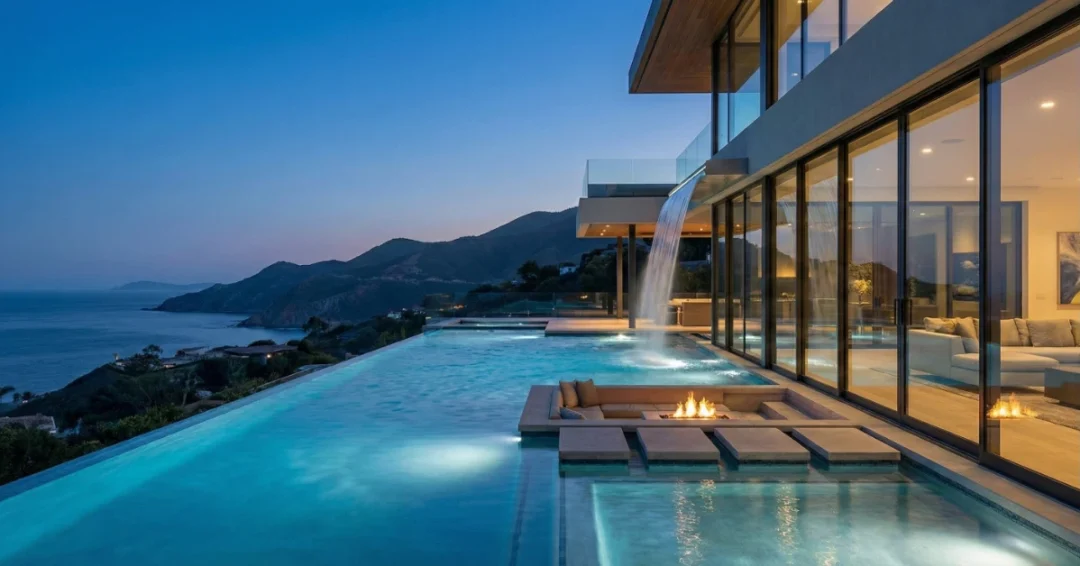
Infinity pools and perimeter-overflow pools take this further. At a hillside or coastal site, an infinity edge fuses the pool's surface with the view beyond — water meeting water, or water meeting sky. The pool becomes a threshold element, and the view reads as continuous rather than framed. Getting this right requires precise coordination on the vanishing edge's elevation relative to eye level from key interior positions — resolved in section drawings before a grade stake is placed.
Reflection pools adjacent to tall glass walls serve a different purpose. Rather than extending a view outward, they double the vertical: a reflection pool outside a double-height room returns the full glazing wall back to itself, creating a sense of depth rather than distance. Typically shallow at 18 to 24 inches, positioned close to the glass line to maximize reflective angle from the interior. The distinction between a swimming pool and a reflection pool is worth establishing early — each serves a fundamentally different visual purpose.
Infinity Edge
Fuses pool surface with horizon or borrowed view
Hillside, coastal, or elevated terrace sites where a strong view exists beyond the pool plane.
View ExtensionPerimeter Overflow
Mirror surface with flush-plane geometry
Flat sites and formal courtyard layouts where symmetry and stillness define the aesthetic.
ReflectionReflection Pool
Doubles vertical architecture — creates depth, not distance
Adjacent to tall glass walls or in courtyard settings. Typically 18–24 inches deep.
Depth & VolumeLap Pool as Axis
Directs the eye, creates a strong organizational spine for the site
Long linear lots and arrival sequences where directional movement along the property matters.
Site SpineSunken Courtyard Pool
Wraps living spaces, creates a surround of reflected light
Enclosed urban sites or private retreats where privacy and immersion are paramount.
Immersive| Pool Type | Primary Visual Effect | Best Site Condition |
|---|---|---|
| Infinity Edge | Fuses pool with horizon or borrowed view | Hillside, coastal, elevated terrace |
| Perimeter Overflow | Mirror surface with flush-plane geometry | Flat sites, formal courtyard layouts |
| Reflection Pool | Doubles vertical architecture, reads as depth | Courtyard, adjacent to glass wall |
| Lap Pool as Axis | Directs the eye, creates site spine | Long linear lots, arrival sequences |
| Sunken Courtyard Pool | Wraps living spaces, creates surround of light | Enclosed sites, urban or private retreats |
Sound as a Design Tool in Luxury Pool Homes
Water sound is one of the most underused elements in luxury pool home design. Most clients think about it late, if at all — a waterfall feature added almost as decoration. But the acoustic dimension of a pool can be designed with the same intention as any other architectural element, and it does real work in the home's sensory experience.
The specific type of water movement determines the quality of sound it produces. A still perimeter-overflow pool is nearly silent — it creates visual calm without acoustic intrusion, which is appropriate when the intent is pure reflection or when a site already has strong ambient sounds worth preserving, like surf or a forest canopy. A sheet waterfall — water falling in a thin, unbroken plane — produces a white noise envelope that masks distant traffic, HVAC equipment, or neighboring properties without being consciously audible as a fountain. It's one of the most effective privacy tools available in outdoor residential design.
Deck jets and laminar flows produce a different character — precise, arcing streams that catch light and land with sharp percussion. These suit active, formal pool environments and less so the contemplative register of a quiet retreat. In a luxury pool home design where outdoor space transitions from social to intimate, sound zoning through water feature placement becomes a genuine acoustic strategy.
From the interior, the benefit is significant. Continuous water sound adjacent to primary living spaces — audible through open sliders — creates a psychological separation from everything beyond the property. It establishes an ambient register that signals retreat, and belongs in the same design conversation as glazing specifications and ceiling height.
How Pools Organize Circulation and Movement
Of all the ways a pool shapes a luxury home's experience, its role in organizing movement is the most architecturally fundamental. Placed without logic, a pool becomes an obstacle. Placed with intention, it becomes the spine of the entire outdoor program.
In luxury pool home design, the pool typically serves one of three circulation functions: it can be a destination that terminates a sequence, a spine that runs parallel to the home and draws movement along it, or a courtyard element that wraps and connects separate wings of the house. Each produces a completely different experience of the property.
Terminus
Pool as destination. Movement is directional and culminates at the water.
Spine
Pool runs parallel. Movement tracks alongside the water the length of the home.
Courtyard
Pool at center. All rooms orient toward water. Privacy and immersion maximized.
When the pool terminates a sequence — positioned at the far end of a long outdoor terrace reached from the main living level — it creates a sense of journey and arrival. The water is the reward. Movement through the home is directional, purposeful, and culminates in an experience. This works particularly well for large-format luxury pool home design where the property has significant depth and the goal is to make guests feel the scale of the site.
When the pool runs as a parallel spine — a long lap pool or linear form set alongside the primary wing of the house — it organizes lateral movement along the building. Every room that faces it has a consistent visual and spatial relationship with the water. Doors open onto the pool deck. The pool deck itself becomes a corridor of sorts, softened by planting and water. This is a particularly effective strategy for single-story homes where indoor-outdoor connection along the full length of the house is a priority. You can explore how we approach indoor-outdoor design for luxury residences in our design process documentation.
The courtyard pool is the most architecturally complex of these arrangements. When a pool occupies the center of a U-shaped or enclosed plan, it becomes the organizing void around which all rooms orient. Every major space faces water. Privacy is maximized. The relationship between inside and outside is immediate from almost any position in the home. This is a strategy common in warm-climate luxury pool home design — in Florida, the Caribbean, and coastal California — where the year-round usability of outdoor space justifies organizing the entire residential plan around it. Our work on luxury second homes in warm-climate markets frequently involves exactly this kind of pool-centered planning.
Integrating the Pool Into the Architecture — Not the Site
The error most luxury pool home designs make — even expensive ones — is treating the pool as a site planning element rather than an architectural one. When a pool is designed by the site planning architect after the house is complete, it inherits whatever space remains and attempts to make the best of a leftover condition. The result is competent but never integrated.
True luxury pool home design brings the pool into the architectural drawings from the beginning. The pool's edge at the house — where coping meets building, how deck plane transitions to interior flooring, whether the pool slides under an overhanging roof plane — these details require cross-discipline coordination from the earliest schematic phase.
A pool beneath a structural overhang creates an indoor-outdoor room that functions in rain and strong sun alike. The overhang's underside reflects light off the water and animates the ceiling plane with movement through the day — impossible to replicate any other way. Getting this right requires knowing the pool's position, depth, finish color, and overhang geometry simultaneously. It cannot be retrofitted.
At Ralston Architects, pool design enters the architectural scope from the first site analysis. Sightlines from primary rooms are mapped before pool placement is fixed. Water feature types are selected alongside acoustic goals. Circulation logic is established before pool shape is determined. This is what separates integrated luxury pool home design from a house with a pool added on.
Is Your Pool Doing Architectural Work?
Check each criterion your current design satisfies
Begin With the Pool in Mind
The best luxury pool home designs share one quality: the water and the house were conceived together — from the first drawing, as a single architectural idea.
If you are planning a luxury residence and the pool is still a line item on a future phase list, it is worth reconsidering that sequence. The pool's position determines too much — the views from your primary rooms, the acoustic character of your outdoor spaces, the logic of how guests and family move through the property — to be left for later. It belongs in the first conversation, not the last. Reach out through our luxury home design inquiry to start that conversation.
Begin With the Pool
in Mind
At Ralston Architects, pool design enters the scope from the first site analysis — not as an amenity added at the end, but as a primary organizing element that shapes sightlines, sound, and movement from the very first drawing.
Begin the Conversation