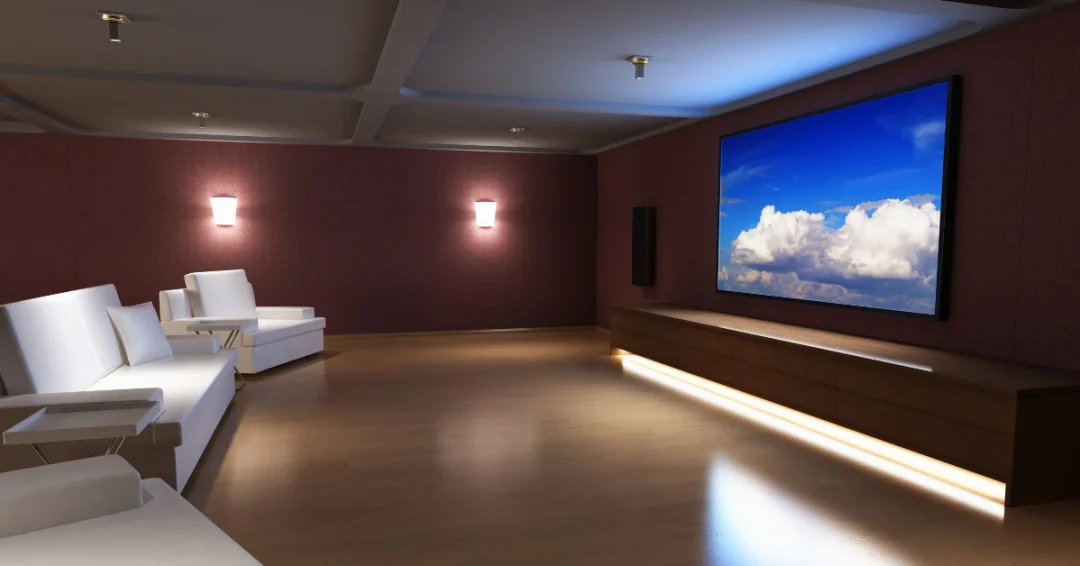
Most of the decisions that determine whether a luxury home theater design succeeds or fails are made long before a single piece of acoustic panel goes up. They’re made at the schematic stage, when the room is still a shape on a floor plan and every option is still available. Wait until finishes are being selected, and you’ve already locked in outcomes – some of them limiting – that can’t be undone without demolition.
I work with clients who want cinema-grade screening rooms built into custom residences, and the conversation I have early in a custom home design project is about scope, not specifications. What kind of room is this, structurally? Where does it live in the home? How does it connect to the spaces around it? What are you trying to achieve that a very good living room television cannot? Those questions aren’t administrative – they’re the questions that determine whether the room performs the way it should when it’s finished.
This piece covers the decisions that matter most and explains why the architect has to be part of making them, not just executing what an AV consultant determines after the fact.
Room Proportions and Why They Govern Everything Downstream
Acoustic performance in a dedicated home theater is largely a function of room geometry. The dimensions of the space – length, width, and height and their ratios to one another – determine where low-frequency energy accumulates, how early reflections behave, and whether the room’s resonance modes will reinforce or fight the acoustic treatment applied later. There are established proportion ratios in professional acoustic design that minimize problematic coincidences between resonant frequencies. A room where dimensions share common factors creates bass modes that stack at the same frequencies, producing audible peaks and nulls that treatment cannot fully correct. A room with dimensions chosen to distribute those modes evenly is far more tractable.
What this means in practice: the room has to be sized for its acoustic purpose, not dimensioned by whatever space remains after the rest of the floor plan is resolved. A screening room that’s 14 feet wide because that’s what fit between two other rooms may end up acoustically challenging in ways that cost more to manage than simply planning the proportions correctly from the start — and understanding what high-end architecture actually costs helps set those expectations early.
Ceiling height deserves particular attention. A flat ceiling at standard residential height in a long screening room creates a flutter echo between the ceiling and floor surfaces that’s immediately audible and degrades speech intelligibility on screen. The solution – whether that’s a raked ceiling that breaks up the parallel reflection path, a shaped soffit, or an acoustic ceiling system – needs to be considered at the framing stage, not after drywall.
A few proportional guidelines that inform the rooms I design:
- Length-to-width ratio – Avoid simple integer ratios like 2:1 or 3:1. A ratio closer to 1.6:1 or 1.9:1 distributes modal energy more evenly across the frequency range.
- Ceiling height – For raked seating with eight to twelve people, a minimum ceiling height of 10 to 11 feet at the front and 12 to 13 feet at the rear is worth designing in. It accommodates both the seating platforms and an overhead acoustic treatment layer without compression.
- Cubic volume – A room below roughly 2,500 cubic feet will have bass mode problems that treatment alone can’t resolve. A room above 5,000 cubic feet requires a more powerful acoustic solution category.
Raked Seating vs. Flat Floor: The Sightline and Acoustic Trade-Off
Raked seating – where each successive row sits on a raised platform above the one in front – is the commercial cinema standard for an obvious reason: it guarantees every seat has a clear sightline to the screen. In a residential context, it does the same thing while adding a level of experiential drama that flat-floor arrangements can’t replicate.
The trade-off is spatial commitment. A raked platform system in a residential screening room typically requires 12 to 18 inches of platform height per row. In a room seating two rows plus a back-row lounge, that’s a meaningful fraction of total ceiling height consumed at the rear. The ceiling height requirement mentioned above is partly a consequence – you need the vertical space to accommodate both the platforms and acoustic treatment above the rear positions.
Flat-floor designs suit smaller rooms, spaces where dual-purpose use is expected, or viewing distances short enough that sightline obstruction isn’t a practical concern. A flat-floor screening room with quality seating and careful screen placement can perform well – but it asks occupants to accept that someone sitting directly behind another person has a compromised view, which matters more as guest counts grow.
From an acoustic standpoint, raked floors interact with the room geometry differently than flat floors. The platform surfaces become part of the acoustic system. Their angle and surface treatment need to be considered in the acoustic design – platforms faced with hard materials can introduce early reflections from below the seating that degrade the listening experience in ways that aren’t obvious until the room is measured.
The raked-versus-flat decision needs to happen at schematic design – it cascades into ceiling height requirements, structural platform loads, mechanical routing, and the entry configuration in ways that can’t be undone easily.
Projection vs. Large-Format Display: An Architectural Decision as Much as a Technology One
The choice between a projection system and a large-format display panel is where many clients start the conversation. But the architectural implications of that choice are significant enough that the decision needs to happen before the room is framed, not after – because each approach shapes the structural and mechanical requirements of the space differently.
A projection setup requires a throw distance – the gap between the projector lens and the screen surface – determined by the projector’s lens and target screen size. For a 120-inch screen diagonal, a standard throw projector needs roughly 12 to 15 feet, meaning the projector is positioned at or near the rear seating position. That affects ceiling treatment, projector housing and noise isolation, and the acoustic position of any center-channel speaker behind the screen. A short-throw projector compresses that distance but introduces different trade-offs in image geometry at wider viewing angles.
The screen surface matters architecturally. A fixed-frame projector screen integrated into the front wall requires that wall to be framed and detailed to receive it – with appropriate backing and coordination with any behind-screen speaker placement. A motorized screen requires a ceiling pocket built into the structure, coordinated with acoustic treatment and HVAC locations, and accessible for service.
Large-format LED display panels – the technology that has displaced projection in many high-end residential installations over the past several years – eliminate the throw distance constraint entirely. A panel sits directly against the front wall, simplifying spatial planning. The trade-off is that even large residential panels top out at sizes projection can exceed, and the visual experience of a 120-inch or larger image in a properly darkened room remains distinct from any panel currently available at residential scale.
Projection favors rooms where image scale above 100 inches is the priority, full light control is achievable, and acoustic screen integration matters – projection screens can be made transparent to sound, allowing front-channel speakers to sit behind the image surface in a way panel displays cannot accommodate. Display panels favor shorter rooms where throw distance is a constraint, spaces with some residual ambient light, or ceilings where projector housing and cable routing would create coordination problems.
Light Control: The Architectural System That Determines the Image
A luxury home theater design lives or dies on light control. The contrast ratio of even a reference-grade projector is irrelevant if the room admits ambient light from windows, doors, or adjacent spaces during use. Light control is an architectural system – not an AV specification – and it needs to be designed with the same discipline as the acoustic system.
Windows in a screening room are a legitimate design choice, particularly in rooms that serve daytime social functions. But every window requires a blackout treatment that achieves genuine light seal – not just a dark shade, but a system that eliminates the gap light most window treatment products allow. Motorized blackout shades with side channel guides that prevent edge infiltration, combined with low-reflectance room finishes throughout, can achieve the necessary control.
Door seals are frequently overlooked. A standard interior door with a gap at the threshold and no light-sealing perimeter admits a visible stripe of corridor light across the floor during screenings. Cinema door hardware – sealed perimeter gaskets, drop-down threshold seals, substantial construction weight – is available and appropriate for a dedicated screening room.
The relationship between the screening room and adjacent spaces matters. A theater opening directly onto a bright hallway creates a transition problem every time someone enters mid-screening. A short vestibule between the corridor and the theater allows eyes to adjust and prevents the light intrusion that a direct connection brings.
Lighting within the room is a layered system. Aisle lighting for safe movement. Step lighting integrated into raked platform risers. A dimmable ambient layer for pre- and post-screening social use. Practical sconces at seating positions for pre-show activity. Each layer requires its own circuit and dimming control, with placement coordinated to avoid reflections that interfere with the image.
Integration with Home Flow: Where the Theater Lives in the Architecture
A dedicated screening room is a significant architectural volume – typically 400 to 700 square feet in a well-sized residential application – and where it sits in the home affects how often it gets used, how it connects to entertaining functions, and whether it reads as a destination or an afterthought.
The most successful placements treat the theater as an anchor of the home’s entertainment zone rather than an isolated room at the end of a corridor. Proximity to a bar or lounge area creates a pre and post-screening social function that makes the space more useful for entertaining large groups at home. Connection to an outdoor terrace – through an acoustically managed door – allows the screening room to serve outdoor entertainment scenarios that would otherwise require a separate AV installation.
Acoustic isolation is the planning constraint that most directly affects placement. A dedicated home theater requires isolation from the rest of the house – both to prevent its sound from disturbing other areas and to prevent mechanical noise and foot traffic from entering. How privacy shapes the architecture of a luxury home extends well beyond the theater room. That isolation comes through room-within-a-room construction: decoupling the theater’s walls, floor, and ceiling from the surrounding structure, along with proper door construction and treatment of duct and pipe penetrations.
That construction approach has square footage implications. A room-within-a-room theater adds several inches to all six surfaces – walls, ceiling, and floor – so the finished interior dimensions are meaningfully smaller than the structural opening. A room planned at 18 by 24 feet in the framing may finish at 16 by 22 feet or less. Planning with finished interior dimensions as the target, not framing dimensions, is essential – and another reason the architect needs to be driving these numbers from the start.
Bringing It All Together Before the First Shovel
The clients who end up with outstanding screening rooms engage with these decisions early, before the floor plan is locked. The room geometry, the structural approach, the isolation strategy, the projection versus display choice, the seating configuration – none of these can be fully resolved after construction is underway without cost and disruption that’s entirely avoidable. A luxury home theater design isn’t a plug-in specification added to a finished custom home. It’s an architectural program that informs structure, floor plan adjacencies, mechanical layout, and electrical infrastructure. Treated that way, the result is a room that performs at a level that justifies the investment – acoustically, visually, and experientially.
If you’re planning a custom residence and want to include a dedicated screening room, that conversation belongs at the very beginning of the design process. Contact Ralston Architects to discuss how a cinema-grade home theater can be integrated into the architecture from the ground up.
Frequently Asked Questions
What makes a home theater “luxury” versus a standard media room?
The distinction is primarily about acoustic and visual performance, spatial dedication, and construction approach. A standard media room is a multipurpose space with a large television and good furniture. A luxury home theater design involves a purpose-built room with controlled acoustics, a dedicated projection or large-format display system, raked seating, professional-grade audio calibrated to the specific room, and architectural light control. The room exists for screening and nothing else.
When in the design process should the home theater be planned?
The structural and acoustic fundamentals of a dedicated home theater – room proportions, isolation construction, ceiling height, seating configuration, projection system type – should be resolved during schematic design, before the floor plan is finalized. These decisions affect structural framing, ceiling heights, mechanical routing, and electrical infrastructure. An AV consultant can be brought in to specify equipment at a later stage, but the architectural parameters need to be set early.
What is the role of the architect versus the AV consultant in home theater design?
The architect is responsible for the spatial and structural decisions that determine what’s possible acoustically and visually: room geometry, isolation construction, ceiling configuration, light control strategy, placement in the floor plan, and connection to adjacent spaces. The AV consultant specifies and installs the technology within that architectural envelope. When the roles are reversed – when AV specifications drive the architecture – the room typically underperforms because the technical requirements weren’t built in from the start.