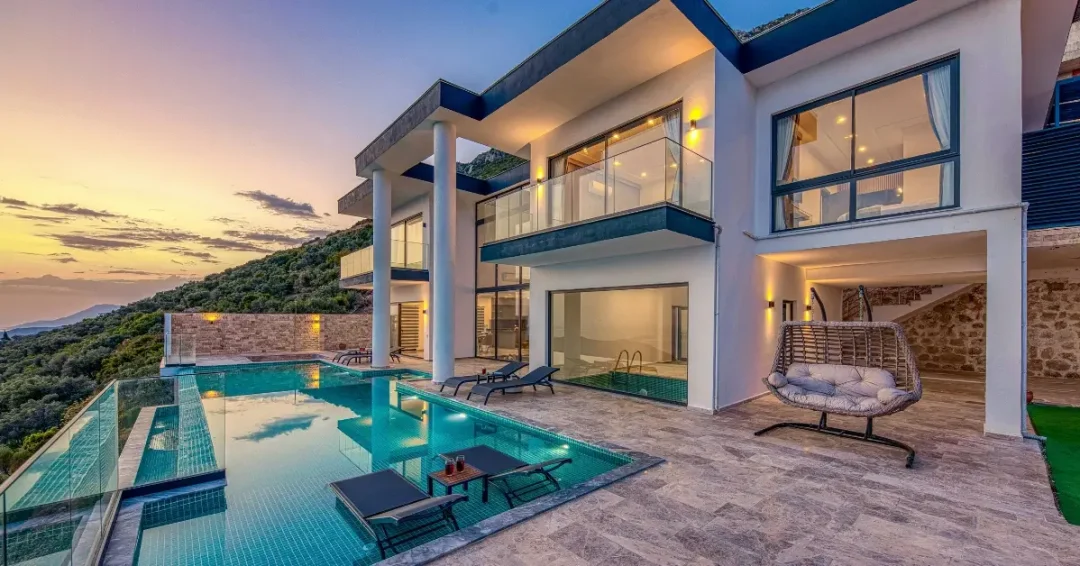
Privacy failures in luxury residential design happen in predictable ways. The entry sequence deposits visitors directly at the front door with clear sight lines to interior living spaces.
Glass walls that offer neighbors or photographers unobstructed views into bedrooms and family areas. Garage entries that expose residents during the vulnerable moment of vehicle-to-home transition.
High-profile client home design addresses these vulnerabilities through systematic planning that treats privacy and security as architectural requirements, not afterthoughts. You’re designing for clients whose daily routines include security considerations that don’t apply to typical residential projects.
I’ve spent two decades designing homes for clients where privacy isn’t about preference – it’s about safety, security, and maintaining control over who sees what aspects of their lives.
The planning strategies that work for high-profile client home design create residential environments that feel open and gracious while remaining fundamentally private.
Here’s how high-profile client home design actually works – the site planning, architectural layout, and security integration that protects privacy without creating fortress-like environments that sacrifice livability.
Key Privacy Challenges in High-Profile Client Home Design
-
- Exposure during vehicle-to-home transitions
-
- Sight lines from public roads or neighboring properties
-
- Unwanted surveillance from photographers or visitors
-
- Visibility of family areas from guest zones
-
- Service personnel access to private spaces
Site Selection and Property Configuration for High-Profile Client Home Design
High-profile client home design starts before you purchase a property. Site characteristics determine how much architectural intervention you’ll need to achieve meaningful privacy protection.
Larger parcels offer obvious advantages. When your property line is 200-300 feet from the nearest public vantage point, you have space to create arrival sequences, landscape screening, and building setbacks that make surveillance difficult.
I evaluate potential sites based on “exposure vectors” – the locations from which the property can be viewed or accessed. Public roads, neighboring properties with elevated vantage points, hiking trails, water access points.
The best sites for high-profile client home design have limited exposure vectors that can be addressed through landscape screening and building orientation.
Access Control and Perimeter Security
High-profile client home design requires controlled access to the property with monitoring capabilities that don’t feel institutional. For properties where security is critical, I design entry gates 150-200 feet from the public road with surveillance coverage that captures approaching vehicles before they reach the gate.
This setback creates a buffer zone where security personnel can evaluate visitors before they have direct views of the residence.
Perimeter fencing gets integrated into landscape design – stone walls, dense hedge plantings, or grade changes that make access difficult while reading as design elements rather than barriers.
| Privacy Element | Recommended Specification | Purpose |
|---|---|---|
| Entry Gate Setback | 150-200 feet from public road | Buffer zone for visitor evaluation |
| Porte-Cochère Height | 12-14 feet minimum | Large vehicle clearance + surveillance protection |
| Landscape Screening | 12-20 feet mature height | Visual barrier from exposure vectors |
| Property Line Distance | 200-300 feet to public vantage | Adequate setback for security measures |
Arrival Sequences That Protect Privacy in High-Profile Client Home Design
The arrival sequence in a high-profile client’s home design must serve multiple functions simultaneously. It needs to create gracious hospitality for expected guests while preventing unwanted visibility into family areas and maintaining security during vehicle transitions.
Motor Court and Porte-Cochère Design
Motor courts provide controlled arrival environments where residents and guests exit vehicles under cover, protected from surveillance and weather. The design challenge is creating this protection without making the arrival feel like a service entrance.
I typically design porte-cochères that are substantial architectural elements – not afterthought canopies. These structures need a height adequate for large vehicles (12-14 feet minimum), a width for multiple vehicles to pass (20-24 feet), and lighting that provides security without creating a harsh institutional character.
The porte-cochère location matters as much as its design. Position it to minimize views into the residence from the arrival area.
Visitors standing at the front door shouldn’t see into living areas, family bedrooms, or service spaces.
Separate Service and Guest Entries
High-profile client home design requires distinct circulation systems for family, guests, and service personnel. These shouldn’t feel like class divisions – they’re functional separations that maintain privacy while allowing the household to operate efficiently.
Guest arrivals happen at the primary entry with its porte-cochère, formal landscape, and architectural presence. Service arrivals – deliveries, maintenance, household staff – happen at a separate entrance, typically accessed from a service drive that doesn’t require passing the main residence.
Family entries often happen through the garage, which requires careful planning. The garage-to-house transition needs to be a secure, private zone with no exterior visibility during the vehicle-to-home movement.
For comprehensive luxury residential design services that integrate privacy planning from the initial site selection phase, these circulation strategies become fundamental to the architectural program.
(Public, Semi-Private, Private)
(vs Standard Luxury)
(Property Line to Public Road)
Interior Layout Strategies for High-Profile Client Home Design
Interior planning in high-profile client home design creates layers of privacy that allow the family to control visibility and access based on who’s in the home and the security posture required at any moment.
Public, Semi-Private, and Private Zones
I organize floor plans into three distinct zones with clear transitions between them. Public zones are where guests are received – entry halls, formal living areas, dining rooms.
These spaces are designed to be impressive and hospitable while revealing nothing about the family’s private life.
Semi-private zones include kitchens, family rooms, libraries – spaces that might be shared with trusted guests but aren’t part of formal entertaining. Private zones are family bedrooms, home offices, children’s play areas – spaces that should be completely invisible to anyone outside the immediate household.
In high-profile client home design, private zones need physical separation from public and semi-private areas, often on different floors or in separate wings.
Sight Line Control and Visual Privacy
High-profile client home design requires managing interior sight lines so movement through family areas isn’t visible from guest spaces or exterior vantage points.
This means avoiding long axial views that allow someone at the front entry to see through the house to family spaces beyond. It means positioning windows in family areas where they don’t align with potential surveillance points outside.
Glass walls and large windows are possible in high-profile client home design, but their orientation matters intensely. A floor-to-ceiling window facing a private courtyard is fine.
The same window facing a property line where photographers might gather creates vulnerability.
Security Integration in High-Profile Client Home Design
The challenge in high-profile client home design is integrating serious security infrastructure without making the home feel like a corporate facility. Security needs to be present but not dominating.
Surveillance and Monitoring Systems
Comprehensive surveillance coverage is standard in high-profile client home design, but camera placement requires careful coordination with architecture. I coordinate camera locations during design development, not after construction.
Camera coverage typically includes all entries, the perimeter fence line, driveways and approach roads, and property boundaries. But cameras should be small, architecturally integrated fixtures – not obvious security equipment.
For advanced security system integration and residential lighting control, the planning happens during architectural design to allow proper concealment and power distribution.
Access Control and Intrusion Detection
High-profile client home design includes comprehensive access control systems that monitor and restrict who can enter which areas of the property and when.
This ranges from gate controls and front door systems to interior doors that can be secured remotely. The implementation needs to be invisible in daily use – residents shouldn’t feel like they’re operating security equipment every time they move through their home.
Electronic locks, card readers, and biometric systems all have residential applications, but the challenge is integrating them into door hardware that maintains architectural character.
High-Profile Client Home Design Security Checklist
-
- Entry gate setback 150-200 feet from public road
-
- Surveillance coverage on all approach routes and entries
-
- Porte-cochère providing covered vehicle-to-home transition
-
- Separate circulation for family, guests, and service personnel
-
- Landscape screening 12-20 feet mature height
-
- Interior zoning preventing guest visibility into family areas
-
- Safe room accessible within 30 seconds from family bedrooms
Landscape Design for Privacy Protection
Landscape planning in high-profile client home design serves security and privacy functions while creating beautiful exterior environments. The landscape isn’t decoration – it’s functional infrastructure.
Screening and Perimeter Plantings
Dense perimeter plantings create visual barriers that make surveillance difficult while maintaining estate-like character. Evergreen trees and large shrubs planted in layered groupings create depth that’s difficult to see through.
I typically design landscape screening that matures to 12-20 feet in height, depending on the exposure vectors we’re addressing.
This takes several years, so high-profile client home design often includes temporary screening measures during landscape establishment.
Lighting for Security and Ambiance
Exterior lighting in high-profile client home design must illuminate the property for surveillance cameras while creating attractive nighttime environments and avoiding light pollution that attracts attention.
The strategy is lighting the property grounds from multiple low-level sources rather than using bright security lights that feel institutional. Path lighting, landscape uplighting, and architectural lighting create visibility for cameras while maintaining residential character.
Safe Room Integration in High-Profile Client Home Design
Many high-profile client home design projects include safe rooms – secure spaces where the family can retreat during security events. The design challenge is creating genuinely secure spaces that don’t feel like bunkers.
Safe rooms need reinforced walls (concrete or steel-lined framing), steel door frames, independent communication systems, and power backup. But they should feel like normal rooms during everyday use.
I typically integrate safe rooms into locations that serve dual purposes – a home office that’s also a safe room, or a bedroom closet that has reinforced construction.
Access to safe rooms needs to be quick and intuitive from family bedrooms without requiring movement through public areas of the house.
| Security System | Cost Range | Key Components |
|---|---|---|
| Surveillance System | $80,000-$150,000 | Cameras, recording, monitoring, architectural integration |
| Access Control | $30,000-$60,000 | Electronic locks, card readers, biometric systems |
| Perimeter Security | $50,000-$100,000 | Gates, monitoring, integrated fencing |
| Safe Room | $80,000-$150,000 | Reinforced walls, steel door, communications, power backup |
| Landscape Screening | $100,000-$250,000 | Mature specimens, layered plantings, immediate coverage |
Cost Considerations for High-Profile Client Home Design
High-profile client home design costs more than standard luxury residential because you’re building multiple layers of security and privacy infrastructure that aren’t visible in the finished project.
Comprehensive surveillance systems run $80,000-150,000 depending on property size and camera count. Access control systems add $30,000-60,000. Perimeter security with gates and monitoring adds $50,000-100,000.
Safe room construction ranges from $80,000-150,000 for a 100-150 square foot space with reinforced walls, steel door, and communication systems.
Landscape screening and privacy plantings typically cost $100,000-250,000 for mature specimens that provide immediate coverage rather than waiting years for growth.
Budget roughly 15-25% more for high-profile client home design compared to standard luxury residential construction at the same square footage and finish level.
Working with Your Architect on High-Profile Client Home Design
If you’re planning a home where privacy and security are priorities, raise these requirements during initial programming. The site selection, building orientation, and interior layout decisions that enable effective privacy protection need to happen early.
Be specific about your security concerns. Different threats require different solutions. Privacy from casual observation is different from protection against determined surveillance, which is different from physical security against intrusion.
Discuss daily operational patterns. How many vehicles do you typically have arriving daily? Do you have household staff? How often do you entertain?
These patterns affect how we design circulation systems, entries, and service access. High-profile client home design works best when the architecture supports your actual lifestyle rather than creating security measures that make daily living cumbersome.
When you’re ready to discuss privacy-focused residential design, the conversation needs to happen during site selection and initial architectural programming.
Contact our team to discuss how high-profile client home design strategies can be integrated into your residential project while maintaining architectural excellence and livability.
Ready to Plan Your Privacy-Focused Residence?
Discover how Ralston Architects creates high-profile client home designs that balance privacy, security, and architectural elegance.
View our portfolio or schedule a confidential consultation to discuss your privacy requirements.
High-Profile Client Home Design FAQs
High-profile client home design typically costs 15-25% more than standard luxury residential construction at the same square footage and finish level due to integrated privacy and security infrastructure. Specific systems include comprehensive surveillance ($80,000-$150,000), access control with electronic locks and biometric systems ($30,000-$60,000), perimeter security with gates and monitoring ($50,000-$100,000), safe room construction ($80,000-$150,000 for 100-150 square feet), and landscape screening with mature plantings ($100,000-$250,000). These costs represent infrastructure that’s largely invisible in the finished project but fundamentally affects how the home functions for security-conscious clients.
Privacy features can be retrofitted to existing homes, but new construction offers significantly better integration and more effective solutions. Existing homes are constrained by current building orientation, window placement, entry sequences, and interior layouts that may expose vulnerabilities difficult to address after construction. Surveillance systems, access control, and landscape screening can be added relatively easily. However, fundamental privacy strategies—controlled arrival sequences, separation of public/private zones, sight line management, safe room integration—are exponentially more effective and less expensive when planned during initial design. If you’re considering purchasing a property where privacy matters, evaluate these factors before buying rather than assuming they can be fully corrected later.
Not when properly designed. The fundamental principle of high-profile client home design is integrating serious security infrastructure without sacrificing residential character or livability. Security needs to be present but not dominating. This means architecturally integrated cameras that are small fixtures rather than obvious equipment, electronic locks and access controls concealed within residential-quality door hardware, perimeter security using landscape elements (stone walls, hedges, grade changes) rather than institutional fencing, and safe rooms that serve dual purposes as offices or closets during normal use. The goal is creating homes that feel open and gracious to residents while remaining fundamentally private and secure—security that’s functionally comprehensive but experientially invisible.
For properties where privacy is critical, I recommend 200-300 feet from the property line to the nearest public vantage point (roads, trails, neighboring properties). This distance provides adequate space for controlled arrival sequences, landscape screening, and building setbacks that make casual surveillance difficult. The entry gate should be positioned 150-200 feet from the public road, creating a buffer zone where security personnel can evaluate visitors before they have direct views of the residence. Smaller lots can achieve privacy through careful building orientation, strategic window placement, and intensive landscape screening, but larger parcels make privacy protection significantly easier and more effective without requiring fortress-like measures.
The key is designing distinct circulation systems that feel natural rather than like class divisions. Guest arrivals happen at the primary entry with porte-cochère, formal landscape, and architectural presence. Service arrivals—deliveries, maintenance, household staff—use a separate entrance accessed from a service drive that doesn’t require passing the main residence. Family entries typically happen through the garage, which requires careful planning to create a secure, private zone with no exterior visibility during vehicle-to-home transition. These aren’t about creating hierarchy; they’re functional separations that maintain privacy while allowing efficient household operations. Well-designed circulation feels intuitive to users—guests naturally arrive at the formal entry, service personnel know where deliveries are received, and families move through private zones without intersecting guest areas.