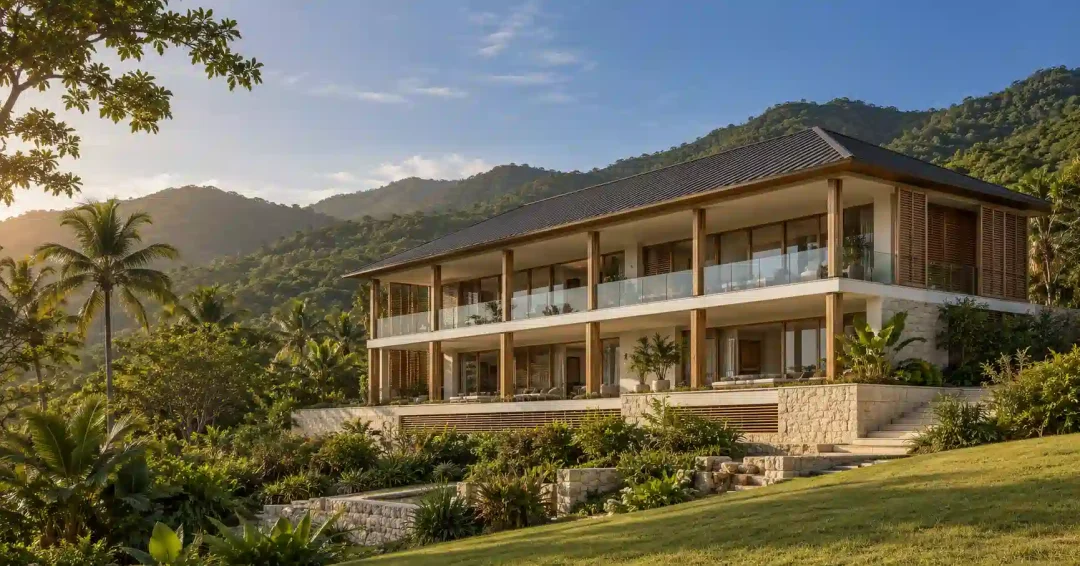
Most plans for a house on St. Kitts or Nevis start with the view. The terrace, the pool edge, the line where water meets sky. Understandable, and backwards.
On an island, the house is close to the last decision, and ahead of it sit questions a mainland lot never raises.
Can you legally hold this land? How close to the shoreline can you build? Where does water come from in a dry year, and what does a window cost after customs?
Putting those questions in the right order is the real work of a luxury home architect in St. Kitts. Taken in sequence, each unknown becomes a decision.
In luxury residential architecture, these answers belong before the first drawing, because water supply and import costs each narrow what the plan can be. Even the view people picture in private island living depends on how close to the shoreline the house can stand.
Why a Luxury Home Architect in St. Kitts Starts With Land Ownership
At Ralston Architects, the work starts with the land, and site selection comes before architecture. On St. Kitts and Nevis, that order carries legal weight.
Under the Aliens Land Holding Regulation Act, some people need a license to hold land. The rule covers anyone who does not belong to St. Kitts and Nevis under the Immigration Act. Land held without a license is forfeited to the Crown.
The Governor-General grants the license. It has no effect until it is registered, and it carries a stamp duty tied to the value of the land.
No official general figure exists for how long a license takes. Read this as a summary of the law as written, and confirm the current rules, duty and timing with local counsel.
The license is one reason I would rather see a parcel before it closes. The others are physical.
Distance from the high water mark limits what can be built and what it costs. So do wind exposure and access to public water. Studying the site before design finds those limits while you can still walk away.
Planning Permission on St. Kitts and on Nevis
The two islands run planning separately, so the rules follow your parcel. On St. Kitts, the Development Control and Planning Act gives the Development Control and Planning Board the power to grant permission. The Physical Planning Department inspects buildings during construction.
The application includes a certified copy of the title or deed and a cost estimate. It also carries signed plans for the site, foundations and structure, plus electrical and plumbing plans. Much of the engineering is settled before anything is submitted.
The coast adds a layer. On St. Kitts, coastal zone developments need an environmental impact assessment unless the Board decides otherwise. The Board decides whether a single house near the shore needs one.
A 2025 environmental management act also contains a rule on building within 30 meters of the high-water mark. It takes effect only on a date the Minister appoints. No such order had been found as of September 2026.
| Rule | St. Kitts | Nevis |
|---|---|---|
| Who grants permission | Development Control and Planning Board | Director of Physical Planning |
| Rules near the shoreline | Coastal zone used for impact assessments ends 100 feet inland from the spring high water mark | Buildings other than ancillary buildings stay at least 120 feet from the high water mark unless the Director relaxes it |
| Water storage with no public supply | 10 gallons per square foot of roof catchment | 1,000 gallons per 100 square feet of roof catchment |
| Solar for your own premises | Special provisions under the 2011 Electricity Supply Act | Exempt from the license requirement |
Confirm current requirements with local counsel and the planning authority on your island before design is fixed.
Designing for Hurricanes and Earthquakes Under the St. Kitts Building Code
St. Kitts and Nevis sit in the Leeward Islands, where the Atlantic hurricane season runs June 1 to November 30. Hurricane Georges made landfall there on September 21, 1998. It came ashore with maximum sustained winds of 100 knots, according to the National Hurricane Center’s Georges report.
During Hurricane Luis in 1995, Nevis and St. Kitts had hurricane-force winds without a landfall on either island. A storm does not have to hit to test a roof.
Earthquakes add a second load. The University of the West Indies Seismic Research Centre describes the Leeward Islands area as the most seismically active zone in the Eastern Caribbean. The building code sets a seismic zone factor for St. Kitts-Nevis.
The edition of the St. Kitts-Nevis Building Code printed in the statute book dates from May 1995. The government set up a committee in April 2024 to review it. The code states no design wind speed.
The code requires the structure to carry wind forces to the ground. Where wind uplift is more than two-thirds of the building’s dead load, it requires anchorage to resist the excess.
Salt air tightens the code’s corrosion requirements. Close to the shoreline, reinforcement must have more concrete cover. The code also requires galvanized connectors and hurricane straps, and it bars light-gauge steel from corrosive locations.
The Building Guidelines cover conventional construction of up to two stories, and they call for continuous anchorage from the foundations to the roof. They also recommend hip roofs, a roof pitch of not less than 25 to 30 degrees, minimal overhangs and wooden shutters.
An estate beyond that scope is engineered to the code. I still use the Guidelines as design logic, since an overhang that looks generous on paper is also a surface the wind can get under. Rules like these shape St. Kitts architecture from the start.
Cisterns, Desalination and Planning for a Dry Year
On an island, you design the water supply along with the house. The Water Services Department’s 2023 statement said it could not provide 24-hour service in some areas of St. Kitts, which led to rationing. The Basseterre Desalination Plant, commissioned in February 2026, has since added about two million gallons a day to the national supply.
Rain is harder to count on. In June 2026, the Federation was placed under a drought warning expected to last until November 30. Rainfall for the year to May 31 had run about 44 percent below the 1990 to 2020 average.
The St. Kitts code leans on storage. A private residence not connected to the public supply must collect roof water in a cistern unless the Board approves otherwise. The code encourages cisterns even for homes on the mains.
The residential minimum is 10 gallons of storage per square foot of roof catchment, and the Board may reduce it for buildings with large roofs. So a home with 8,000 square feet of roof starts at a minimum of 80,000 gallons before any reduction. A cistern that size is part of the structure, so I plan it with the foundations from the first sketch.
Desalination is the other path. The cistern requirements do not apply where a building runs on desalination with an adequate back-up system. With desalination, seven days of storage against a breakdown also qualifies.
A private plant must be designed and built with the Board’s approval. The proposal has to give the raw water source and analysis, the plant capacity and the treatment process. It must also cover effluent disposal, operation and maintenance.
Power, Solar and the Island Grid
On St. Kitts, SKELEC generates power at its Needsmust station from 15 diesel generating sets with 43 megawatts of firm capacity. NEVLEC is the sole supplier on Nevis. IRENA’s energy profile shows 96 percent of 2023 electricity generation in St. Kitts and Nevis came from non-renewable sources.
SKELEC is procuring a 50-megawatt solar plant with battery storage in the Basseterre Valley. Nevis is planning a 30-megawatt geothermal plant, and neither project is operating yet. A private home can move sooner.
My advice to anyone hiring a luxury home architect in St. Kitts is to design the roof for solar, even if panels come later. Orientation, structure and room for battery storage are easy to plan in the first drawing and hard to retrofit. Good off-grid luxury home design plans power, water and waste as one system.
Imported Materials, Customs Duty and Work Permits
Each island receives imports through its own port. Cargo for St. Kitts comes through the Deep Water Cargo Port in Basseterre, run by the St. Kitts Air and Sea Ports Authority. Imports to Nevis come through Long Point Port near Charlestown, run by the Nevis Air and Sea Ports Authority.
Imported building materials carry customs duty set line by line under the CARICOM Common External Tariff. A customs service charge on the landed value is added. VAT is then charged on a value that already includes the duty and the service charge.
The tax stacks, so the specification itself drives cost. I choose every import deliberately, with its port of entry and its duty in view from the start. The approach is the same one behind sourcing materials for high-end construction.
Working in St. Kitts and Nevis requires a written work permit, and employing someone without one is an offense. The requirement covers anyone who is not a citizen, an approved CARICOM citizen or a citizen of an OECS Protocol Member State.
The application is made while the worker is still outside the Federation. It is tied to a specific job with a specific employer, who must have advertised the post locally for at least a month.
Plan for the permit early if a system needs an off-island specialist to install it. I would rather specify systems that do not depend on flying someone in for every service call. Access and crews shape remote-site luxury architecture in the same way.
A Caribbean Estate Architect Who Holds the Whole Picture
Count the parties so far. The Governor-General grants the license, and each island has its own planning authority. On St. Kitts, the Board also has a say over water storage and desalination.
Power comes from two utilities, and customs duty applies to imported building materials. Workers who are not citizens, approved CARICOM citizens or citizens of an OECS Protocol Member State need a written work permit. The fear that nobody holds it all together is reasonable, so anyone choosing a luxury home architect in St. Kitts should ask who does.
My answer is one studio that carries the design from the first look at the parcel all the way to the furniture. Ralston Architects designs custom second and third homes and estates for families across the U.S. and the Caribbean.
Architecture, interior design, and landscape and site planning all sit within the studio. So do master planning and furniture, fixtures and equipment. With every discipline in one place, the cistern, the roof, the setback and the solar array are decided together.
I’m Warren C. Ralston, AIA, NCARB, founder and principal architect. Forbes named me among America’s Top 200 Residential Architects in 2024 and among its Best-in-State Residential Architects in 2025.
For a look at the studio’s work, Caribbean Pine is one project in the Ralston Architects portfolio. Reach out early, ideally before the purchase closes.
Start With the Land
Tell us about the land you own on St. Kitts or Nevis, or the parcel you are about to buy.
We will talk through the parcel and the build path with you before design starts.
Common Questions About Building a Home on St. Kitts and Nevis
Can a non-citizen buy land in St. Kitts and Nevis?
Yes, but the law generally requires a license. Without a license, someone who does not belong to St. Kitts and Nevis may hold land only on an annual tenancy or lesser interest. Such holdings are limited to five acres in total.
Cabinet can grant exemptions by order, and some areas carry them. One example is purchases of up to two acres on the South-East Peninsula bought to build single residences or villas. Confirm your own position with local counsel.
Does a new home count toward citizenship by investment?
It can, with conditions. Under the citizenship by investment rules, a single-family private home can qualify only once it is designated Approved Private Real Estate. An incomplete home cannot receive that designation until it is certified substantially complete.
Confirm how the published rule applies to your plans with your own legal and investment advisers.
How long does planning permission take?
The law sets a decision period on each island. On St. Kitts, an application with no decision and no extension notice after 90 days is deemed refused. On Nevis, the Director of Physical Planning must decide within 90 days, unless you agree in writing to extend that period.
Confirm current timing with the planning authority on your island before you set a schedule.
Can I drill a well for water?
Usually not. The St. Kitts code generally prohibits drawing water from the ground through a private borehole. It does allow salt water from the coast for flushing toilets, as long as that system stays separate from the potable supply.
Can I feed solar power back to the grid?
The government’s SOLARISE program, announced in April 2026, lets homes and businesses feed excess solar power back to the grid under net billing. Confirm its terms and whether it covers Nevis before you plan around it.
Solar panels and other alternative energy equipment are also free of import duty, customs service charge and VAT for now. The relief is temporary and has been extended to December 31, 2026.
Who can prepare building drawings on Nevis?
Building drawings on Nevis must be prepared by an engineer, an architect or a licensed land surveyor. For buildings over 2,000 square feet, the Nevis regulations add that structural designs should be certified by a structural or civil engineer.
Confirm current requirements with the Nevis planning authority before any drawings begin.