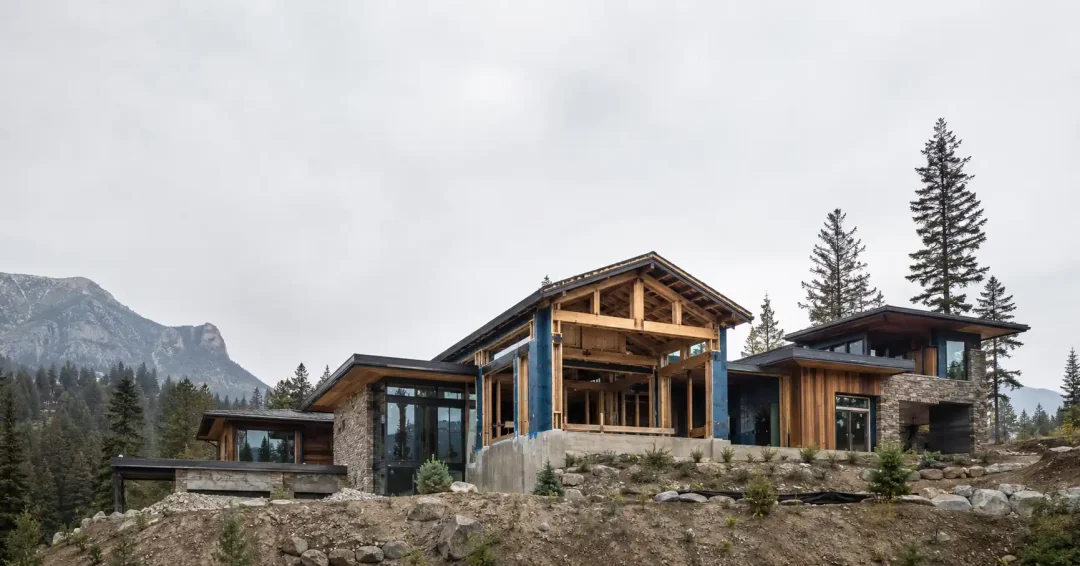
Most homeowners researching how to choose a custom home builder start in the wrong place. They compare portfolios, read reviews, and ask about square-foot pricing – reasonable questions for a production home, and largely irrelevant to a luxury custom project where the real risk isn’t whether a builder can pour a foundation. It’s whether a builder will execute your architect’s drawings as intent, or treat them as a starting point for their own preferences.
We’ve watched this distinction play out across two decades of luxury residential work, and it’s rarely visible in a first meeting. A builder can present a beautiful book of completed homes and still be the wrong choice for your project. The gap shows up eight, twelve, eighteen months in – in the framing detail that got “simplified,” the window specification that got substituted for something the builder’s usual supplier carries, the site visit that stopped happening once the walls went up.
This is the guide we wish more clients had before their first builder meeting. It covers what we actually evaluate when recommending a builder, the financial and relational signals that predict trouble before it starts, and why our involvement doesn’t end when construction begins.
The Problem With Most Builder Vetting Advice
Search for how to choose a custom home builder and you’ll find the same five items repeated across dozens of sites – check licensing, check insurance, read reviews, compare bids, ask for references. These are reasonable questions for any home. They are not sufficient questions for a $3 million to $15 million custom project, where the finished result depends on hundreds of decisions a general contractor makes without consulting you.
None of that generic advice addresses the actual failure mode we see when choosing a custom home builder for luxury work – a builder capable of building a house, but not capable of building the specific house your architect designed. Finding a luxury home builder means finding one who treats the drawings, the material specifications, and the design intent as fixed, not as a rough outline they’ll interpret through whatever their usual crews already know how to do.
That distinction is the foundation of custom home builder selection at this level. Everything below builds from it.
What We Actually Evaluate When Choosing a Custom Home Builder
Vetting a builder for a custom home means moving past the standard checklist entirely. When we’re helping a client through this process, five factors carry more weight than anything generic advice tells you to check.
- Portfolio at comparable scale and complexity. A builder with an excellent record at $2 million homes is not automatically equipped for a $9 million program. Coordination complexity, consultant management, and the sheer number of custom details scale with budget in ways that reward direct experience at your level.
- Subcontractor tier and relationships. The trades a builder can access change what’s actually buildable. A general contractor whose usual electricians have never wired a home theater or a lighting control system will either learn on your project or quietly substitute something simpler.
- Design team integration. How a builder communicates with the architect during construction tells you more than how they communicate with you. Ask directly – will they call us before making a field decision, or after.
- Site supervision frequency. A dedicated on-site superintendent who visits daily is a different commitment than a builder who checks in twice a week between other jobs.
- References from past architects, not just past clients. A homeowner can tell you whether they liked their builder. An architect can tell you whether the builder executed the drawings without being asked twice.
A Side-by-Side Comparison
The luxury home builder criteria that matter most rarely show up on a generic checklist. Here’s how they compare, side by side.
| Criterion | Standard Builder | Design-Led Luxury Builder |
|---|---|---|
| Subcontractor tier | General trades, assembled per project | Established relationships with trades experienced in custom millwork, integrated technology, and high-end finish work |
| Site supervision | Periodic visits, shared across projects | Dedicated on-site superintendent, daily presence |
| Communication with the architect | As-needed, often after a decision is already made | Built into the process, before field decisions are finalized |
| Change order process | Informal, documented after the fact | Written, priced, and approved before work proceeds |
| References offered | Past homeowners | Past homeowners and the architects who worked alongside them |
Financial Stability Tells You What References Won’t
When vetting a custom home builder, financial health is one of the least-asked questions in a first meeting, and one of the most predictive. A contractor who is slow to pay subcontractors on other projects will eventually be slow on yours, and a sub who hasn’t been paid stops showing up, which stalls your schedule regardless of how good your contract looks on paper.
Ask directly about payment terms with subcontractors, how the builder is bonded, and whether they can provide a bank or surety reference in addition to homeowner references. A builder who answers these questions without hesitation is signaling something real. One who deflects is signaling something too – and it’s worth weighing against the fuller investment picture in our guide to the cost of high-end architecture.
This is also where verifying licensing matters, particularly for clients building across state lines. Requirements vary significantly by jurisdiction, and state licensing agencies maintain direct consumer resources for confirming a contractor’s standing before you sign anything. If you’re planning a project outside your home state, this deserves particular attention – we cover the broader implications in our guide to second home planning across state lines.
Use this as your custom home builder checklist for a first or second meeting.
- Reluctance to name subcontractors, or hesitation when asked how long they’ve worked with their trade partners.
- No dedicated on-site supervisor named for a project of your scale.
- Treating drawings as flexible rather than as the agreed design to be built.
- Vague or undocumented change orders instead of a written, priced approval process.
- Resistance to architect coordination during construction, or a preference to deal with the owner directly on field decisions.
Why We Stay Involved Through Construction Administration
Most architecture firms hand off once construction documents are complete. We don’t. Construction Administration – the phase the American Institute of Architects defines as running from the start of construction through final completion – is where design intent is either protected or quietly eroded, one substitution at a time.
In practice, this means we review shop drawings, answer field questions before a builder guesses at an answer, and walk the site at the stages that matter most – framing, rough mechanical, and the finish carpentry that’s expensive to redo. A builder who welcomes this involvement is telling you something about how they see the relationship. A builder who treats it as oversight to be managed around is telling you something too.
Substitutions rarely announce themselves as substitutions. A window brand changes because a supplier had a shorter lead time. A tile pattern shifts because the original layout was time-consuming to install. Individually, each change looks minor. Across a project, they compound into a house that resembles the design rather than one that fulfills it. Staying engaged through construction is how we catch these decisions while they’re still decisions, not after they’re poured, framed, or installed.
Questions to Ask Before You Sign
Bring these directly into your builder interviews. They’re less obvious than “how long have you been in business,” and they tell you more.
- How many custom homes are you building right now? Ask who the dedicated superintendent will be for yours specifically.
- Which subcontractors will frame, run mechanical, and handle finish carpentry? Ask how long the builder has worked with each one.
- What does your change order process look like in writing? Get the approval sequence, and the pricing method, before you sign anything.
- How will you coordinate with our architect once construction starts, and how often will that happen.
- Can you provide a reference from an architect you’ve worked with on a project at a comparable scale.
Should You Find an Architect or a Builder First
Find your architect first. This isn’t a self-serving answer – it’s a sequencing question with a clear answer once you understand what an architect actually does in the builder selection process. By the time you’re vetting builders, your architect should already have helped you evaluate the site itself. We know which local and regional builders can execute at your project’s scale, we evaluate a builder’s bid against the actual drawings rather than a general impression, and we coordinate the relationship so you’re not the only checkpoint between two parties who’ve never worked together.
This is part of why we think about it as assembling a team rather than hiring in sequence. The architect who helped you settle on the right design partner is also the person best positioned to help you avoid the most common, and most expensive, custom home builder selection mistakes.
Frequently Asked Questions
Should I find an architect or a builder first?
Find your architect first. An experienced architect can evaluate builders against your actual drawings, knows which local firms can execute at your project’s scale, and coordinates the relationship so miscommunication doesn’t fall on you to resolve.
What’s the difference between a high-end builder and a custom builder?
A custom builder constructs a unique, one-off design. A high-end or luxury-tier custom home builder does that while also maintaining subcontractor relationships, supervision standards, and a change order process suited to complex, high-value work – the distinction that matters most for a luxury project.
How do I know if a builder can execute luxury finishes?
Ask to see completed, occupied homes at a comparable finish level, not renderings. Then ask which subcontractors executed the millwork, tile, and specialty finishes, and how long the builder has worked with them.
What questions should I ask a custom builder’s references?
Ask past clients how change orders were handled, whether the builder’s on-site supervisor was consistent throughout the project, and whether the finished home matched the architectural drawings. Ask past architects specifically whether the builder executed design intent without repeated intervention.
What are the red flags of a bad custom home builder?
Reluctance to name subcontractors, no dedicated on-site supervisor, informal or undocumented change orders, and resistance to coordinating directly with your architect during construction are the signals we watch for most closely.
How does construction administration protect me during the build?
Construction Administration keeps the architect involved after design is complete, reviewing shop drawings, answering field questions, and walking the site at key stages so substitutions and deviations get caught while they’re still easy to correct.
Do I need a different builder for each state I build in?
Not necessarily, but licensing requirements and builder availability vary significantly by state. This is a key part of what we help evaluate when planning a second home in a different state.
The Builder Is the Last Decision, Not the First
Custom home builder selection isn’t a task to complete before design starts. It’s a decision best made once your architect understands your project well enough to evaluate builders against it, not against a generic checklist. The criteria that matter – subcontractor tier, financial stability, site supervision, and a builder’s willingness to work alongside your architect through construction – rarely surface in a first meeting on their own. They surface when someone asks the right questions.
That’s the role we play, from land acquisition and design development through the final walkthrough. If you’re evaluating builders now, or want a second opinion before you sign, we’d welcome the conversation.
Ready to talk through your builder selection?
Schedule a consultation and we’ll help you evaluate the right team for your project, from land through construction administration.