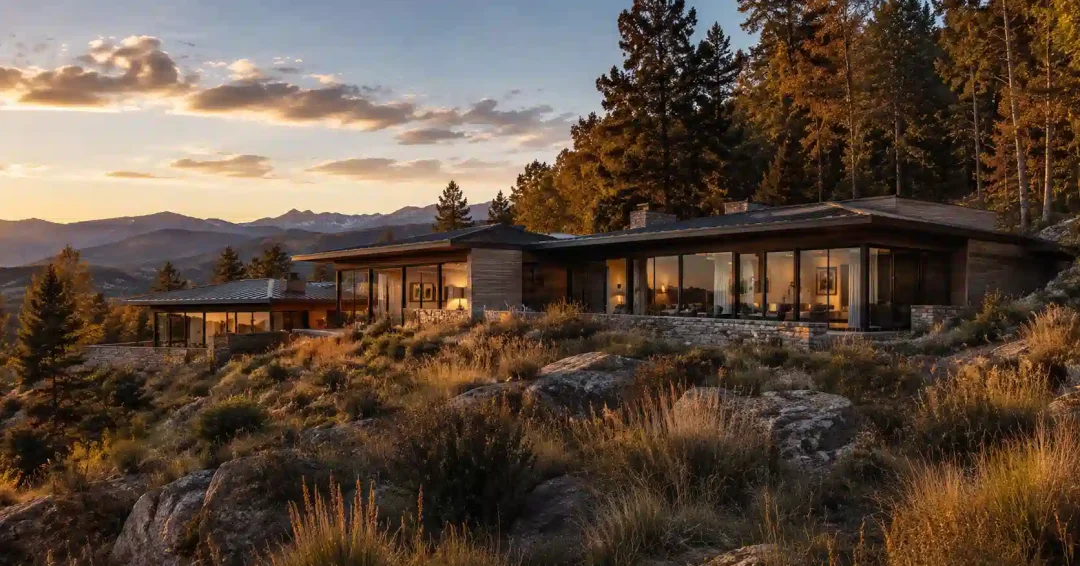
There’s a version of this conversation we have often. A client calls, they’ve found a parcel, they’re excited, and they want to start designing. Then we pull up the topographic data. The slope runs the wrong direction for the view they’re imagining. There’s a creek setback that eliminates a third of the buildable area. The utility situation – power, water, septic – will add well over $200,000 before we draw a single line. Nobody told them any of this when they were buying land to build a house, because nobody on their team was looking for it.
That’s the gap this piece addresses. Not how to buy land in general – there’s plenty written about that – but how the search looks different when an architect is part of it from the beginning. The site you choose is, in a real sense, the first design decision of your custom home. It sets constraints you’ll live with for decades. Getting eyes on it before you make an offer is worth considerably more than most buyers realize until after closing.
Why the Land Search Is a Design Decision
The standard sequence goes: find land, hire architect, design home. It’s intuitive. It’s also backwards.
What we see when clients arrive with land already under contract is a set of fixed conditions we’re now designing around rather than with. A north-facing slope. A setback line that kills the primary suite view. A ridgeline neighbor who built last year and is now directly in the sight line from the site’s best position. None of these are fatal, individually. But they compound – and they were all discoverable before the purchase. The client just didn’t know to look, and their realtor wasn’t looking for those things either.
The alternative is treating the site search as Phase One of the design. Before an offer is made, we want to know what the land will allow, what it will cost to make it buildable to the standard we’re working at, and whether the site’s natural assets line up with what the client actually wants to build. That’s a design conversation, not a real estate one.
Realtor-Led Search vs. Architect-Led Search
Both matter. A good realtor knows the market in ways we don’t – pricing, timing, seller dynamics, comparable transactions. What they’re not looking for is sun path. Or how the drainage will behave in a heavy rain year. Or whether a county overlay district is going to cut the buildable footprint in half. That’s not a criticism of realtors. It’s just a different professional lens.
| Dimension | Realtor-Led Search | Architect-Led Search |
|---|---|---|
| Primary lens | Price per acre, comp sales, market position | Topography, orientation, site potential, buildability |
| Tools used | MLS listings, comps, local market knowledge | Topographic mapping, sun-path analysis, zoning review, utility assessment |
| Typical blind spots | Grading complexity, view-shed encroachment, solar orientation, drainage | Negotiation leverage, market timing, comparable pricing |
| Red flags missed | Hidden site-prep costs, setback constraints, utility extension scope | Seller relationship context, local market dynamics |
| Outcome risk | Design constraints discovered post-purchase; site-prep budget surprises | Overpaying without market anchoring |
The searches that go best are ones where we’re working alongside a client’s realtor, not replacing them. The feedback loop before an offer tightens considerably when both perspectives are in the room. The surprises after closing – the expensive kind – drop off sharply.
Where We Start – Geography and Market Filters
“Colorado” is not a site brief. Neither is “somewhere in the Hamptons” or “mountain modern, probably Utah.” Those are starting points for a conversation we need to finish before a site search begins in earnest.
For the second and third home projects that make up most of our work, the location question carries more weight than clients often expect at the outset. A family that spends two weeks per year at a ski retreat needs a different site than one that’s there for six weeks across two seasons, with kids who need proximity to certain infrastructure. Getting specific about actual use patterns changes the geography search significantly.
The filters we work through:
- Proximity to the right resort or community infrastructure – Ski access, water access, private aviation, medical, private school, or hospitality amenities all shape where a home actually gets used versus where it sits. Silo Ridge in the Hudson Valley is a useful example – parcel selection there is inseparable from how the community itself functions, and buyers who don’t factor that in often end up with a site that doesn’t serve how they actually live.
- View corridor priority and permanence – A view is worth what it will be in 20 years, not what it is today. We look at how surrounding parcels are zoned, what can go up on the adjacent ridgeline, and whether a view that’s selling the land right now is legally protected or just currently empty.
- Solar orientation relative to climate – This one surprises people. A south-facing slope in a ski market captures passive heat and morning light in the primary suite. The north-facing equivalent can mean shadow patterns across the main living spaces from October through April – a home that fights its climate rather than working with it. Those are real livability and operating-cost consequences.
- Access and road infrastructure – In mountain and rural resort markets, road situation matters more than clients expect. Year-round access, construction access for cranes and concrete trucks, maintenance responsibility in snow years – a parcel that looks ideal on a map can have a road situation that adds cost, timeline, or ongoing friction that wasn’t in anyone’s initial calculation.
- Utility availability and extension cost – Well and septic versus municipal connection, propane versus gas, the distance to the nearest power connection on a remote parcel. In some resort markets, extending utilities to the building site runs $150,000 or more before a single design decision is made. That number needs to be in the land-search calculus, not discovered afterward.
What Makes a Parcel Genuinely Buildable
“Buildable” isn’t a binary. Every parcel can be built on at some price. The question is what it costs to build what you actually want, at the quality level you’re working at, on that specific site.
We’ve built homes on sites that other architects declined to touch – steep grades, rocky outcroppings, heavy tree canopy, complex drainage. Some of those turned out to be the most architecturally powerful projects we’ve done, because the site’s difficulty was also its character. But that calculation only works if you go in knowing what the site will demand. Surprises in this category are almost always expensive.
What we’re evaluating:
- Topographic complexity and grading requirements – Flat land is cheaper to build on. It’s also less interesting architecturally. Sloped parcels introduce retaining walls, cut-and-fill grading, foundation complexity – but they open up multi-level design, walk-out levels, and views that a flat site simply can’t produce. A site that adds $300,000 in grading may still be right if it yields the home the client has been imagining. The key is knowing that number before the offer, not after the closing.
- Soil conditions and bearing capacity – Rock requires blasting or specialized foundation systems. Clay requires engineered drainage. Both are knowable with the right pre-purchase due diligence. Both directly affect foundation budget and timeline.
- Zoning, setbacks, and height limits – The legal buildable envelope is defined by local zoning, not by what the land looks like physically. We review zoning classifications, minimum setbacks from property lines and water features, maximum lot coverage, and overlay districts – scenic, historic, floodplain. A generous-looking parcel can have a buildable footprint far smaller than it appears.
- Tree protection and preservation requirements – In a number of the markets we work in, existing tree canopy carries legal protection. Removing trees for grading or construction requires permits, sometimes mitigation plantings, occasionally fines. We map protected tree zones early because they directly shape where the home can sit and how the approach and exterior circulation are designed.
- Water features and environmental buffers – Streams, wetlands, and shoreline carry state and federal setback requirements that often run 50 to 100 feet from the water feature. A parcel with a beautiful creek through it may have a no-build buffer that eliminates the exact area where the home would naturally want to go. Better to know that before the purchase than after.
The Site Prep Cost Reality
The most consistent land-search mistake we see – not occasionally, but constantly – is evaluating parcels on acquisition price without accounting for site-ready cost. A $500,000 parcel that needs $350,000 in grading, utility extension, and site preparation is a more expensive starting point than a $700,000 parcel that needs $80,000 in site work. The sticker price doesn’t tell the story.
What goes into site preparation on a luxury custom home project:
- Grading and earthwork – Slope regrading, pad cutting, drainage management. On complex mountain or hillside sites, this runs $100,000 to $400,000 depending on scope and how difficult the site is to access with equipment.
- Utility installation and extension – Power, water, sewer or well and septic, telecommunications. In remote resort markets, this line item is often one of the largest in the pre-foundation budget.
- Access road construction – When a parcel doesn’t have adequate road access, building one is a site cost. Culverts, drainage, surface preparation for construction traffic – none of that is cheap in mountain terrain.
- Environmental mitigation – Erosion control, stormwater management plans, wetland mitigation where required, replacement planting. Environmentally sensitive parcels carry regulatory compliance costs that belong in the pre-offer estimate.
Running through that full calculus before an offer is placed is a core part of what evaluating a parcel means in practice – and it changes the negotiation conversation entirely when you know the real number going in.
The Architect’s Network and Off-Market Parcels
After twenty years in resort and second-home markets – the Hamptons, Park City, Nashville, the mountain west, the Caribbean – we know people. Land brokers who call before something lists. Civil engineers who’ve worked every buildable acre in a market and know which ones are genuinely worth the trouble. Developers who are assembling communities and have parcels they haven’t announced yet. That network is real, and it surfaces opportunities that never reach Zillow.
We don’t lead client conversations with this. It’s not a pitch. But when a client has a clear picture of what they’re looking for – a ridgeline parcel with southwest exposure in a ski market, or a waterfront acre with specific view orientation and boat access – the quieter path through trusted relationships is often faster than a public search, and considerably more discreet.
Privacy matters here in ways that are easy to underestimate. A publicly broadcast site search in a tight resort market announces a buyer’s interest, often to sellers who will price accordingly. A search through trusted professional relationships keeps that information contained. It’s connected to why the land acquisition process itself – not just the search – benefits from discretion and trusted relationships at every stage.
How to Engage an Architect When Buying Land for a Custom Home
The right moment is before you’ve identified a parcel you want to buy. Earlier than most clients expect. We hear often that someone feels they’re “not ready” for an architect because they don’t have land yet – but that’s precisely when architectural input is most useful. Once a parcel is purchased, the questions change from “should we buy this?” to “what do we do now that we have it?”
A preliminary site assessment – pulling topographic data, reviewing zoning classifications and utility records, looking at aerial photography – can happen before a site visit. When the visit happens, it’s structured and specific rather than impressionistic. You leave knowing what the parcel can become, what it will take to get it there, and whether those numbers work for the project you’re planning.
Resources like the USGS National Topographic Maps program give a baseline read on slope, drainage, and elevation. The American Planning Association publishes guidance on how zoning frameworks operate across jurisdictions. Both are useful starting points – but reading what topographic conditions mean for a specific home program, or applying zoning constraints to a specific design vision, is where the architectural judgment comes in.
Early engagement also shapes planning your second home at the program level. The conversation about how the home should function – how many people it hosts, what the lifestyle drivers are, how it fits into the family’s broader property portfolio – can start while the site search is still underway. The program is ready to meet the land the moment a parcel is identified, rather than starting from scratch after closing.
Understanding the cost of custom architecture before land is purchased is the clearest way to calibrate site budget against home budget. We work across a range of markets, and what a dollar buys in site work varies significantly from one to the next.
Ready to start the land search conversation?
We work with clients at the earliest stage of a custom home project – before land is identified, and certainly before any offer is made. If you have a market in mind, a site type you are drawn to, or simply a home you have been imagining for a long time, that is enough to begin.
Reach out to the studioPre-Offer Land Evaluation Checklist
Before making an offer on any parcel for a luxury custom home, confirm you have answers to the following:
- Zoning classification confirmed, with setback and height limits reviewed
- Topographic mapping reviewed for slope, drainage patterns, and grading scope
- Solar orientation assessed relative to planned living spaces and climate
- View corridor verified for permanence – adjacent parcel zoning reviewed
- Utility situation confirmed – connection type, extension distance, estimated cost
- Access road assessed for year-round use, construction access, and maintenance responsibility
- Environmental buffers identified – streams, wetlands, floodplain, shoreline setbacks
- Tree protection reviewed under applicable local ordinances
- Total site-ready cost estimated before offer, not after closing
- Architect’s preliminary assessment completed on topography and buildability
The Relationship Between Site and Design
Some of the homes we’re most proud of started on sites that other firms walked away from. Grades too steep, too rocky, too exposed. What those firms saw as problems, we saw as material – a slope that forces a more interesting floor plate, outcroppings that become part of the structure rather than obstacles to clear, a wind exposure that required a building orientation that turned out to be architecturally superior to the obvious one.
That’s not a philosophy. It’s just what happens when site and design are treated as one project instead of two. Our luxury residential architecture practice starts from the premise that the land doesn’t constrain the home – it informs it. The floor plate, the orientation, the material choices, how indoor and outdoor living connect. When we know the site early, those relationships become opportunities. When the site is a fixed given, they become workarounds.
The full picture comes together in the master planning phase – site through architecture, interiors, and landscape as a coherent whole. But that whole starts with the land. And the land starts with the search.
Frequently Asked Questions
Is it better to hire an architect before or after buying land?
Before, in most cases. An architect evaluates topography, buildability, site-preparation costs, and design potential before an offer is made – information that changes the negotiation and prevents the post-purchase surprises that are most common in luxury custom home projects. Once land is purchased, those conversations shift from “should we buy this” to “what do we do with what we have.”
How do I find off-market land for a luxury custom home?
Working with an architect who has established relationships in your target markets is one of the more reliable paths. Firms operating at the luxury level in resort and second-home markets maintain connections with land brokers, civil engineers, and developers who know about parcels before public listing – and a quiet search through those relationships is often faster and more discreet than an open market search.
What makes a lot “unbuildable” for a custom luxury home?
Very few parcels are truly unbuildable – almost anything can be built on at some price. The real question is what it costs to build what you actually want on that site. Zoning setbacks, environmental buffer requirements, extreme grading scope, and utility extension can all make a parcel far more expensive to develop than its acquisition price suggests. A pre-offer site assessment puts real numbers on those costs before you’re committed.
Can an architect help find land for a custom build?
Yes. Many architects working at the luxury residential level are actively involved in land-search – providing topographic assessments, buildability reviews, and access to off-market parcels through professional networks. This is especially true for studios with long track records in resort and second-home markets, where relationships with land brokers and developers run deep.
How much should I budget for site prep on a mountain or resort lot?
It varies considerably by topography, utility situation, and access. In mountain and resort markets, site preparation budgets of $150,000 to $400,000 are not unusual on complex parcels. The only reliable way to get an accurate number before purchase is a pre-offer assessment that looks at grading scope, utility extension distance, and access road requirements together.
What should I look for when buying land to build a luxury home?
Solar orientation, view corridor permanence, zoning and setback constraints, topographic complexity and its grading cost implications, utility availability and extension cost, access road conditions, and environmental buffer requirements. Every one of those carries design and budget consequences – and all of them are far easier to understand before purchase than after.