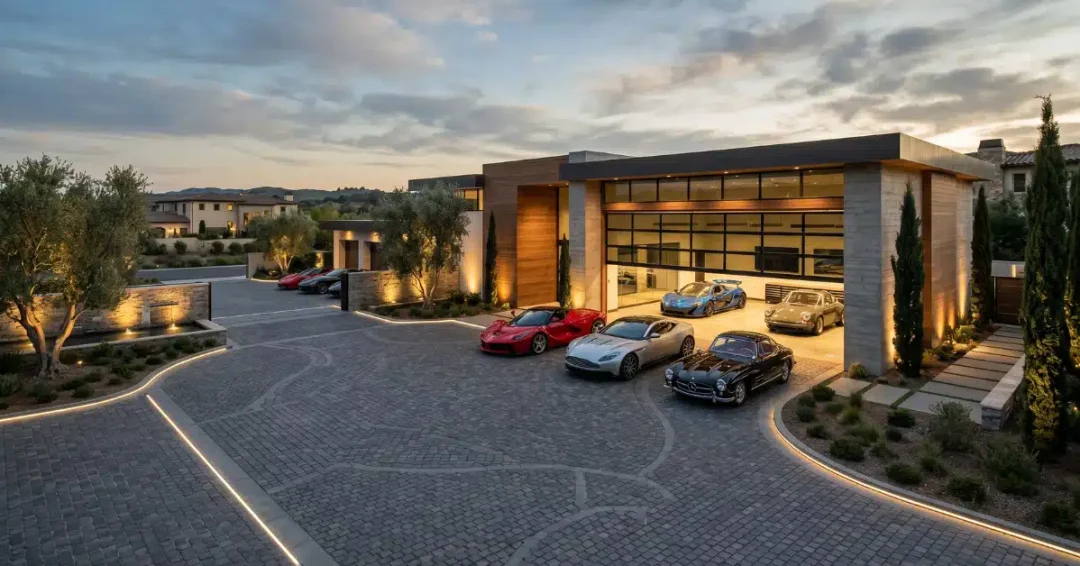
Your car collection tells a story about who you are. Each vehicle - a fully restored 1965 Shelby, a track-prepped McLaren, a weekend touring bike - represents a decision made with intention. Yet most luxury homes treat the car collection garage as an afterthought. Four walls, a concrete floor, and a door that opens. The cars deserve better than that - and so does the property. If you are exploring garage design ideas that actually match the level of the collection, this is where to start.
I've spent years working with clients who are serious collectors. What I've come to understand is that the car collector garage is one of the most misunderstood opportunities in residential architecture. Done well, luxury garage design and a thoughtfully composed motor court become an extension of the home's identity - a private venue that happens to house some of the world's finest machines.
This guide covers what actually separates a functional storage space from an architectural statement - and how our residential design expertise approach every element: from motor court approach sequences to interior finishes, climate systems, lighting philosophy, and the way great garage design connects to the rest of the residence.
Why Most Car Collector Garages Fall Short
There's a distinction worth making early. A garage designed for a car collector is not a large garage. It's an entirely different typology.
Standard residential garages are engineered around clearance minimums and code compliance. Width, height, turning radius - everything is calibrated to hold the average vehicle at the lowest construction cost.
That logic produces spaces that feel institutional. They don’t honor the objects inside them.
High-performance collectors understand what their vehicles are worth - which is exactly why the car collector garage they live in matters so much - not just financially, but experientially. A 1962 Ferrari 250 GTE that sits in a climate-uncontrolled space with fluorescent lighting and a painted concrete floor is having its story diminished. The environment contradicts the object.
The architectural challenge - and the opportunity - is to create a space that operates on the same level of intention as the collection itself. That means thinking about motor court design, interior architecture, systems infrastructure, and the experiential sequence from the moment a guest or owner arrives.
The Motor Court: First Impressions and Arrival Choreography
Before anyone enters the garage, they move through the motor court. This arrival space deserves far more design attention than it typically receives.
A well-conceived motor court is not just a hardscaped turnaround area. It's a threshold - the transition from the public world to the private one. It sets tone. It communicates the level of care and aesthetic commitment that lives inside the home.
Several elements define a motor court that actually works:
- Geometry and proportion: The court should have enough depth for vehicles to maneuver without feeling constrained, but intimate enough that it doesn't feel like a commercial parking area. For four-car garages and above, a minimum court depth of 60 feet creates the right spatial experience without excess.
- Material palette: Bluestone, granite sets, large-format concrete pavers, or custom-blended asphalt can each work beautifully depending on the home's architectural language. The hardscape palette should coordinate with the broader high-end landscape design strategy for the property. The material choice should respond to the residence - never feel imported from a different aesthetic tradition.
- Drainage and grade: Water management in motor courts is frequently underthought. A collector who drives a vintage vehicle in light rain should not encounter standing water on the approach. Properly integrated linear drains and thoughtful grading solve this silently and permanently.
- Lighting hierarchy: Low bollard lighting, in-ground fixtures, and wall-mounted sources should illuminate the court without creating harsh pools. The same principles from landscape lighting design apply directly to motor court specification. The goal is to see the vehicles and the space - not to flood the environment with light.
- Perimeter definition: Walls, hedging, low masonry - some form of boundary creates enclosure and privacy. The court should feel held, not exposed. For properties where discretion is essential, see our approach to architectural privacy design.
Motor Court Design Checklist
- Minimum 60 ft court depth for four-car garages and above
- Material palette responds to the home's architectural language
- Linear drains integrated for water management on approach
- Layered lighting: bollards, in-ground, and wall-mounted
- Perimeter defined by walls, hedging, or low masonry
- Approach sequence designed for arrival experience - not just access
- Coordinated with driveway grade and entry visibility
The approach to the motor court matters as much as the court itself. Everything outside the garage door shapes the experience of arriving at a car collector garage. A winding, tree-lined drive that reveals the home gradually creates a completely different experience than a straight shot from the street. Both can work architecturally, but the arrival sequence shapes how the collector - and their guests - feel before they've even stepped out of the car.
Interior Garage Designs for the Serious Collector
When custom garage interior ideas are executed well, the space reads as architecture. When it's executed poorly, it reads as a showroom trying too hard. The distinction matters most in a true car collector garage - one that has to work architecturally around some of the most visually demanding objects in the world.
The distinction comes down to restraint and material quality. A well-designed collector's garage doesn't announce itself. It presents the vehicles without competing with them.
For collectors researching luxury garage ideas and modern garage design ideas, the floor gets the most attention. And floor systems are where most collectors begin their thinking, rightly so. Polished concrete, large-format porcelain tile, and sealed epoxy systems each have legitimate applications. Polished concrete ages gracefully and works well with contemporary architecture. Porcelain tile in large formats - 48x48 or larger - creates a surface that approaches showroom quality while being more practical for active use. Epoxy systems have improved dramatically, particularly the metallic formulations, and can produce remarkable visual results.
| Floor System | Best For | Durability | Heat Compatible |
|---|---|---|---|
| Polished Concrete | Contemporary architecture | High with sealing | ✓ Yes |
| Large-Format Porcelain | Showroom-quality finish | Very high | ✓ Yes |
| Metallic Epoxy | Visual impact, active use | High (chemical resistant) | ✓ Yes |
| Sealed Epoxy (Matte) | Working/maintenance zones | High | ✓ Yes |
What the floor system must accomplish, beyond aesthetics:
- Chemical resistance: Oil, brake fluid, and cleaning agents will contact the floor. The finish needs to hold.
- Slip resistance when wet: A beautiful floor that becomes hazardous in rain is a liability.
- Heat compatibility: If in-floor radiant heating is installed - and for a serious collector's space, it should be - the floor system must be compatible with the thermal cycling involved.
- Repairability: High-use floors will see wear. The system should allow for isolated repair without a visible patchwork result.
Wall systems are where most car collector garage designs lose the plot. The default - drywall with a white paint coat - produces a space that looks like a rented storage unit. Purpose-built wall paneling systems, architectural aluminum cladding, full-height glass partitions for workshop separation, or carefully detailed masonry can all lift the quality of the experience significantly. The wall finish decisions connect directly to the broader luxury interior design language of the residence.
Climate Systems Every Car Collector Garage Needs
A serious car collection represents significant capital. Beyond the financial dimension, these are often irreplaceable objects. The environmental systems in the garage are not optional features - they are the primary protection layer for everything stored inside.
Climate control in a car collector garage has two distinct objectives that must be balanced. The first is maintaining stable temperature and humidity to protect paint, interiors, rubber, and mechanical systems from degradation.
The second is providing comfort for the people who spend time in the space - and for a collector who loves their cars, that time can be substantial.
For humidity control in a car collector garage, the target range for vehicle storage is 40-50% relative humidity. This aligns with guidance from vehicle storage specialists who study long-term preservation conditions. Fluctuation above 60% creates conditions for corrosion, mold in fabrics, and paint damage over time. Below 30%, rubber seals and gaskets dry faster than they should. A dedicated dehumidification system - not a whole-home system that may or may not reach the garage effectively - is worth the investment at this level.
Other systems that belong in any serious collector's garage:
- In-floor radiant heating: The most comfortable and uniform heat source available. Eliminates the temperature stratification that forced-air creates and keeps the floor surface at a usable temperature in winter months.
- Vehicle lifts: Two-post and four-post lifts require specific structural considerations - floor thickness, reinforcement, and clearance height. These decisions must be made in the design phase, not after the slab has been poured.
- Compressed air and electrical service: 200-amp dedicated service is a baseline for a working collector's space. Air drops at calculated intervals and 240v outlets for EV charging and compressors should be designed into the layout from the start.
- Security systems: Motion detection, high-definition cameras with off-site storage, and access control that logs entry are standard at this level. Integration with the home's primary security infrastructure creates a unified system rather than a parallel one. Our guide to luxury home security design covers the full architecture.
- Fire suppression: A wet-pipe sprinkler system is not exciting, but a fire in a garage with irreplaceable vehicles is catastrophic. This is non-negotiable.
Ventilation is also critical - not just for air quality but for managing the fumes that come with a working garage environment. A dedicated exhaust system that activates with vehicle startup, combined with fresh air intake, creates a healthy environment and protects the finish work from long-term contamination.
Lighting Design: The Detail That Changes Everything
Lighting in a car collector garage is where most projects either become exceptional or settle for adequate.
The fundamental challenge in garage lighting is that the space serves multiple purposes that have competing requirements. You need broad, even illumination for general use and maintenance work.
You also need focused task lighting for detail work and inspections. And you need a lighting mode that presents the vehicles the way they deserve to be seen - which is not under fluorescent strips.
Modern garages designed for collectors use a layered lighting approach:
- Architectural ambient lighting: Cove lighting, indirect LED systems, and perimeter sources create a base level of illumination that fills the space evenly without harsh shadows.
- Task lighting: High-output LED strips above work areas and at vehicle lift zones, addressable independently from the ambient system.
- Accent lighting: Carefully positioned spotlights or floor-level lighting that highlights specific vehicles. The best collector's garages treat each parking position as a display opportunity.
- Color temperature control: The ability to shift between warm (3000K) and cooler (4000-5000K) temperatures changes the entire character of the space and how vehicles read visually. Programmable lighting systems make this adjustable.
One detail I pay particular attention to in every car collector garage: avoid lighting that creates reflections on horizontal surfaces at eye level. A vehicle's hood is essentially a mirror. Poor lighting placement creates hot spots and distracting reflections that diminish the viewing experience rather than enhancing it.
The Relationship Between the Garage and the Home
Here is where car collector garage design becomes residential architecture in the fullest sense.
The garage is often physically and visually separate from the main house. That separation can feel like disconnection or it can feel intentional - a private world within the larger property. The right answer depends entirely on the client, the collection, and what role the garage plays in their life.
Some collectors want a direct, sheltered connection from the primary residence to the garage. This is particularly relevant in climates with harsh winters or for clients who use the garage daily. A covered breezeway or interior connection accomplishes this while maintaining the distinct identity of each space.
Others want the garage to stand on its own - a pavilion, essentially, that can be opened to guests for events, car shows, or informal gatherings. In this configuration, the garage takes on some of the qualities of an entertainment space. Wet bars, lounge seating, a screen for viewing races - these become part of the program.
The façade of the car collector garage matters enormously. A collector's space should not read as an appendage to the house - it should read as part of the same architectural intention. Garage door selection is one of the most impactful decisions in this regard. Full-height glass doors in aluminum frames, custom wood doors, or architecturally designed panel systems all create a very different first impression than the builder-grade sectional doors that come standard. The door system is one element we cover in depth in our full design process.
Car Collector Garage Layout: Designing for Experience
The floor plan of a car collector garage should start with how the collector actually interacts with their vehicles - not with how many cars need to fit. This is where most garage design ideas fall short: they optimize for capacity when the real goal is experience.
Every private car collection has its own logic - vehicles acquired for different reasons, used at different frequencies, displayed with different priorities. There is a meaningful difference between a garage designed for storage and one designed for engagement. A storage-oriented layout maximizes capacity. An engagement-oriented layout prioritizes access, viewing angles, the ability to take a vehicle in or out without repositioning others, and the experience of being in the space - which is the entire point of a great car collector garage.
For most serious collectors, a hybrid approach serves best:
- A defined display zone: Two to four spaces - often with vehicle lifts - that hold the most significant pieces. These cars may not move frequently but should be viewable and accessible. The display principles that apply to rare collection display design translate directly to this zone.
- A working zone: One to two spaces with overhead lifts, tool storage, and adequate workspace for maintenance, detailing, and mechanical work.
- A rotating collection zone: Spaces for vehicles in active rotation that need to be accessed easily without a complex repositioning sequence.
Circulation patterns matter as much as the individual zones. A collector should be able to move through the space naturally - approaching each car from a viewing distance before getting close, moving around vehicles without squeezing between bumpers, and accessing the workspace without crossing through the display area.
Working with an Architect: What the Process Actually Looks Like
Clients who are planning a car collector garage or motor court for the first time often underestimate the complexity of the project - and overestimate how standard the decisions are. This is not a garage addition. At this level, it's a building.
The design process for a serious car collector garage typically spans six months to a year from initial conversations to construction documents. For an overview of how that unfolds, see our architecture consultation process. Several phases matter:
Programming: Before anything is drawn, we spend time understanding the collection - current and future. How many vehicles? What types? Which see daily use? Which are stored long-term? Is there a workshop dimension to the owner's engagement with cars? Will the space need to accommodate guests?
Site analysis: The garage's relationship to the main house, the driveway approach, the orientation of light, views from the house toward the garage - these site conditions shape the design far more than most clients expect at the outset.
Systems coordination: Mechanical, electrical, plumbing, and structural engineers need to be part of the process early. The structural requirements for vehicle lifts, the mechanical load of climate systems, and the electrical demands of a working car collector garage space are significant. These cannot be solved after the architecture is set.
Material selection: Floor systems, wall cladding, door systems, glazing - the material choices in a garage designed at this level are as involved as the decisions for the interior of the main house. Mock-ups and samples are worth the time. This phase also includes FF&E specification for the lounge, workshop, and display areas.
The builder selection also matters significantly. A car collector garage of this complexity requires a contractor with experience in exacting concrete work, high-end finish systems, and the coordination of specialized subcontractors. The wrong builder will cost more than their initial bid suggests.
Frequently Asked Questions
What is the ideal ceiling height for a car collector garage?
For a car collector garage with vehicle lifts, a minimum clear ceiling height of 14 feet is required. Lifts that can raise a vehicle high enough for comfortable work underneath need 12 feet at a minimum, but 14-16 feet provides the clearance for taller vehicles and more comfortable overhead access. If car stacking systems are planned - which can effectively double capacity in the vertical dimension - ceiling heights of 18-20 feet become necessary. The ceiling height decision needs to be made before structural drawings are completed.
How much does a luxury garage and motor court design typically cost to build?
Construction costs for a purpose-built collector's garage vary widely based on size, systems complexity, and finish level. For broader context on what drives pricing at this tier, see our breakdown of high-end architecture costs. A well-designed four-car garage with climate systems, quality finishes, and integrated lighting typically runs $400-800 per square foot in most U.S. markets, not including the motor court. At the high end - full climate systems, vehicle lifts, showroom-quality finishes, and architectural façade work - budgets above $1 million for the garage building alone are not uncommon. Motor court costs depend heavily on material selection and square footage but should be accounted for separately in initial budget discussions.
What are the best luxury garage ideas for floor systems?
The right floor system depends on usage patterns and aesthetic priorities. Polished concrete works well in contemporary architectural contexts and ages gracefully with proper sealing maintenance. Large-format porcelain tile - particularly 48x48 and larger - provides a high-end appearance and exceptional durability. Metallic epoxy systems can produce visually dramatic results and are chemically resistant, but require more careful specification to avoid slip hazards when wet. For active maintenance spaces, a matte or satin finish performs better than high-gloss systems that show every imperfection. All systems should be compatible with in-floor radiant heating if that system is planned.
Should a car collector garage connect to the home or stand alone?
Both configurations work well when designed with intention. A connected garage - whether through a direct door, covered breezeway, or enclosed passage - is more convenient for daily use and in cold climates. A freestanding pavilion creates more flexibility for how the space functions, particularly if entertainment use is planned. The architectural treatment of the connection, or the separation, matters as much as the decision itself. A poorly detailed breezeway diminishes both buildings. A beautifully composed freestanding garage becomes an asset to the overall property.
How do I plan for future additions to my car collection?
The most important planning decision for a growing collection is designing for expandability from the start. This means oversizing the electrical service so that future charging stations or equipment don't require a panel upgrade. It means pouring slabs with adequate thickness and reinforcement to support lifts at any position, even if lifts aren't installed immediately. And it means leaving physical space in the building footprint - or designing the structure so that an addition doesn't compromise the architecture of the original. The cost of planning for flexibility in the design phase is negligible compared to the cost of retrofitting for it later.
What security systems are appropriate for a high-value car collection?
A layered security approach is appropriate at this level. The outer perimeter - the motor court and driveway - should have motion-activated lighting and camera coverage that integrates with the home's broader security system. The garage itself needs access control that logs entry, high-definition interior cameras with off-site redundant storage, and motion detection that distinguishes between a person entering and environmental triggers. For collections with significant value, a direct alarm connection to a monitoring service with a rapid response protocol makes sense. Some collectors also use GPS tracking devices integrated discreetly into the most valuable vehicles.
How do vehicle lifts affect car collector garage structural design?
Two-post lifts create point loads that require specific slab thickness - typically 6 inches minimum with appropriate reinforcement at the lift anchor positions. Industry lift installation standards provide additional technical guidance on load requirements. Four-post lifts distribute load more broadly but still require structural review. If vehicle stacking systems are considered, the structural requirements increase substantially and should be engineered for specifically. The critical error is specifying lifts after the slab is poured - retrofitting an inadequate slab for lift installation is expensive and in some cases impossible. Lift positions should be fixed in the architectural drawings and engineered accordingly before construction begins.
What role does natural light play in car collector garage design?
Natural light, when managed well, dramatically improves the experience of a car collector garage. The same principles detailed in our post on natural light in architecture apply here. North-facing clerestory windows provide even, consistent light that doesn't create harsh shadows or heat gain. East and west-facing glazing should be designed carefully to avoid direct sun angles that wash out paint color and create difficult viewing conditions. South-facing glazing works well in controlled doses with the right solar control glass. The goal is to bring daylight into the space without creating the glare, heat, and UV exposure that damage both vehicles and finishes over time. Automated shading systems can manage the variation across seasons effectively.
The Standard a Car Collection Deserves
A collection built with real discernment - vehicles chosen for their design, their provenance, their mechanical character - deserves a home that reflects the same level of consideration. Not a warehouse. Not an upgraded residential garage. A properly conceived car collector garage - one where luxury garage design principles guide every decision from the motor court approach to the floor finish - becomes an architectural space that honors what's inside it.
That standard is achievable. It requires the right team, a realistic budget conversation, and a process that begins with understanding rather than assumptions. The motor court, the structure, the systems, the finishes, the lighting - when these elements are resolved together, the result is a space that adds to the story the collection tells rather than contradicting it.
If you're planning a car collection garage or motor court for a serious collection, the conversation should start well before a shovel hits the ground. Reach out to Ralston Architects via our start a design inquiry to discuss what that process looks like for your property and your cars. You can also explore our luxury residential portfolio to see completed projects.