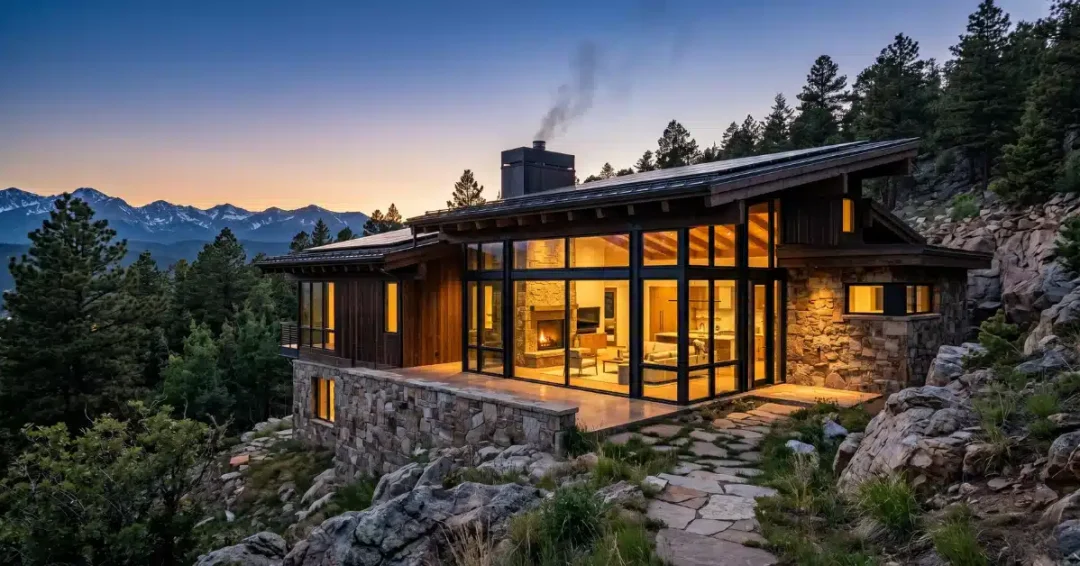
Mountain modern architecture in Colorado is a category that gets borrowed loosely - applied to homes with exposed beams, a few stone walls, and large windows pointed at a ridge. What it actually means, when executed with full understanding of what building at altitude demands, is something far more specific. I've spent years designing modern mountain homes above 8,000 feet, and the single thing that separates genuine high-altitude design from standard residential work dressed in mountain aesthetics is this: the environment is not a backdrop here. It is a participant in every decision.
This guide covers the real technical and design distinctions that define Colorado mountain modern home design at elevation - the engineering demands, the passive systems that actually perform, the material science that holds at altitude, and the client experience that shapes why these homes are built in the first place.
Why High Altitude Rewrites the Rules of Mountain Modern Home Design
Most clients arrive at a Colorado mountain site with expectations formed at sea level. The first thing a serious mountain modern architect does is recalibrate those expectations against physics.
Concrete takes approximately 50% longer to cure at 8,000 feet than at sea level - thin air slows the chemical reaction that gives concrete its structural strength. HVAC systems must be sized roughly 20% larger to compensate for reduced air density. According to the American Society of Civil Engineers, UV radiation intensity increases roughly 10 - 12% per 1,000 feet of elevation gain, meaning exterior materials degrade at a rate that would be unrecognizable to a builder working at lower elevations.
These are not minor adjustments. They are wholesale revisions to every material decision on the project.
Snow load tells the same story. Summit County, Colorado carries ground snow load values exceeding 150 pounds per square foot in certain zones. Denver's equivalent is 30 psf - a fivefold difference that drives an entirely different roof structural system. The angle, framing depth, connection hardware, and overhang geometry all change when you're designing a mountain modern home in Breckenridge at 9,600 feet, or Telluride at 8,750 feet, or Aspen at 7,908 feet.
What surprises clients most is thermal cycling. Colorado mountain zones regularly see diurnal temperature swings exceeding 40°F in a single day. Every joint, every seal, every material transition expands and contracts repeatedly. At altitude, detail errors surface within a few winters.
What a Colorado Mountain Modern Architect Actually Designs For
The distinction between a mountain modern architect with real Colorado altitude experience and one who applies good residential design to a mountain site comes down to four specific technical domains that simply don't exist in standard residential practice.
Structural engineering for real snow and wind loads. Modern mountain home architecture at altitude requires structural engineers who understand ASCE 7 mountain loading requirements and the local amendments that overlay them in Colorado's resort counties. Roof framing systems must account for uniform snow loads, drift accumulation from wind scour, and unbalanced loading conditions. Standard residential structural framing doesn't address these - and roof failures in mountain homes almost always trace to a structural specification borrowed from a lower-elevation project. Our luxury residential design process builds this engineering coordination in from day one.
Glazing for altitude-specific physics. Insulated glass units face pressure differentials at Colorado elevations that can cause seal failures and reduce thermal performance when standard sea-level-rated products are installed. Triple-pane, altitude-rated glazing with appropriate gas fills and pressure-equalized spacers isn't an upgrade in a modern mountain home - it is baseline specification.
Thermal envelope performance in dry, high-UV conditions. Colorado mountain climate is a dry, deeply thermal-cycling environment where insulation must be specified for radiant gain alongside conductive loss. Thermal mass - stone, concrete, rammed earth - earns its place in mountain modern architecture here in a way it rarely does elsewhere. The diurnal temperature swing allows mass to absorb daytime solar gain and release it through cold mountain nights.
Material science that holds at altitude. UV radiation in Colorado's mountains destroys finishes that would last a decade at sea level. This drives material selection toward composite decking, thermally modified woods, natural stone, and Corten steel - materials whose long-term behavior at altitude is known and manageable. A mountain modern architect who specifies the same exterior palette they'd use in a coastal project is applying generic expertise to a specific place. The home will eventually show it.
Site Work: The Foundation of Every Modern Mountain Home
Before a line is drawn, a Colorado mountain modern architect does something that never appears in a portfolio but shapes every decision that follows: they read the land across seasons.
Mountain sites in Colorado are not flat parcels with simple utility access. They are sloped, often steeply. They face particular directions that determine solar exposure across all four seasons - which at altitude can mean the difference between a naturally warm home and one that fights its environment for heat nine months of the year.
A site that looks perfect in July tells a very different story in February. This is why experienced Colorado mountain architects ask clients to visit their land across multiple seasons before design begins. The site you see in summer warmth is one thing. The site you're actually building on shows itself in winter - where the access road becomes difficult, where water pools near the foundation line, where snow accumulates against the structure.
Modern mountain home design that responds to topography rather than imposing on it produces better architecture and better performance. A floor plate that follows grade reduces retaining wall costs, decreases foundation risk from expansive soils and frost heave, and creates interior ceiling conditions impossible to achieve on a flat site.
Passive Design Principles That Actually Work in Mountain Modern Architecture
There is a category of design decisions that looks invisible in finished photography but drives comfort and energy performance throughout the life of a Colorado mountain home. In mountain modern architecture, passive solar orientation, thermal mass placement, and calculated overhang geometry are not secondary considerations - they are primary generators of both performance and form.
Solar orientation at Colorado's latitudes and elevations allows a south-facing modern mountain home to capture meaningful winter solar gain through properly specified glazing, reducing heating loads even in the coldest months. No solar panels required. What's required is placing the right amount of glass on the south facade, sizing roof overhangs to shade that glass in high summer while admitting low-angle winter sun, and selecting floor and wall materials that retain and release captured heat effectively.
The same overhang that manages solar gain also manages snowmelt and ice dam risk. At altitude, ice dams form when interior heat escapes through the roof deck, melts the underside of the snowpack, and that water refreezes at the cold overhang edge. The architectural solution is a system: continuous air sealing, insulation levels that exceed code minimums, and overhang geometry that keeps the cold zone of the roof edge consistently below freezing.
Insulation specification at altitude goes beyond R-value targets. Vapor drive behaves differently in Colorado's dry mountain air than in wetter climates. Wall assemblies must be detailed to manage this drive - getting it wrong results in condensation within wall cavities that becomes mold and structural decay faster at altitude than in temperate zones. You can review how our custom home design services address these system-level decisions from the start.
Large Windows in Colorado Mountain Homes: The Detail That Defines the Experience
The defining visual characteristic of mountain modern home design - expansive glazing that connects interior living space to exterior views - is also the most technically demanding element to specify correctly at Colorado elevations.
The fundamental issue is atmospheric pressure. At elevations above 7,000 feet, the pressure differential between the sealed gas fill in an insulated glass unit and the exterior atmosphere places ongoing stress on the edge seals. Standard argon-filled units rated for sea-level installation can experience premature seal failure and gas migration at Colorado mountain elevations, reducing the thermal performance the specification was designed to deliver.
Altitude-rated units with pressure-equalized spacer systems address this directly. They are the correct baseline specification for any mountain modern home in Colorado's resort counties - not a premium upgrade.
Beyond the unit itself, the structural framing for large windows in a mountain modern home must account for snow drift loads that accumulate against vertical glazing, and for the thermal movement differential between a glass unit and its frame under Colorado's extreme diurnal temperature swings.
| Specification | Standard Residential | Colorado Mountain Modern |
|---|---|---|
| Glass unit type | Double-pane, argon-filled | Triple-pane, altitude-rated, pressure-equalized |
| Snow load framing | Standard header sizing | Engineered for 150+ psf drift accumulation |
| Thermal movement detailing | Standard flashing | Altitude-specific movement joints + air barrier continuity |
| UV rating | Sea-level performance | Rated for 25 - 40% increased UV intensity at altitude |
| Expected lifespan | 5 - 10 yrs at altitude before seal failure | 20 - 30 yrs with correct altitude specification |
Materials That Belong in Mountain Modern Architecture - and Materials That Don't
One of the clearest indicators of genuine Colorado mountain architecture experience is an architect's material palette. There are materials that perform beautifully at altitude and materials that degrade, move, crack, or fail in predictable ways. The difference is learned through direct project experience at elevation.
Materials that consistently perform well in Colorado mountain modern homes include:
- Locally quarried Colorado stone - sandstone and granite in particular: Stone has already endured everything Colorado weather can produce. It weathers predictably, retains heat effectively for passive solar systems, and only improves aesthetically with age. Locally sourced stone also carries a visual coherence with the site that imported materials cannot replicate.
- Weathering Corten steel: Develops a stable iron oxide patina that resists further corrosion without maintenance coatings, eliminating the painted-steel maintenance cycle that altitude UV intensity makes costly. The warm rust tone resonates visually with Colorado's iron-rich mountain geology.
- Thermally modified wood: Kiln-treated at high temperatures to reduce moisture absorption and cell structure porosity, thermally modified wood resists the UV degradation and extreme moisture cycling that destroys standard exterior wood at altitude. Correct specification for exterior siding, decking, and soffit applications.
- Architectural concrete: When properly mixed and cured for altitude conditions, concrete is among the most durable materials available for Colorado mountain construction. Exposed aggregate and board-formed finishes age with character and provide the thermal mass that passive solar systems depend on.
- Standing seam metal roofing: The standard specification for Colorado mountain modern homes - it sheds snow cleanly, handles freeze-thaw cycling without seal degradation, and works with snow retention systems where needed at lower roof sections.
Materials requiring scrutiny at Colorado altitude include cedar and redwood siding without full UV protection systems, EIFS stucco without properly detailed drainage planes, and argon-filled glazing units that are not altitude-rated. Each can fail in predictable ways at elevation, typically within the first three to five years of occupancy.
Mountain Modern Architecture: Material Specification Checklist
- ✅ Locally quarried stone for thermal mass and site coherence
- ✅ Weathering Corten steel for maintenance-free exterior metalwork
- ✅ Thermally modified wood for siding, decking, and soffits
- ✅ Altitude-rated triple-pane glazing with pressure-equalized spacers
- ✅ Standing seam metal roofing with engineered snow retention
- ✅ Architectural concrete detailed for altitude cure conditions
- ❌ Cedar or redwood without UV-rated protective systems
- ❌ Standard argon-filled glazing not rated for altitude pressure
- ❌ EIFS stucco without properly detailed drainage plane
How the Design Process Works for a Colorado Mountain Modern Home
Clients building a mountain modern home in Colorado for the first time often ask how the process differs from building a luxury residence elsewhere. The honest answer: the front end is more demanding, and because of that, the back end is more certain.
The pre-design and schematic phases in Colorado mountain modern home design require more research, more site visits, and more engineering input than a comparable residential project at lower elevation. Site analysis across seasons, solar study by orientation, structural pre-engineering for local snow and wind load conditions, local jurisdiction permitting requirements, and wildfire interface code - all of this precedes the first elevation drawing.
Once that groundwork is in place, the design process becomes more certain. The structural system is sized correctly from the beginning. The building envelope is detailed for the actual conditions the home will experience. The material palette is assembled with full knowledge of how each element performs through a Colorado mountain decade.
The construction phase at altitude has its own demands. Build seasons are compressed. Construction crews performing above 8,000 feet for the first time need time to acclimatize - crews perform 15 - 20% slower until their bodies adjust to reduced oxygen. Concrete pours must be scheduled around temperature windows that allow proper curing without freeze damage. According to the American Institute of Architects, projects with thorough pre-construction planning at altitude experience significantly fewer change orders and schedule overruns than those that proceed with sea-level assumptions.
What Luxury Clients Are Actually Building in Colorado's Mountains
The clients building modern mountain homes in Colorado's resort communities - Aspen, Telluride, Steamboat Springs, the high country above Boulder - are not building primary residences. A luxury mountain home in this context is a second or third property built around a specific vision of how to inhabit time away from professional life.
First, these homes are occupied discontinuously. A modern mountain home may sit empty at altitude for weeks, then fill with family and guests for an extended gathering. Mechanical systems must hold a safe minimum temperature through extended vacancy and come to full comfort relatively quickly when occupancy resumes. Remote monitoring integration for temperature, leaks, and security is standard rather than optional.
Second, these homes exist primarily to serve a gathering and entertaining lifestyle at altitude. The great room, the outdoor terrace, the arrival sequence - these are the reason the home exists. Indoor-outdoor transitions receive extraordinary design attention: lift-and-slide door systems, retractable glass walls, covered terraces with outdoor heating, heated stone paving, and fire features that perform in mountain wind conditions. In a Colorado mountain modern home, these are not upgrades. They are the experience.
Third, the clients building here have spent real time in the places they're building. They know the difference between mountain modern home design that draws genuinely from the land and mountain modern that could be anywhere. Our portfolio of modern mountain homes reflects that distinction in every project.
Frequently Asked Questions About Mountain Modern Architecture in Colorado
What is mountain modern architecture?
Mountain modern architecture is a residential design approach that combines contemporary form - clean lines, open floor plans, extensive glazing, minimal ornamentation - with materials, structural systems, and passive design strategies derived from alpine and high-altitude building conditions. In Colorado, genuine mountain modern architecture integrates locally appropriate materials like natural stone, weathering steel, and thermally modified wood with high-performance building envelopes designed for snow loads, UV intensity, and extreme thermal cycling.
What makes mountain modern home design different from standard residential design?
The primary differences are structural engineering, material specification, and passive system design. Mountain modern homes in Colorado must be engineered for snow loads that can exceed 150 psf in resort counties - versus 30 psf in Denver. Exterior materials must perform under UV radiation 25 - 40% more intense than at sea level. HVAC systems require 20% oversizing for altitude. Glazing must be altitude-rated for pressure differential. Each of these represents a domain of expertise that develops through direct mountain project experience.
What elevation requires high-altitude design expertise in Colorado?
The full set of mountain modern architecture challenges becomes significant above 8,000 feet. Communities like Breckenridge at 9,600 feet, Telluride at 8,750 feet, and Aspen at 7,908 feet sit in the zone where every design and material decision needs to be made with altitude conditions explicitly in mind. Projects below 7,000 feet benefit from altitude awareness but can tolerate more standard residential approaches on individual decisions.
What exterior materials work best for modern mountain homes in Colorado?
Locally quarried natural stone, weathering Corten steel, thermally modified wood, properly cured architectural concrete, and standing seam metal roofing consistently perform well across Colorado mountain conditions. Materials requiring scrutiny include untreated softwood cladding, standard argon-filled glazing units, and EIFS stucco systems without properly detailed drainage planes.
How long does it take to design and build a modern mountain home in Colorado?
A complete custom mountain modern home at Colorado altitude typically requires 12 - 18 months of design, permitting, and pre-construction work, followed by an 18 - 24 month construction phase. Compressed build seasons, material staging logistics, and altitude-specific construction pacing all extend the schedule relative to lower-elevation residential projects.
Why does glazing specification matter more in Colorado mountain modern homes?
At elevations above 7,000 feet, lower atmospheric pressure creates ongoing stress on insulated glass unit seals and causes gas fill migration in standard glazing products not rated for altitude. Altitude-rated triple-pane units with pressure-equalized spacer systems are standard practice for Colorado mountain modern homes - the correct baseline specification for a building envelope that needs to perform for decades.
Do modern mountain homes in Colorado require specialized mechanical systems?
Yes. HVAC systems must be sized approximately 20% larger than comparable sea-level installations to compensate for reduced air density. Combustion equipment requires altitude-adjusted configurations. Radon mitigation systems are frequently required in Colorado mountain geology. For discontinuously occupied second homes, heating systems must maintain safe minimum temperatures through extended vacancy periods.
Work With a Colorado Mountain Modern Architect Who Has Built at Altitude
Mountain modern architecture in Colorado demands more than design ability. It demands direct experience with the physics, the engineering, the materials, and the construction realities of building at elevation. The environment at 8,000 - 10,000 feet is a participant in every decision - and it doesn't accommodate assumptions carried in from lower altitudes.
When that expertise is present from the first site visit, the result is a modern mountain home that doesn't fight its location. It belongs there - performing through Colorado winters, aging through decades of UV and thermal cycling, and delivering the experience of mountain living that made the land worth purchasing in the first place.
If you're ready to discuss your Colorado mountain home project, we'd welcome the conversation. Explore our mountain home design process or contact Ralston Architects to begin.