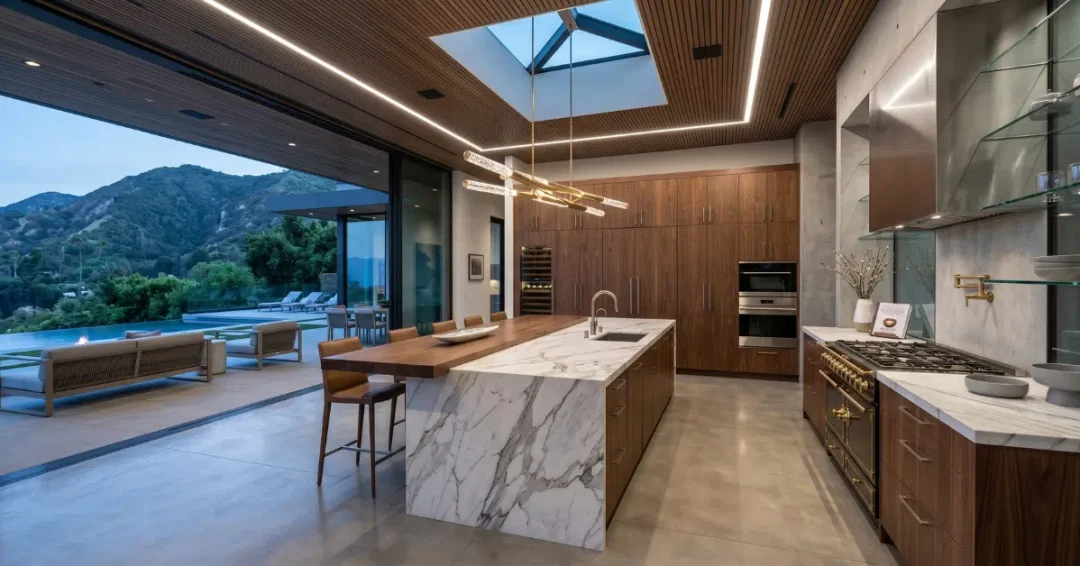
Every client who walks through our door for a custom home project eventually says the same thing about the kitchen: "I want it to feel luxurious." And I understand the impulse.
But what I've found, after designing estates from the Hamptons to the Caribbean, is that most people who say that are actually describing something different - something deeper. They're not asking for expensive finishes. They're asking for a space that feels inevitable. Like it could only have been built for them, in that house, on that land, for the way they actually live.
Luxury kitchen design at the ultra-high end is not a materials conversation. It's an architecture conversation. The difference between a $200,000 kitchen and an $800,000 kitchen is rarely the marble you select or the brand of your appliances.
It lives in proportion, in sequence, in how the space receives light at 7 in the morning versus 7 at night. It lives in whether the kitchen was designed as a room or as a component of the home's total spatial logic.
In this piece, I'll walk through what genuinely changes when kitchen design moves into the ultra-luxury tier - what decisions get made, why they matter, and what separates a kitchen that photographs beautifully from one that performs beautifully for 20 years.
Why Luxury Kitchen Design Starts With Architecture, Not Appliances
The most common mistake I see in high-end kitchen projects - even very expensive ones - is that the architecture gets solved last. The floor plan gets locked, the structure gets designed, and then a kitchen designer or cabinet company steps in to fill the space.
The result is technically impressive, but spatially compromised. You end up with a beautiful kitchen inside a box that was never designed for it.
At the ultra-high end, this sequence inverts. The kitchen's architectural logic shapes the home itself.
That means decisions like ceiling height, window placement, and structural column location get resolved as part of the home's primary architecture - before a single cabinet drawing is produced. When a client tells me they want to cook while watching their children swim, that's a site planning note, not a kitchen design note. It changes where the kitchen lives in the home, how the exterior wall opens, and whether we're designing around a window or an entire glazed wall system.
The questions that actually define luxury kitchen design at this level include:
- Where does the primary light source come from? North light reads differently than east or west exposure. A kitchen used heavily in the morning should be oriented to morning sun - or deliberately shielded from it. Natural light in design starts with orientation, not glazing product selection.
- How does the kitchen connect to the site? Does it open to a terrace, a garden, a pool? The transition from interior to exterior isn't a door choice - it's a structural decision.
- What is the acoustic relationship to adjacent rooms? In a home built for large entertaining, sound from a kitchen can carry in ways that undermine the dining room experience. This gets resolved in the architecture, not the finishes.
- How does the kitchen read from the primary living spaces? Whether the kitchen is open, semi-open, or fully enclosed has consequences for how the home feels across its entire social floor.
- What is the hierarchy of activity? In a home with private chef capabilities, the kitchen may have two distinct zones with different mechanical and spatial requirements. That's a different structural problem than a family kitchen used primarily by the homeowners.
None of these questions get answered on a cabinet spec sheet. They get answered in the architectural design phase, months before any vendor is selected.
Proportion: The Invisible Luxury in High-End Kitchen Design
If there's a single element that separates truly exceptional luxury kitchen design from expensive-but-ordinary kitchen design, it's proportion. And it's the hardest thing to explain to someone who hasn't spent time in well-proportioned spaces.
Walk into a kitchen where the ceiling is 9 feet and the island is 10 feet long, and something feels off - even if you can't name it. The island is too commanding for the volume of the room. The scale tells you something is wrong before your conscious mind can articulate it.
Now raise that ceiling to 12 feet, deepen the room by four feet, add a structural soffit at the range wall that creates a visual horizon, and the same island reads as generous rather than aggressive.
Proportion in a luxury kitchen operates on several levels:
- The relationship of ceiling height to floor area. Taller ceilings require larger floor areas to feel balanced. A 14-foot ceiling in a 200-square-foot kitchen creates a vertiginous quality. The same ceiling in a 450-square-foot kitchen feels like an event.
- The scale of cabinetry to wall height. In a standard kitchen, cabinets typically run to 8 or 9 feet. In a high-end kitchen designed with architectural intention, upper cabinetry often runs floor-to-ceiling - eliminating the dead zone and creating a more resolved vertical composition.
- The mass of the island relative to the room. An island's visual weight comes from its length, height, material, and the clearance surrounding it. Tight circulation paths around a heavy island feel confining at any price point.
- The depth of the perimeter countertops. A standard counter runs 25 inches deep. In a high-end kitchen designed for serious cooking or entertaining, counter depth often increases to 30 or 32 inches - changing how the room feels to move through.
- The visual weight of the range wall. In most luxury kitchens, the range wall is the primary architectural statement. Its composition - hood, range, surrounding cabinetry, wall surface - needs to be designed as a single element, not assembled from separate decisions.
These are not choices made at a showroom. They require an architect working from a spatial brief, not a product catalog.
| Design Element | Standard High-End Kitchen | Ultra-Luxury Kitchen Design |
|---|---|---|
| Planning Sequence | Kitchen designed after floor plan is locked | Kitchen logic shapes the home's architecture from the start |
| Cabinetry | Semi-custom or European cabinet lines | Custom millwork designed room-specific by architect |
| Appliance Integration | Selected from vendor catalog, fitted into space | Concealment/celebration philosophy set architecturally |
| Outdoor Connection | Door or window opening decided during construction | Resolved as spatial design gesture during early design phase |
| Mechanical Systems | Planned after kitchen layout is set | Engineer engaged during design development, shaping structure |
| Butler's Pantry | Overflow storage added as needed | Second operations center with its own service circulation logic |
Where Materials Matter in Luxury Kitchen Design - and Where They Don't
I want to be direct about something that often surprises clients: in a genuinely well-designed luxury kitchen, materials are almost secondary. Not unimportant - but secondary.
A kitchen designed with strong architectural bones and correct proportion will read as exceptional in almost any material palette. A kitchen with weak bones and poor proportion will feel compromised regardless of whether you select $600-per-square-foot marble or $60-per-square-foot stone.
You can spend an extraordinary amount of money and still end up with something that doesn't satisfy you, because the thing you were looking for was never available at the finishes level.
That said, at the ultra-high end, materials do perform differently in specific ways.
Stone selection becomes a spatial design decision. In a high-end kitchen, the primary stone surface - the island, perimeter counter, or full-height backsplash - is selected not just for its aesthetic quality but for how it reads across distance, reflects light, and anchors the eye. A dramatically veined marble on a 14-foot island is a composition. It either works with the spatial logic of the room or competes with it.
Cabinetry becomes a millwork question. At the ultra-high end, cabinetry stops being furniture and becomes architecture. Custom millwork designed by the architect and built to the dimensions of the specific room will have an exactness and integration that even the best European cabinet lines can't match. The reveals, the material transitions, the relationship between cabinet faces and adjacent surfaces - these details define whether a kitchen feels composed or assembled. This is why luxury interior design at this level is treated as a continuation of the architecture, not a separate discipline applied after the fact.
Hardware is punctuation, not sentence. Hardware at this tier should almost disappear - or be so deliberate in its presence that it functions as a design element. The default position in ultra-luxury kitchen design has moved toward minimal or integrated hardware, where the visual surface remains uninterrupted and function is resolved in the joinery.
Appliance integration reflects a philosophy. Whether appliances are fully concealed, partially concealed, or celebrated as design objects is an architectural decision - not a personal preference. What's inconsistent - and what clients often feel before they can name it - is when the concealment logic is applied partially or without intention. This is where FF&E specification and design becomes a critical phase in the overall project sequence.
Warren Ralston - Principal Architect
"A kitchen with strong architectural bones will read as exceptional in almost any material palette. A kitchen with weak bones will feel compromised regardless of what you spend on stone."
The Mechanical Layer Nobody Discusses in Luxury Kitchen Design
Here is where ultra-luxury kitchen design separates itself most clearly from what most designers discuss publicly: the mechanical layer.
Ventilation, plumbing, electrical, gas, and integrated technology in a high-end kitchen are not add-ons. They are design constraints that shape the architecture from the beginning. And they are among the most common sources of cost overruns when they get resolved late in the process.
A professional-grade range at the scale appropriate for a serious cooking kitchen requires a ventilation system that can move significant air volume. That system requires ductwork of a certain diameter, running a certain distance, with specific clearances. If the ductwork path hasn't been accounted for in the structural design, the resolution ends up visible, compromised, or expensive to correct.
This is why the mechanical engineer needs to be in the room during design development - not after the kitchen design is complete.
At the ultra-high end, kitchens often include systems that go well beyond standard residential requirements:
- Integrated refrigeration zones - separate refrigerator and freezer columns, under-counter wine storage, beverage drawers, and temperature-specific zones for cheese, produce, or specialty items
- Multiple sink configurations - a primary prep sink, a secondary bar sink, a pot-filler over the range, and sometimes an outdoor-connected utility function
- Dedicated ventilation for butler's pantry or secondary kitchen - which requires its own mechanical resolution
- Integrated audio and lighting control - scene-based lighting and discreet audio distribution that doesn't conflict with the architectural composition
- Heated flooring - which requires early coordination with the structural slab or subfloor system, not a retrofit decision
Each of these systems requires coordination between the architect, mechanical engineer, and kitchen designer before anything is built. The cost of late coordination is almost always higher than the cost of early planning.
The Butler's Pantry as Part of Luxury Kitchen Architecture
One of the clearest signals that a kitchen project has been designed with genuine architectural intention is how it resolves the butler's pantry.
In a kitchen designed primarily for aesthetics, the butler's pantry is often an afterthought - a secondary space that handles overflow storage. In a kitchen designed for performance, the butler's pantry is a second operations center, and its relationship to the primary kitchen is as deliberate as the relationship between the kitchen and the dining room.
At the ultra-high end, the butler's pantry often handles catering prep for large-scale entertaining, meaning it may need its own full refrigeration, its own dishwasher, its own ventilation, and a direct service path that doesn't cross the social flow of the home. Getting this right requires understanding the client's actual entertaining patterns - not just their aspirational ones.
How frequently do they host events requiring catering staff? What is the scale of those events? Is there a preference for a fully closed kitchen during entertaining, with all activity channeled through the service sequence? These questions have architectural answers, but they start with a conversation about how the clients actually live.
Outdoor Connection and Luxury Kitchen Design: The Element That Elevates Everything
If there is a single design decision that generates more long-term satisfaction than any other in a luxury kitchen, it is the quality of the outdoor connection. This is one of the core reasons luxury outdoor living design must be considered alongside the kitchen architecture from day one - not as a site design afterthought.
I've seen kitchens with $500 per square foot stone work and $50,000 range configurations where the client told me, years later, that they wished the kitchen opened to the outside. And I've seen kitchens with simpler material choices where clients say they use the space every day because of the way it connects to the terrace, the garden, or the view.
The outdoor connection is the hardest thing to add retroactively and the easiest thing to get right when addressed in the design phase.
What good outdoor connection looks like in a high-end kitchen depends entirely on the site and the client's patterns. Some clients want the kitchen to open fully onto a covered terrace - which means the threshold, flooring transition, and ceiling height of both spaces need to be coordinated as a single design gesture. Others want visual connection without thermal exposure - a large fixed glazed wall that frames a garden or view. Others want a pass-through counter that allows service to an outdoor bar or grill area without requiring movement through the main circulation path.
All of these solutions start with a site analysis and a client lifestyle conversation - not with a product selection. The sliding glass system, the pivot door, the fixed window wall - those are the conclusions. The design decision is the spatial relationship.
What the Luxury Kitchen Design Planning Process Actually Looks Like
One of the most consistent sources of friction in high-end kitchen projects is misaligned expectations about the planning process. Clients experienced in construction sometimes approach the kitchen as a relatively self-contained component - something that can be finalized in parallel with or slightly after the primary architectural work.
In reality, at the ultra-high end, the kitchen is inseparable from the home's architecture. Treating it as a late-stage decision almost always produces compromises.
The sequence that produces the best results looks like this:
- Early design phase: Kitchen location, orientation, ceiling height, outdoor connection, and relationship to adjacent rooms get resolved as part of the home's spatial logic - before floor plans are locked.
- Schematic design: Kitchen footprint, primary zones (cooking, prep, cleanup, pantry), island configuration, and range wall composition get designed as part of the architectural drawings - not delegated to a separate specialist at this stage.
- Design development: Mechanical engineer joins the process. Ventilation paths, plumbing rough-in locations, electrical load requirements, and structural implications of appliance selection get resolved. Kitchen designer or millwork architect begins detailed cabinet design in response to the architectural intent.
- Construction documents: Millwork drawings get coordinated with structural, mechanical, and electrical drawings. Conflicts get resolved on paper, not in the field. Stone slab selection gets confirmed against the spatial design.
- Construction: Substrate work, rough-in installations, and structural elements get built to the coordinated set. Millwork installation happens as an exacting fit operation, not an adaptation exercise.
When this process is followed with discipline, the kitchen that gets built is the kitchen that was designed. When steps get compressed or reordered, the result is almost always a gap between design intent and built reality - and at this investment level, that gap is deeply unsatisfying.
Frequently Asked Questions About Luxury Kitchen Design
What is the typical cost range for ultra-luxury kitchen design?
At the ultra-high end, luxury kitchen design and construction - including architecture, millwork, appliances, stone, mechanical systems, and lighting - typically ranges from $400,000 to well over $1 million for primary residences. Cost is driven primarily by decisions about size, systems complexity, and material specification rather than a fixed formula. The budget should be allocated in proportion to what produces lasting satisfaction: architectural resolution first, materials second. For a fuller picture of overall project investment, our overview of high-end architecture costs covers the broader framework.
How is luxury kitchen design different from a high-end kitchen remodel?
A high-end kitchen remodel improves an existing space within its existing architectural constraints. Luxury kitchen design - particularly in a custom home - resolves those constraints at the source. You're not working around an existing ceiling height or ventilation path; you're designing those elements from the beginning to serve the kitchen's requirements. Clients who have done both often describe the custom approach as categorically different from even the highest-quality remodel.
Should I hire an architect or a kitchen designer for a luxury kitchen?
At the ultra-high end, the answer is often both - but in a specific sequence. The architect should establish the spatial logic, proportion, and integration with the home's architecture. A specialized kitchen designer or millwork architect then develops the cabinetry and interior detail within that framework. When these two roles are reversed, the result tends to have strong interior detail but weaker architectural integration. According to the American Institute of Architects (aia.org), early architect involvement in kitchen design consistently produces better spatial outcomes than post-construction integration - particularly in homes where the kitchen anchors the primary social floor.
How long does a luxury kitchen design process take?
In a custom home build, kitchen design runs concurrent with the overall architectural timeline - typically 12 to 18 months from initial design through construction documentation. Millwork fabrication alone often requires 16 to 24 weeks from final approval to delivery. Clients who expect to make final kitchen decisions in the final months before move-in typically end up with compromises in material selection or coordination.
What makes a luxury kitchen design truly custom versus semi-custom?
Truly custom luxury kitchen design starts from a room-specific brief and produces drawings and specifications that couldn't have been created for any other project. The cabinetry is designed and dimensioned for the specific room. The stone selection responds to specific light conditions. Semi-custom products - even at high price points - are designed to work in a range of applications, which means they involve compromises that a custom approach doesn't require. At the ultra-high end, the difference between the two is perceptible in how the space feels, even when it's difficult to articulate why.
What appliance configuration makes sense at the ultra-luxury level?
Appliance configuration should follow the client's actual cooking patterns rather than a default professional-grade setup. A client who hosts large-scale dinners with catering staff has different requirements than a client who cooks daily for family. What changes in ultra-luxury kitchen design is the level of integration and quality of the mechanical infrastructure supporting those appliances. The appliances themselves are secondary to the systems designed around them.
How do you incorporate a butler's pantry into a luxury kitchen design?
The butler's pantry should be positioned and sized based on the entertaining sequence - specifically, how catering or service staff will move through the home during events without intersecting the social flow. In a well-designed estate, the butler's pantry has a service entry path separate from the main kitchen's social connection, its own mechanical provisions, and a clear relationship to both the kitchen and the entertaining spaces it serves. It's most effective when designed as part of the service circulation logic of the entire home, not as an appendage to the kitchen floor plan.
Luxury Kitchen Design: Early-Stage Planning Checklist
- Kitchen orientation and light source established before floor plan is locked
- Outdoor connection resolved as a structural design decision, not a door selection
- Acoustic separation from adjacent entertaining spaces addressed in architecture
- Mechanical engineer engaged during design development, not after kitchen design is complete
- Butler's pantry service circulation planned alongside kitchen social circulation
- Millwork architect/kitchen designer engaged after spatial logic is set by architect
- Stone slab selection coordinated with final room dimensions and light conditions
- FF&E specification sequence integrated into overall project timeline
What Separates a Luxury Kitchen That's Admired From One That's Lived In
The kitchens that clients talk about years after a project is complete are rarely the ones with the most expensive stone or the most celebrated appliance configuration. They're the ones that feel right at 6:30 on a Tuesday morning as much as they do during a dinner party.
The ones where the light does something at a specific time of day that no one anticipated and everyone loves. The ones where the spatial sequence from the kitchen to the terrace to the dining room creates a flow that the family has organized their entire social life around.
That quality doesn't come from a showroom. It comes from a luxury kitchen design process that treated the kitchen as a room first and a product selection second - that started with how you actually live rather than with what looks impressive in photographs.
If you're beginning the process of designing a custom luxury residence and want to explore what that approach could look like for your project, we'd welcome the conversation. The earlier we're in the process, the more those foundational decisions remain open - and those are the decisions that matter most. Reach out to us and let's talk through what you're building.