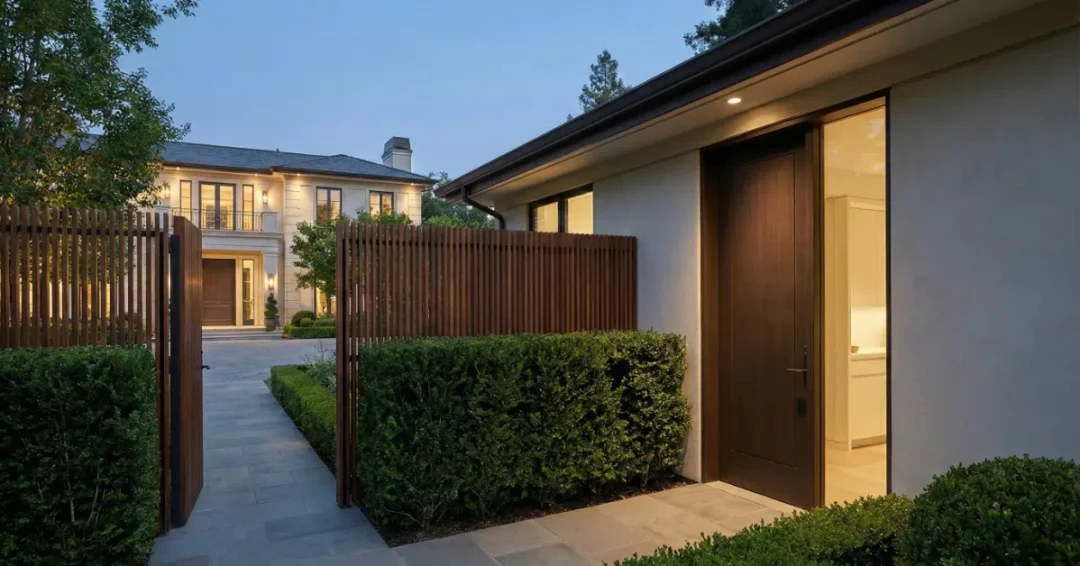
This content is for informational and educational purposes only. Ralston Architects recommends consulting directly with a licensed architect familiar with local zoning, accessory dwelling unit regulations, and residential building codes applicable to your specific site and jurisdiction.
Staff quarters home design is one of the most technically specific challenges in luxury residential architecture - and one of the most frequently handled poorly. The goal is not simply to provide comfortable accommodation for household staff. The deeper objective is to design a home where service happens invisibly: meals arrive without the kitchen team crossing the dining room, laundry is retrieved without staff appearing in the bedroom wing, grounds maintenance proceeds without anyone moving through principal living areas. When this is done well, the home functions at a level that feels effortless. When it is done poorly, the friction is constant and the privacy of both principals and staff is compromised.
This guide addresses the architectural principles that make invisible service possible - from the placement of staff quarters to the routing of service corridors, delivery entries, and back-of-house circulation paths.
The Principle Behind Invisible Service
Great estates and luxury hotels solved this problem long before residential architects began taking it seriously. The answer is always the same: parallel circulation systems, separate entries, and staff accommodation positioned to allow movement through the property without intersecting principal zones. The architecture does the work so the protocols do not have to.
Where Staff Quarters Belong in the Home's Layout
The first decision in staff quarters home design is position - not just on the site, but relative to the home's functional core. Staff accommodation needs to be close enough to primary service zones (kitchen, laundry, mechanical rooms) that it enables efficient operation, and far enough from principal sleeping and living areas that sound, movement, and early-morning activity remain completely separate.
In single-structure homes, the preferred position for staff quarters is adjacent to the back-of-house service core - typically off the kitchen or utility wing, with direct access to service corridors and a private entry that is entirely distinct from the home's main entry sequence. This position allows a staff member to move from their room to any service zone in the house without crossing principal circulation paths. It also means that staff arriving for early shifts, or departing late, do so through an entry that the principals never use and cannot see from primary rooms.
In multi-structure properties - where the site allows a separate staff cottage or accessory structure - the calculus changes. A detached staff structure provides the clearest separation of principal and staff living, allows staff genuine residential privacy, and removes any acoustic or light bleed between the two populations. See how master planning for luxury estates addresses multi-structure site organization from the earliest design phase. The tradeoff is distance: a staff cottage positioned for maximum separation may require staff to cross open site to reach the main house, which creates its own visibility issues. The optimal position for a detached staff structure is connected to the main house by a covered service passage or enclosed corridor - close enough for operational efficiency, physically separate enough for genuine privacy on both sides.
Vertical separation is the third option, used frequently in multi-story luxury homes. Staff quarters on a floor separate from principal bedrooms - typically the lower level or a dedicated upper floor zone - with a private stair that serves only the staff level and the service core. This arrangement works well in urban or constrained suburban sites where a separate structure is not possible and where floor-plan discipline can maintain separation through the section rather than the plan. Our approach to luxury residential planning addresses staff circulation as a first-order design constraint alongside principal program requirements.
| Placement Type | Best For | Primary Consideration |
|---|---|---|
| Adjacent to service core | Single-structure homes, operational efficiency | Sound separation from principal zones |
| Detached structure | Large sites, maximum privacy both parties | Covered connection to avoid exposed crossing |
| Vertical separation | Multi-story, constrained sites, urban homes | Dedicated stair, no shared floor access |
| Over garage or service building | Existing service structures, phased development | Sound attenuation from below, separate entry |
Adjacent to Service Core
Detached Structure
Vertical Separation
Over Garage / Service Building
Designing Service Paths That Never Cross Principal Circulation
Staff quarters home design cannot succeed without resolving circulation - specifically, the relationship between where staff move and where principals move through the same house. In a well-designed residence, these two path systems are essentially parallel: they connect the same functional destinations (kitchen to dining, laundry to bedrooms, entry to principal rooms) but through different corridors, different stairs, and different doors.
Service doors on the back-of-house passage side are typically flush with the wall, detailed as wall panels when closed, and swing into the corridor — not into the room.
The back-of-house corridor is the primary instrument of invisible service in staff quarters home design. This is a dedicated passage - typically narrower than principal hallways, sometimes as tight as 36 inches - that runs behind or alongside the primary living sequence and connects the service core to all zones that require regular staff access. In historic estate architecture, this was called the servants' passage and it was an explicit part of every floor plan. In contemporary luxury residential design, the same principle applies under different language, but the discipline required to maintain it is identical.
What makes back-of-house corridors work is door placement. Every room that staff need to access regularly - principal bedroom suites for turndown and laundry, dining rooms for service, home offices for supply and maintenance - should have two door positions: a principal entry from the main corridor, and a service entry from the back-of-house passage. These doors are typically flush with the wall on the service side, detailed to read as wall panels rather than doors when closed, and swing into the service corridor rather than into the room. This means a staff member can enter, perform the required task, and depart without ever using the door that the principal uses or appearing in the principal's line of sight.
Stair separation is equally critical in multi-level staff quarters home design. A shared stair between staff quarters and principal levels is the single most common failure point in otherwise well-considered plans. Even when staff quarters are thoughtfully positioned, a shared stair forces intersection at the most legible architectural moment - the point of vertical transition between floors. A dedicated service stair, running from the staff level to the kitchen and service zones, eliminates this intersection entirely. It does not need to be elaborate. It needs to be separate, and it needs to connect the right zones.
Exterior paths matter as much as interior ones. Staff who arrive for morning shifts, gardeners moving between outbuildings, delivery personnel bringing provisions - all of these movements should be routed through a service entry that is visually screened from principal arrival sequences and principal outdoor living areas. This typically means a separate service drive or side entry positioned so that the working parts of the property remain behind the domestic presentation face of the home. Our work on luxury second home design and site planning regularly involves resolving this separation at the site scale before the building plan is developed.
Staff Quarters Room Standards That Support Operational Quality
The quality of staff accommodation in a residential setting is directly related to the quality of service it produces. Staff who are comfortable, who have adequate private space, and whose quarters are genuinely removed from their working environment perform at a higher level and remain in position longer. This is not a welfare abstraction in staff quarters home design - it is an operational reality that every serious luxury property owner eventually confronts.
In staff quarters home design, a private bedroom for each staff member is the baseline. Shared accommodation degrades the appeal of live-in positions and creates turnover that is disproportionately disruptive in a household context. Each bedroom should have a minimum of 120 to 150 square feet of floor area, a dedicated closet, operable windows with good natural light, and a private or semi-private bathroom. The bathroom ratio in well-specified staff quarters is ideally one bathroom per two staff members at the maximum - one per person where program allows.
A dedicated staff lounge or common room serves an important spatial and operational function. It gives staff a place to decompress, eat staff meals, and spend time off-duty that is genuinely separate from both their bedrooms and their work environment. Without it, the only option is the bedroom, which collapses the separation between rest and work that makes live-in positions sustainable. The lounge should have a small kitchen or kitchenette, a dining area, seating, and connectivity - and it should have its own entry point to the exterior so that staff can come and go during off hours without activating the service entry to the main house.
Sound attenuation within staff quarters home design between quarters and adjacent spaces is a technical requirement that is frequently underspecified. Staff quarters walls shared with principal spaces - or with mechanical rooms, laundry facilities, or kitchens - should be designed to achieve STC (Sound Transmission Class) ratings of 55 or higher. Standard residential framing at STC 33 to 38 is wholly inadequate. Achieving STC 55 requires decoupled wall assemblies, resilient channels or staggered stud framing, dense-pack insulation in the cavity, and mass-loaded drywall layers on one or both sides. This is a construction-phase decision that cannot be economically retrofitted.
Private Bedroom
120–150 sq ft minimumDedicated closet, operable windows with natural light, and private or semi-private bathroom. Shared accommodation creates turnover that is disproportionately disruptive in a household context.
Staff Lounge
Separate exterior access requiredKitchenette, dining area, seating, and connectivity. Must have its own exterior entry so staff can come and go during off hours without activating the main service entry.
Private Bathrooms
Max 2 staff per bathroomIdeally one bathroom per person where program allows. One per two staff members is the maximum acceptable ratio in well-specified staff quarters design.
Acoustic Separation
STC 55 or higher requiredStandard residential framing at STC 33–38 is wholly inadequate. Decoupled assemblies, resilient channels, dense-pack insulation, and mass-loaded drywall are required. Cannot be retrofitted.
STC Ratings at a Glance
Standard residential framing allows audible conversations through the wall. The STC 55+ target requires construction-phase decisions — decoupled assemblies, staggered framing, dense-pack insulation, and mass-loaded drywall — that cannot be economically added after the fact.
Walls shared with principal spaces, mechanical rooms, laundry facilities, or kitchens must meet the higher specification from the outset.
Staff Quarters Design Checklist
Design Review Checklist
Click each item to mark it confirmed
0 of 8 items confirmed — resolve all before schematic design is complete.
Staff Quarters Home Design Requires Decisions Made Early
The most important thing to understand about staff quarters home design is that it cannot be resolved late in the process. Once a floor plan is established, corridor widths are fixed, stair positions are committed, and the relationship between principal and service circulation is locked in. Adding a back-of-house passage after the fact means borrowing space from rooms that have already been sized. Adding a separate service stair means finding a structural bay that was never planned for it.
These decisions belong in the first schematic phase - in the same conversation where room adjacencies, entry sequences, and floor-to-floor relationships are being worked out. The service plan and the principal plan need to be developed simultaneously, with the same design attention and the same resolution of detail. A home that functions at the highest level for a family with household staff is a home where the architecture of service was considered from the first drawing.
At Ralston Architects, staff circulation and quarters design are part of the architectural brief from day one on any project where household staff are part of the client's life. The result is a home where service is genuinely invisible - not because the staff are hiding, but because the architecture gave them a path that never required them to be seen. Begin the conversation through our luxury home design inquiry.
Staff quarters home design is resolved in the first phase or not at all. If household staff are part of your life, begin the architectural brief with that reality — not as a footnote, but as a primary design driver.
Contact Ralston Architects