This content is for informational and educational purposes only. Ralston Architects recommends consulting directly with a licensed architect and a qualified art conservator for project-specific guidance related to your collection, site conditions, and climate control requirements.
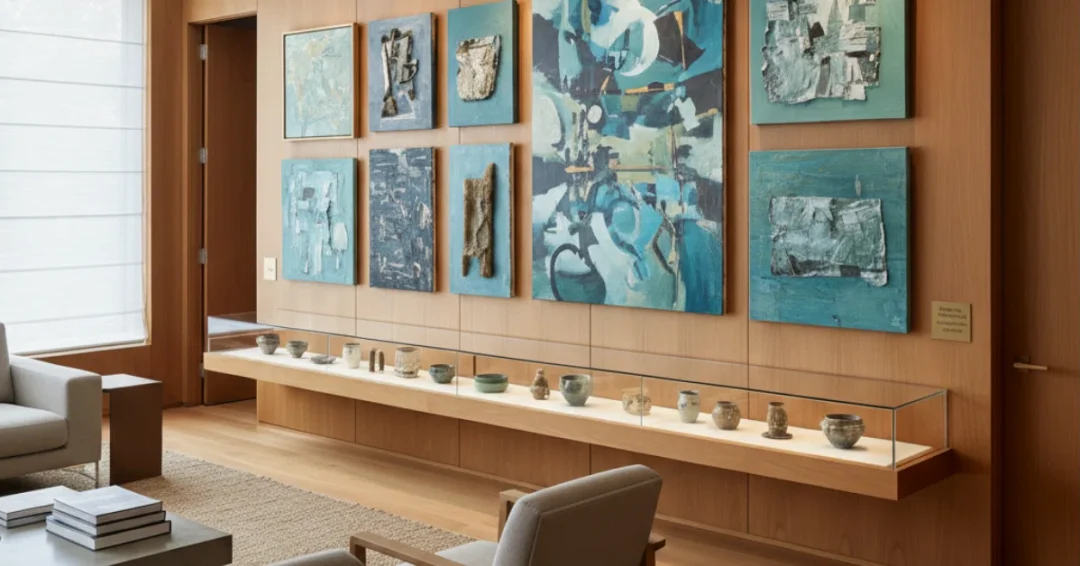
Art collection home design is a discipline that sits at the intersection of residential architecture and museum science. When a client owns serious work — whether three pieces or three hundred — the home that holds it must be designed with the same rigor applied to the collection itself. The walls, the light, the temperature, the humidity: each one is either protecting the work or slowly damaging it, and there is no neutral position.
This guide addresses what it actually takes to design a private residence around a significant art collection, from the structural logic of gallery walls to the conservation-grade climate systems that most residential architects never specify.
The Standard Worth Holding
A private home designed for serious art collection is not a gallery with furniture in it. It is a residence that applies institutional conservation principles to a domestic context — rigorously, but invisibly. The goal is that the home feels lived in and the art feels protected, without either condition compromising the other.
How Art Collection Home Design Shapes Wall Architecture
The wall is the primary canvas of art collection home design, and it demands more architectural thought than almost any other surface in the home. Height, depth, material, finish, structural capacity, and hanging system all interact — and all need to be resolved before a single work is installed.
Ceiling height is the first decision. For large-format contemporary work — canvases running six, eight, or ten feet in their longest dimension — a standard nine-foot ceiling creates a compression that diminishes the work and eliminates any possibility of negative space above it. Serious art collection home design typically calls for gallery-adjacent spaces with ceiling heights between eleven and fifteen feet, scaled not to the room's furniture but to the scale of the work itself. The proportion of wall height to work height should allow for at least twelve to eighteen inches of clear wall above any hanging piece at its uppermost point.
Wall depth and structural backing matter as much as height. Large sculptural pieces and heavy framed canvases require backing that goes beyond standard stud framing. A well-specified art wall uses continuous blocking — either structural plywood sheathing or a dense blocking schedule — behind the drywall surface across the entire hanging zone, not just at pre-planned locations. This gives the client and curator the freedom to move work without constraint, which matters as collections grow and rotate.
Wall finish in art collection home design is almost always a dead flat or matte paint in a neutral tone — typically warm white, off-white, or a carefully considered gray. Sheen is the enemy of art display. Any reflectivity in the wall surface creates competing light return that interferes with how the eye reads the work. The finish should be specifiable, consistent, and easy to touch up without visible repairs. This is not an aesthetic preference. It is a functional requirement of the display environment.
Hanging systems deserve specific attention. In a home designed for a serious collection, fixed picture rails or museum-quality hanging rod systems — the kind used by institutions — are worth specifying at construction. These systems allow for tool-free repositioning, precise height adjustment, and load ratings appropriate for significant framed works. They eliminate the cycle of patching, repainting, and re-drilling that degrades wall surfaces over time and is entirely incompatible with conservation standards. Our approach to luxury residential interiors incorporates hanging system specification as a standard element of any collection-focused project.
| Wall Element | Residential Standard | Art Collection Standard |
|---|---|---|
| Ceiling Height | 9 ft typical | 11 – 15 ft in primary display zones |
| Wall Backing | Studs at 16″ OC | Continuous structural blocking full zone |
| Paint Finish | Eggshell or satin | Dead flat or matte only |
| Hanging System | Drywall anchors, studs | Museum-grade rod or rail system |
| Negative Space | Not considered | 12 – 18″ clear above tallest hang point |
Ceiling Height
Wall Backing
Paint Finish
Hanging System
Negative Space
Lighting Design for Art Collection Homes
Lighting in art collection home design requires a level of specification that most residential lighting designers never reach. The difference between good residential lighting and proper art display lighting is not primarily a fixture question — it is a physics question, involving color rendering, spectral output, UV content, heat generation, and beam geometry.
Color Rendering Index — CRI — is the starting point. Standard residential LED fixtures commonly run at CRI 80 to 85, which is adequate for living but insufficient for displaying art accurately. Work lit at CRI 80 looks flat, its deeper tones compressed, its subtler passages lost. Art collection home design specifies a minimum CRI of 95, and ideally 97 to 99, for all primary display lighting. At this level, the full spectral range of pigments reads as the artist intended. The difference is visible immediately and it is not subtle.
UV and infrared output are the conservation concerns. UV radiation is the primary driver of photochemical degradation in works on paper, photographs, and certain pigments. Infrared generates heat at the surface of the work, accelerating chemical breakdown and causing differential expansion and contraction in canvas and support materials over time. Proper art collection home design specifies LED sources that are UV-filtered or UV-absent by design — most quality LED chips produce negligible UV by their nature — and selects fixtures with IR-filtered optics where heat output is a concern for sensitive materials.
Beam control is where art lighting becomes genuinely technical. A track head or adjustable downlight used for art display should be aimable with fine control, adjustable in beam spread from spot to flood, and equipped with barn doors or snoot attachments that allow the illuminated field to be shaped to the work's boundaries without spill onto adjacent surfaces or into visitor sightlines. Glare from display fixtures is one of the most common failures in residential art collection home design — a ceiling full of track heads aimed at works with uncontrolled spill produces an exhausting visual environment and compromises the reading of every piece.
Layered lighting is the correct approach. Primary display light — directed, controlled, high-CRI — handles the works themselves. Ambient fill light — indirect, low intensity, from coves or wall-wash sources — lifts the room's base illumination without competing with display light. The ratio between display and ambient determines the drama of the environment. A 5:1 or higher ratio between display and ambient intensity creates a gallery-like focus. A 2:1 ratio produces a more residential register where art and room coexist at closer visual weight. Neither is wrong — but the choice should be intentional, and it should be specified, not approximated.
Dimming and scene control complete the lighting system. In an art collection home design, lighting scenes should be programmable across display, ambient, and circulation zones independently. The collection should be viewable at full display intensity for active engagement, at a reduced conservation level for periods when the home is occupied but the collection is not being actively viewed, and at near-zero for unoccupied periods. This requires a control system that goes beyond residential dimmer switches — a proper scene-based system addressable by zone. Our luxury residential design process addresses lighting control specification as a core deliverable, not an afterthought.
Climate Control Standards for Art Collection Home Design
Of the three disciplines in art collection home design — walls, lighting, and climate — climate is the one most likely to be underspecified and the one whose failures are the most irreversible. Light damage is visible and relatively slow. Climate damage — cracking paint layers, warping panel supports, foxing on paper, delaminating photographs — can occur over a single winter season in an improperly conditioned space.
The conservation standard for fine art storage and display is 68 to 72 degrees Fahrenheit and 45 to 55 percent relative humidity, maintained with fluctuation of no more than plus or minus five degrees or five percent RH within any 24-hour period. This is the institutional standard applied by major museums and private collection facilities. Achieving it in a residential context requires systems that go well beyond a standard HVAC installation.
Standard residential HVAC tolerates ±10°F daily swings — incompatible with conservation requirements.
Seasonal humidity swings are the primary driver of canvas and panel support damage.
Residential HVAC systems are designed to maintain occupant comfort, which tolerates temperature swings of ten degrees or more across a day. They cycle on and off, creating humidity spikes and drops that a conservation environment cannot accommodate. Art collection home design requires dedicated conditioning equipment for primary display zones — typically a high-accuracy air handling unit with independent humidity control, separate from the home's primary HVAC system, sized to the thermal load of the specific spaces it serves.
The building envelope in display zones also matters significantly. Exterior walls adjacent to primary collection spaces should be insulated and vapor-managed to a standard that minimizes thermal bridging and moisture infiltration. Single-pane glazing, uninsulated concrete walls, and vapor-open assemblies are all incompatible with conservation-grade climate control. In coastal or high-humidity climates, this envelope analysis is particularly important and should happen before mechanical systems are ever sized. You can learn more about how we approach luxury second home design in coastal markets where climate complexity is a primary design factor.
Filtration is the final climate consideration. Particulate matter — dust, combustion products, pollen — accumulates on art surfaces and is difficult to remove without risk of damage. A collection-grade HVAC system specifies MERV-13 or higher filtration at air handling units serving display zones, with filter change intervals that prevent pressure buildup from bypassing filtration efficiency. Carbon filtration for volatile organic compounds is worth considering in newly constructed spaces where off-gassing from finishes and adhesives may be present for the first year or more of occupancy.
Is Your Home Ready for a Serious Collection?
Art Collection Home Design Starts Before the Floor Plan
The conversations that determine whether a home can genuinely support a significant collection happen very early in design — in the same sessions where site orientation, structural system, and room layout are being established. By the time a floor plan is fixed, the ceiling heights are committed, the wall positions are set, and the mechanical system locations are determined. Retrofitting conservation-grade lighting, structural backing, or dedicated climate control into a completed residential design is expensive, disruptive, and often architecturally compromised.
At Ralston Architects, we engage art collection requirements in the first design conversations — not as a checklist applied at the end, but as a set of spatial and technical parameters that shape the architecture from the beginning. The result is a home that holds the collection properly, displays it beautifully, and protects it for the long term. Reach out through our luxury home design inquiry to begin that conversation.
Moving Forward With Your Collection
At Ralston Architects, we engage art collection requirements in the first design conversations — not as a checklist applied at the end, but as a set of spatial and technical parameters that shape the architecture from the beginning.
Begin the Conversation