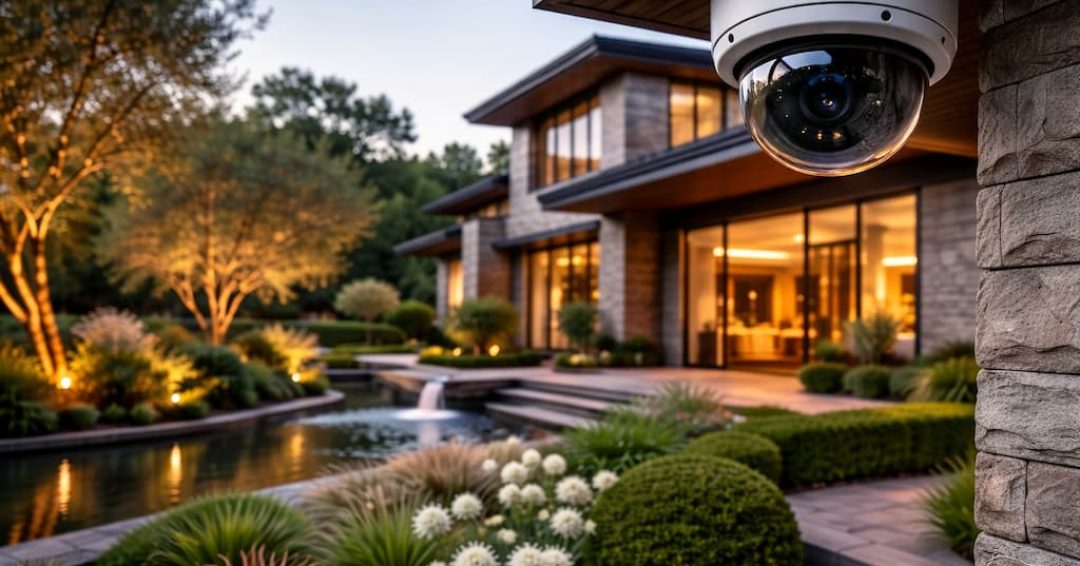
Stop treating security as an afterthought you bolt onto finished plans. When you’re investing in a luxury estate, luxury home security architecture belongs in the architectural DNA—not hidden behind decorative screens or added during construction as an expensive retrofit. The most successful luxury home security architecture strategies are conceived alongside structure, circulation, and site planning from day one.
I’ve designed residential estates for clients who require discretion and protection without living in fortresses. High-net-worth families, public figures, executives – they need luxury home security architecture that works invisibly, that protects comprehensively, and that integrates seamlessly with exceptional design. The question they ask isn’t whether to include security. It’s how to build it into the architecture from day one.
The answer requires three integrated systems: safe rooms designed as actual architecture rather than panic retrofits, long-range detection and monitoring that creates defensive depth, and entry sequences that control access without feeling oppressive. Most architects handle security through consultants who show up after floor plans are finalized. I design it into the spatial organization, the circulation patterns, and the structural systems before we draw the first wall.
Why Standard Luxury Homes Fail Security Requirements
Here’s the pattern I see repeatedly. Architects design beautiful homes focused entirely on aesthetics and lifestyle. Security consultants get brought in during construction documents. They try to retrofit systems into spaces that were never designed to accommodate them. The result is compromised security, compromised design, or usually both.
I’ve walked clients through homes where the panic room is accessible only through the primary bedroom – useless if the threat is already inside. Where perimeter security relies entirely on technology with no architectural backup. Where the grand entry creates a stunning first impression but zero control over who enters and how they move through the house.
Effective luxury home security architecture requires thinking about protection the same way you think about structure or mechanical systems – as fundamental building infrastructure that shapes everything else. The difference between a secure estate and a vulnerable one comes down to decisions made during schematic design, not equipment specified during construction.
The Foundation of Luxury Home Security Architecture
When I talk about luxury home security architecture, I’m describing a design philosophy where protection and livability aren’t competing priorities. They’re complementary aspects of the same architectural strategy. Security doesn’t mean living in a bunker. It means designing spatial relationships, sightlines, and access patterns that naturally create defensive advantages.
Think about historic estates built when security was life-or-death. They controlled approaches with landscape. They organized circulation to channel movement. They created strong points where families could retreat. These weren’t just defensive positions – they were sophisticated architectural responses to genuine threats. Modern luxury home security architecture applies those same principles with contemporary technology and design language.
This approach requires early commitment. You can’t design floor plans, then ask where security fits. You design security requirements into the site selection, the building placement, the room relationships, and the structural systems. Every major architectural decision either enhances security or diminishes it.
Safe Room Integration in Luxury Home Security Architecture
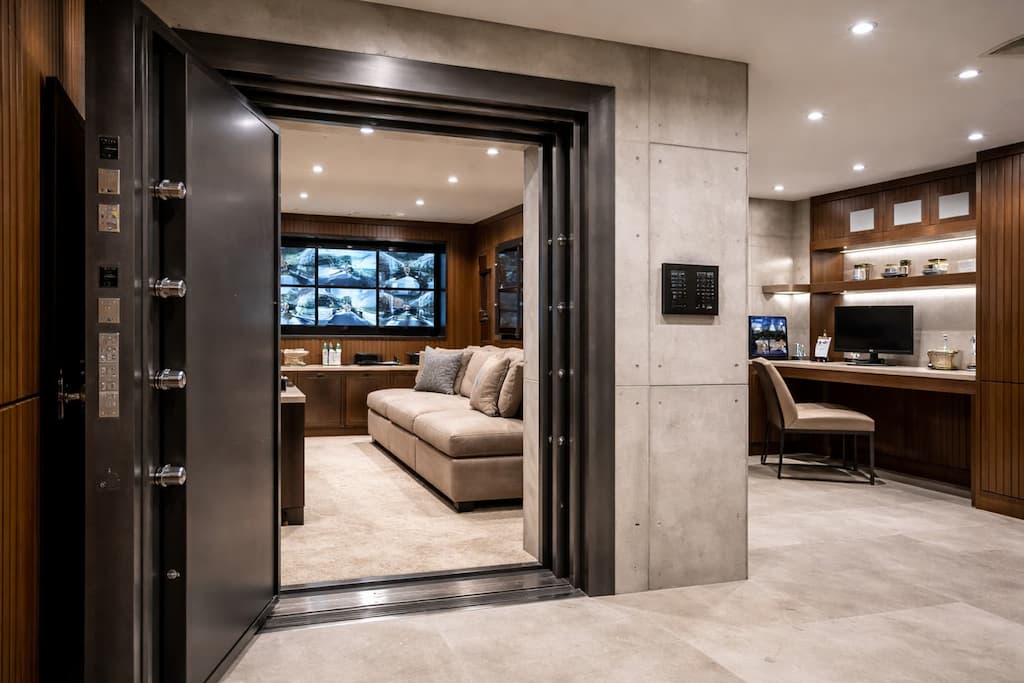
In luxury home security architecture, the panic room retrofit is security theater—an expensive solution that fails to provide true architectural protection. A contractor converts a closet, reinforces walls, adds a steel door, and calls it secure. But if it’s only accessible from the primary bedroom, or if it has no independent utilities, or if occupants can be trapped inside, it’s not actually safe – it’s just expensive.
Location Strategy for Safe Rooms
I locate safe rooms at the intersection of primary circulation and the most secure zone of the house. This typically means positioning them where the main stair meets the second floor, or where the family wing connects to service areas. Why? Because occupants need to reach safety from any location in the house without traveling through exposed spaces or dead-end corridors.
The safe room becomes a hub in the circulation pattern rather than a termination point. In normal use, it functions as a study, media room, or storage space. During an emergency, it’s immediately accessible from bedrooms, public spaces, and service areas. This requires drawing floor plans around the safe room rather than carving space from finished layouts.
Multiple access points matter more than most security consultants acknowledge. A safe room with one entry can become a trap. I design them with two independent entries – typically a primary door from the main circulation and a secondary access through service corridors or connected spaces. This creates options during different threat scenarios.
Structural Integration for Safe Rooms
Safe rooms require structural engineering from the foundation up. You’re not just reinforcing walls – you’re creating a hardened structure within the larger building. This affects foundation design, floor framing, wall systems, and roof structure.
I detail safe room walls with concrete masonry or poured concrete rather than wood framing with ballistic panels. This provides superior protection against forced entry, maintains integrity during fire, and creates genuine structural strength rather than just bullet resistance. The walls extend from foundation to roof structure without interruption.
Floor and ceiling assemblies receive the same attention. The safe room sits on reinforced concrete – either a slab-on-grade or a structural slab over basement space. The ceiling uses concrete or steel deck with concrete topping, creating a complete protective envelope. This adds approximately $150 to $200 per square foot to that specific area but delivers actual security rather than the illusion of it.
Systems Independence for Safe Rooms
A safe room must function when the rest of the house doesn’t. This requires independent utilities – dedicated HVAC with separate outside air intake, emergency power, telecommunications, and water supply. I run all utilities through protected chases that can’t be compromised from outside the secure envelope.
Doors and hardware specify to actual security standards – steel doors with multi-point locking, frames that transfer loads to structure, and hardware rated for forced entry resistance.
Long-Range Detection: Creating Defensive Depth Through Luxury Home Security Architecture
n luxury home security architecture, technology handles surveillance and monitoring, but architecture creates the spatial framework that makes those systems effective. The difference between vulnerable estates and secure ones isn’t camera resolution – it’s how the building and site work together to create layered defense.
Site Planning for Security Zones
I organize sites in concentric security zones starting at the property line. Each zone has different detection strategies and architectural responses.
The outer perimeter uses landscape to create clear sightlines while controlling access. Strategic clearing creates 50 to 100 feet of open ground inside the property line through meadow planting or low groundcover – designed landscape that provides security value.
The intermediate zone uses walls, berms, water features, and planting to channel movement toward controlled paths where detection systems have complete coverage. Someone approaching can’t move freely – they’re guided onto specific routes.
The inner perimeter – within 50 feet of the building – combines hardscape, lighting, and landscape to eliminate concealment. Low walls prevent vehicle approach, grade changes control access, and window placement eliminates ground-level entry to vulnerable spaces.
Building Placement and Monitoring Infrastructure
Where you locate the house determines how easily it can be secured. I position structures to maximize sight distance to entry points, minimize blind approaches, and create natural choke points for monitoring concentration.
Hilltop sites offer sight distance advantages – you see approaches from distance, attackers work uphill, and detection has clear sightlines. Valley sites provide privacy but require more aggressive perimeter control since threats can observe from elevation.
Long-range detection systems need architectural support – power, data, mounting structures, and protected equipment locations. I create dedicated security equipment locations during design: concrete pads for gates and cameras, weatherproof enclosures for network equipment, underground conduit for all wiring.
Lighting serves security as much as aesthetics. I design exterior lighting to create attractive environments, eliminate dark zones, and support camera systems with appropriate illumination.
Controlled Entry Points in Luxury Home Security Architecture
Every opening in your building envelope is a potential breach point. Luxury home security architecture treats entries as designed sequences that control how people access the property and move through spaces once inside.
Primary Entry Sequence Design
The front door is a controlled transition from public to private space. I design entry sequences with multiple decision points where access can be granted, denied, or monitored.
The sequence begins at the property gate, progresses through an arrival court where visitors are visible from the house, continues to an entry vestibule where identity can be confirmed, and enters through the primary door into a reception space – not directly into living areas. Each transition has architectural definition serving both hospitality and security.
Service Entry and Secondary Access Control
Most security failures happen at secondary entries. I design them with the same control principles as primary entries but optimized for different patterns.
Service entries separate from family circulation entirely. Staff, deliveries, and maintenance access through dedicated zones that don’t provide access to private spaces without controlled checkpoints. Service entries locate where they’re visible from staff areas but not from the street, connecting to service corridors that link kitchen, laundry, and mechanical spaces without providing access to family areas.
Garage and Glass Security
Attached garages create vulnerability. The garage door is often the weakest point, and the garage-to-house door gets treated as interior rather than a security boundary. I treat the garage as a transitional zone – the connecting door receives exterior-grade construction, deadbolts, and often access control hardware in a vestibule buffer.
For higher security, I design detached garages 30 to 50 feet from the main house, eliminating direct building connection. The covered walk becomes another observation and control zone.
Glass is always vulnerable. I specify impact-resistant or laminated glass for all ground-floor openings and accessible upper-floor locations. This significantly increases breach time and noise. Combined with monitored systems, it provides time for response or retreat.
Window placement follows security logic. Ground-floor windows in private areas locate 30 to 36 inches above grade minimum. Large glass door systems receive laminated glass, multi-point locking, and when required, retractable security screens integrated into jamb details during design.
Circulation Patterns That Support Security Response
How people move through your house determines how quickly they can reach safety. Most luxury homes optimize circulation for convenience and drama. Security-conscious design optimizes for speed of response and clarity during emergencies.
Multiple Path Redundancy
I design circulation systems with redundant paths between key locations. If the main stair is blocked, secondary stairs provide alternatives. If the primary corridor is impassable, service corridors offer other options. This redundancy exists in normal use as architectural richness. During emergencies, it becomes life-saving flexibility.
The safe room requires accessibility from every bedroom and major zone without forcing occupants through exposed spaces. I map these paths during schematic design and test them against threat scenarios.
Vertical Circulation Security
Main stairs locate where they’re visible from security monitoring positions but not directly visible from exterior entries. Someone entering shouldn’t immediately see how to access upper floors. Secondary service stairs provide alternative vertical circulation that doesn’t pass through entry zones.
For clients requiring maximum security, I include exterior fire stairs that provide emergency egress without traveling through the house. These detail as architectural features – steel and stone assemblies that integrate into the exterior design.
Technology Integration Without Dependence
Security technology evolves rapidly. Luxury home security architecture creates infrastructure that supports current technology while allowing upgrades without renovation.
Infrastructure and Equipment Planning
I design every security-sensitive location with oversized conduit runs, abundant power circuits, and network connectivity. Dedicated security network infrastructure runs independently from general house data systems, preventing network compromises from affecting security.
Security systems require dedicated equipment rooms – typically 150 to 200 square feet for estates under 10,000 square feet. They include conditioned HVAC, 24-hour battery backup, and dedicated circuit protection. I locate these rooms in secure zones with controlled access during schematic design.
The Real Cost of Luxury Home Security-Integrated Architecture
Designing luxury home security architecture from inception adds 3% to 6% to construction costs. For a $5 million estate, that’s $150,000 to $300,000.
A properly designed safe room costs $40,000 to $75,000 during construction versus $150,000 to $250,000 retrofitted. Long-range detection infrastructure adds $25,000 to $50,000 during design versus $75,000 to $150,000 after completion. Controlled entry sequences cost $50,000 to $100,000 but provide security technology alone can’t deliver.
The total premium typically runs $200,000 to $500,000 on estates in the $4 million to $10 million range – 4% to 6% of project cost. Compare that to retrofit costs often equaling 15% to 20% of home value.
Privacy Considerations in Security Design for Luxury Homes
High-net-worth individuals require security but also demand privacy. Security architecture reduces your public profile while increasing protection.
Visual privacy starts at the property line. Strategic landscape screening prevents observation from roads or neighboring properties while working with long-range detection systems. I design estates where the building footprint isn’t fully visible from public vantage points through strategic siting, landscape berms, and architectural massing.
Interior spaces with security sensitivity – offices, safes, collections – locate in zones with no exterior windows or with window placement preventing external observation. This means understanding which spaces hold sensitive materials and protecting them accordingly.
Working with Security Professionals During Design
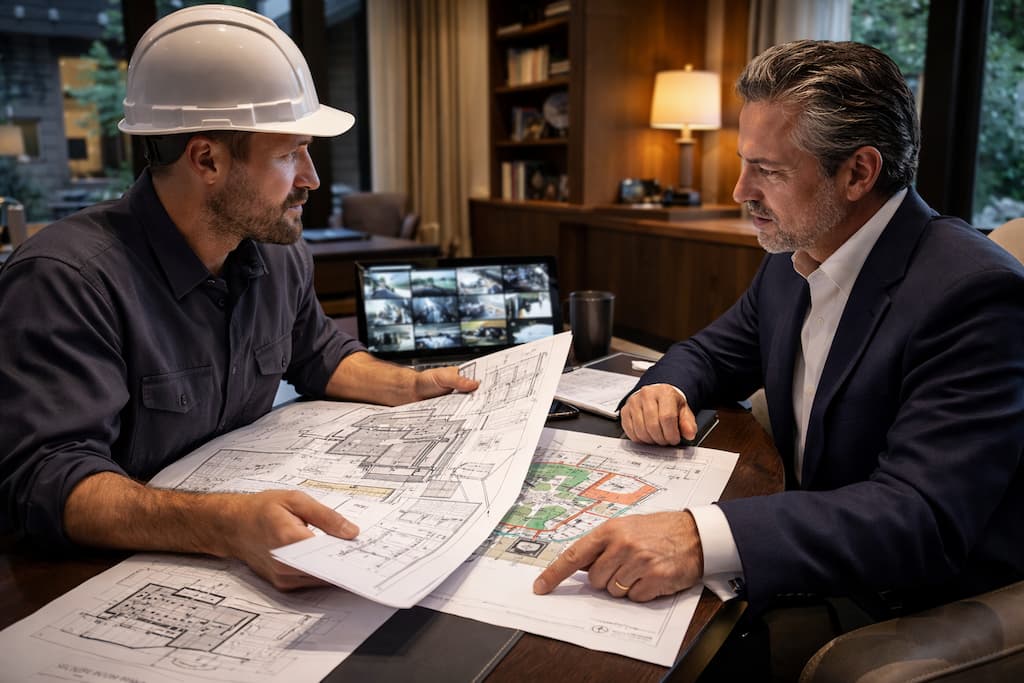
I bring security consultants into projects during feasibility studies. They analyze the site for vulnerabilities, identify threat scenarios specific to the client’s profile, and establish security requirements. This shapes site planning and building placement before we design a single room.
During schematic design, consultants review floor plans for circulation vulnerabilities, monitoring challenges, and access control opportunities. Their input adjusts room relationships and entry sequences while everything is still fluid. This integration costs nothing but provides exponentially better results than recommendations made after architectural design is complete.
When Luxury Home Security Architecture Makes Sense
Not every luxury home requires this level of security integration. But if you’re a public figure, executive, or anyone with elevated visibility, your home should reduce exposure rather than advertise your location. If you have significant collections or valuables, physical security protects assets insurance can’t replace. If police response exceeds 20 minutes, your architecture needs to provide protection until help arrives. And if the property is intended for long-term family use, security-aware design adapts to evolving threats without requiring rebuilding.
Moving Forward with Security-Conscious Design
Building a luxury estate with genuine protection requires luxury home security architecture—a design approach where security is embedded into site planning, circulation, and structure from the beginning. The most successful examples of luxury home security architecture deliver privacy, safety, and longevity without compromise.
That requires security awareness during site selection, honest threat assessment, and bringing security expertise into design before schematic design begins. It requires accepting the cost premium of building protection into architecture rather than bolting it on afterward.
The families I work with understand this. They’re building estates where security enables privacy, where protection works invisibly, and where luxury and safety coexist. They accept that true security comes from intelligent design, not cameras and alarms alone.
If security matters to your estate, start by assessing your actual risk profile. Then work with an architect who understands translating security requirements into spatial design. The most secure home is the one designed from the beginning to be secure.
Frequently Asked Questions: Luxury Home Security Architecture
What is luxury home security architecture?
Luxury home security architecture is the integration of security strategies—such as safe rooms, controlled access, and perimeter planning—directly into architectural design from the earliest stages, rather than added later as technology retrofits.
Why should security be integrated during schematic design?
Security decisions made during schematic design influence site placement, circulation, and structural systems. Early integration results in stronger protection, lower costs, and a seamless luxury aesthetic.
How is a safe room different from a panic room?
A true safe room is structurally integrated, independently supported by utilities, and accessible from multiple areas of the home. Panic rooms are often retrofits that lack redundancy and architectural planning.
How does architecture improve perimeter security?
Architecture creates layered defense by controlling sightlines, approach routes, grade changes, and access points—making technology like cameras and sensors more effective.
Can a luxury home be secure without feeling like a fortress?
Yes. When security is embedded into circulation patterns, landscape design, and building massing, protection becomes invisible—enhancing privacy without compromising comfort or aesthetics.
Who benefits most from luxury home security architecture?
Public figures, executives, high-net-worth families, and estate owners seeking long-term privacy, asset protection, and resilience benefit most from security-integrated architectural design.